BRAVE NEW WORLD OF A.I.

Excerpts from Wallace Henley’s latest book “Who Will Rule The Coming Gods – The looming spiritual crisis of A.I.”

The existential crisis is that in the very age when the recognition of and reverence for the transcendence of our creator God is being jettisoned, technology is on the verge of dramatic breakthroughs in robotics. Where do these people think intelligence comes from? Certainly not from matter or energy.

In the rush to make artificial intelligence machines to better serve us, humans, the wizards of the cyber world are making machines that many predict will master us. Some are already worshiping at the feet of the great god AI just as the ancient Philistines once bowed before Dagon idols. However, “AI operates at the level of syntax and cosyntics (code+syntax), but lacks semantics, pragmatics, and apobetics” Gitt, W., Without Excuse, Creation Book Publishers, Atlanta, GA, 2011. Apobetics is the highest level of the information hierarchy. It questions the purpose, objective, plan or design, being transmitted in order for the receiver to achieve the desired successful goal or outcome. (It is derived from the Greek word, apobeinon.)

Stephen Hawking warned of an age when AI could develop a will of its own, a will that is in conflict with ours and which could destroy us…“We stand on a threshold of a brave new world,” one needing “effective management in all areas of its development.” (Stephen Hawking predicted a race of superhumans will take over the world,” by Nick Whigham, news.com.au, October 15, 2018)

The development of artificial intelligence promises either a brilliant future or a threat to the very survival of humans. Much will depend on the ethical values and moral codes programmed into the machines.

“If AI transcends into Big Brother in a way that appears to be the best thing for society, I’m worried the masses will buy it without vetting,” writes Lindsay Bell, a specialist in content marketing.

Considering such possibilities and portents many questions arise, like these:

  • Who will rule over the new gods? (Which is another way of asking: What will artificial intelligence regard as having transcendent authority over it?)
  • Who decides the values and ethical boundaries that will govern the machines that might have godlike status in the future?
  • Who will be the equivalent in the future of Orwell’s ‘Party’ that controls the god-like machines?”

To borrow words from C.S. Lewis in The Abolition of Man: Are people “without chests” building artificial intelligence robots “without chests”? Can we really expect such devices to “honor” and serve us, or is it inevitable we will awaken to the terrifying reality that we have “traitors in our midst” of our own making?

God has written His laws on the human heart, says the Bible. (Romans 2:15) But who is constructing the algorithms of ethical and moral criteria that will determine good and bad in the operating system of an AI machine?

Thus, the most troubling question of all: Who indeed will rule the coming “gods”?

Fortunately, we know the answer to that troubling question. God has told us in His Word, the Bible but it along with God, Himself is being jettisoned. Hence many, including many in our churches, do not know what the Bible teaches about Jesus soon coming return to rescue the Saints, to destroy the works of the devil, and pour out His wrath on an unrepentant world with the trumpet and bowl judgements.

Because the time before Jesus returns to earth is a time of tribulation that escalates into great tribulation for Christians with the appearance of the Antichrist, God provides us with great detail in His Word of what will transpire at that time so that we know He is still in control of the events. In fact, it is obvious to us now that much of His so-called church is so lukewarm that He will spew it out of His mouth (church of Laodicea). It has compromised with the world and its values: homosexuality, gay marriage, and transgender issues and even teaching that Jesus is not the only way back to God.

“‘I know your works: you are neither cold nor hot. Would that you were either cold or hot! So, because you are lukewarm and neither hot nor cold, I will spit you out of my mouth. For you say, I am rich, I have prospered, and I need nothing, not realizing that you are wretched, pitiable, poor, blind, and naked. I counsel you to buy from me gold refined by fire, so that you may be rich, and white garments so that you may clothe yourself and the shame of your nakedness may not be seen, and salve to anoint your eyes, so that you may see. Those whom I love, I reprove and discipline, so be zealous and repent.” Revelation 3:15:19

CREATIVITY IN THE MILLENNIAL KINGDOM PART 2

If you have not already taken a look, let me suggest that you check out my first post CREATIVITY IN THE MILLENNIAL KINGDOM PART 1 posted yesterday on the 23rd of November, where I reported on ENERGY and TRANSPORT

We are made in God’s image by the creator of this Cosmos and were given dominion by Him over Earth. We lost that dominion at The Fall when Adam and Eve disobeyed God. Satan, a spiritual demonic being, is now the Prince of this World. Regardless, we still have the God-given ability to create using the abundant materials He created, within the boundaries of the complex physical laws God has established to control His universe.

Based on Biblical prophecy we are fast approaching the time of Jesus’ return to this earth to rescue the Saints and to pour out His wrath on an unrepentant world. The world has turned its back on God and His values and His commandments. One of the most significant Biblical end-times prophecies tells us that prior to Jesus’ return God’s nation, Israel would be re-established. Against all odds, the Jews are back in their land with the Hebrew language reborn. This occurred back in 1948. We are now starting to see many of the other prophesied end times signs, wars, and rumours of wars, apostasy in the church as it compromises with the world and its distorted values, gay marriage, homosexual and transgender priests, pestilences, famines, lawlessness and more. What this site is about, is preparing people for Jesus’ Millennial reign on this earth when Jesus and the resurrected Saints will be ruling the nations with a “rod of iron”. There is no doubt in my mind that new technologies will be developed in the Millennium that enhance living standards. Technologies such as Robotics and the use of Computers and AI.

INDUSTRY – Robotics

The race this year between artificial intelligence (AI) giants like DeepMind, Nvidia, Tesla, Google AI, Meta, and OpenAI has been something to watch. Every few weeks has brought a major breakthrough with applications in this incredible technology. This time, it’s a breakthrough in something called imitation learning from OpenAI. Imitation learning is exactly what it sounds like: an AI that learns by imitating. The implications of this kind of imitation learning are incredible and will become very relevant next year.

When I think of a wide range of general tasks where a robotic arm or dexterous humanoid robot could be useful, imitation learning makes perfect sense. Whether at home or the workplace, imagine being able to show an AI-powered robot what task(s) need to be performed. An AI could learn by watching. Then it could supplement that learning by going to the internet and finding more learning material, and soon master any given task(s).

That’s what makes OpenAI’s announcement so incredible. It’s the beginning of robots being able to learn by watching, rather than through weeks of programming and testing. 

Flocks of assembler robots show potential for making larger structures. This report comes from the Massachusetts Institute of Technology (MIT). Researchers from MIT’s Center for Bits and Atoms (CBA) make progress toward groups of robots that could build almost anything, including buildings, vehicles, and even bigger robots.

The new work builds on years of research, including recent studies demonstrating that objects such as a deformable airplane wing and a functional racing car could be assembled from tiny identical lightweight pieces — and that robotic devices could be built to carry out some of this assembly work. Now, the team has shown that both the assembler bots and the components of the structure being built can all be made of the same subunits, and the robots can move independently in large numbers to accomplish large-scale assemblies quickly.

As in previous experiments, the new system involves large, usable structures built from an array of tiny identical subunits called voxels (the volumetric equivalent of a 2-D pixel). But while earlier voxels were purely mechanical structural pieces, the team has now developed complex voxels that each can carry both power and data from one unit to the next. This could enable the building of structures that can not only bear loads but also carry out work, such as lifting, moving and manipulating materials — including the voxels themselves.

“When we’re building these structures, you have to build in intelligence,” Gershenfeld says. While earlier versions of assembler bots were connected by bundles of wires to their power source and control systems, “what emerged was the idea of structural electronics — of making voxels that transmit power and data as well as force.” Looking at the new system in operation, he points out, “There’s no wires. There’s just the structure.”

The robots themselves consist of a string of several voxels joined end-to-end. These can grab another voxel using attachment points on one end, then move inchworm-like to the desired position, where the voxel can be attached to the growing structure and released there.

Gershenfeld explains that while the earlier system demonstrated by members of his group could in principle build arbitrarily large structures, as the size of those structures reached a certain point in relation to the size of the assembler robot, the process would become increasingly inefficient because of the ever-longer paths each bot would have to travel to bring each piece to its destination. At that point, with the new system, the bots could decide it was time to build a larger version of themselves that could reach longer distances and reduce the travel time. An even bigger structure might require yet another such step, with the new larger robots creating yet larger ones, while parts of a structure that include lots of fine detail may require more of the smallest robots.

Aaron Becker, an associate professor of electrical and computer engineering at the University of Houston, who was not associated with this research, calls this paper “a home run — [offering] an innovative hardware system, a new way to think about scaling a swarm, and rigorous algorithms.”

Becker adds: “This paper examines a critical area of reconfigurable systems: how to quickly scale up a robotic workforce and use it to efficiently assemble materials into the desired structure. … This is the first work I’ve seen that attacks the problem from a radically new perspective — using a raw set of robot parts to build a suite of robots whose sizes are optimized to build the desired structure (and other robots) as fast as possible.”

INFORMATION – Computing power

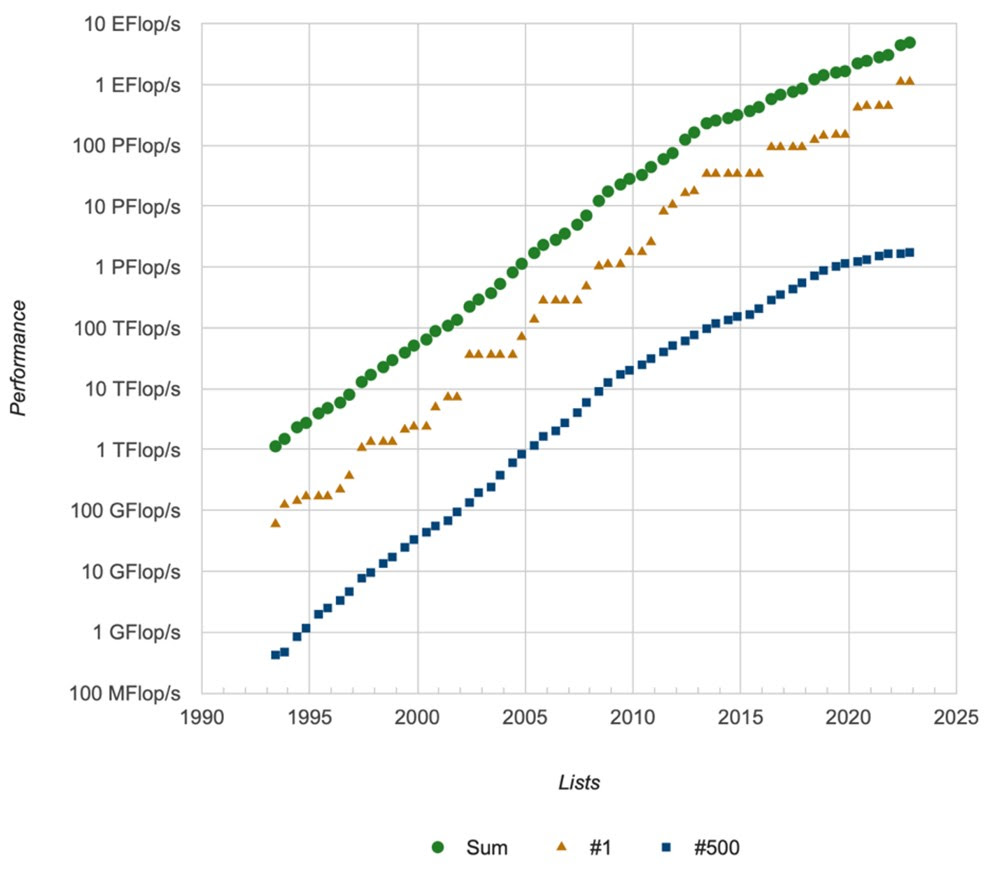
This year was a banner year in the world of supercomputing. The first major breakthrough was the commissioning of Frontier – the world’s first exaflop supercomputer. It’s capable of doing over a quintillion (1,000,000,000,000,000,000) operations per second.

Then this fall, Tesla announced its artificial intelligence (AI) supercomputer, Dojo, which also performs at more than an exaflop. 

And just days ago, AI-centric semiconductor company Cerebras announced that it had commissioned its own AI exaflop supercomputer for just $30 million.

Performance of the World’s Top Supercomputers

Source: top500.org

The chart above is extraordinary. It’s in log scale, with each vertical tick representing a 10-fold increase in computing power. 

The next major performance level will come out next year at the Los Alamos National Laboratory, when Nvidia launches its 10 exaflop supercomputer Venado.

The exponential growth of computing power has resulted in an abundance of both computer processing and data. But the rapid growth created a problem. The International Systems of Units (SI) started running out of SI prefixes like “exa” (1018) to denote the ever-increasing magnitude of the numbers.

After “exa,” there was only “zetta” (1021) and “yotta” (1024). At the current pace, it won’t be long before we blow past those prefixes too.

That’s why, at the 27th meeting of the General Conference on Weights and Measures, Resolution 3 extended the range of SI prefixes to account for even greater numbers in the future:

  • ronna   (1027).
  • quetta   (1030).

Technology is moving so fast right now, it won’t be long before we’re hearing words like “ronnabytes,” or “quettaflop supercomputers.”

DIGITALISATION, ARTIFICIAL INTELLIGENCE, AND ROBOTICS

THE SWITCH TO RENEWABLE ENERGY IS A MASSIVE DISRUPTER TO GOVERNMENTS, COMPANIES AND INDIVIDUALS TO MANAGE CHANGE BUT ADD DIGITALISATION, A.I. AND ROBOTICS AND WE HAVE CHAOS.

“But you, Daniel, shut up the words and seal the book, until the time of the end. Many shall run to and fro, and knowledge shall increase.Daniel 12:4

How about this prophecy given to Daniel about the time of the end. In addition, we have many prophecies that in the “last days” chaos and lawlessness will abound.

How about this FLYING CAR developed by an Israeli company that uses hydrogen and electric battery power.

For some people like me that love change and can see all the new investment opportunities that this change provides, it is an exciting time. The big challenge for me is that I can so easily get sidetracked from what God is calling me to do in the twilight years of my life. I need to make sure I continue to live eternally now knowing that there are eternal rewards for building God’s kingdom on earth.