• The majority view among the early church theological centres was that God’s judgments are ultimately restorative (apocatastasis) or that the wicked ultimately perish (annihilationism). • Only Rome/Carthage—later shaping Western theology through Tertullian, Augustine, and others—consistently taught eternal conscious torment. • Augustine himself appears to have initially leaned toward universal restoration before adopting the eternal torment view.
Thus, the idea that hell consists of everlasting conscious torment was not the universal or majority teaching of the early church.
THE SCRIPTURAL WITNESS: THE WICKED PERISH, DIE, AND ARE DESTROYED
Scripture repeatedly uses the language of literal death and destruction—not infinite torment.
Below are key passages grouped by theme.
2A. The wages of sin is death, not endless life in torment
• Romans 6:23 The wages of sin is death, but the gift of God is eternal life in Christ Jesus.
Paul sets up a contrast: – Sin → death – Christ → eternal life
If the wicked instead live eternally in torment, they would also have eternal life (just in misery). That contradicts Paul’s contrast.
2B. Destruction, not perpetual suffering
• Matthew 7:13 Broad is the road that leads to destruction.
• 1 Corinthians 1:18 The message of the cross is foolishness to those who are perishing.
• Philippians 3:18–19 Their end is destruction.
• Galatians 6:8 Whoever sows to the flesh will reap corruption (Greek: phthora, decay, ruin).
• Hebrews 10:39 We are not of those who shrink back to destruction.
The consistent imagery is final loss of life—not everlasting torment.
2C. Death is the final result of sin
• James 1:14–15 Sin, when it is full-grown, gives birth to death.
• Acts 3:23 Every soul who does not listen to that prophet shall be destroyed.
• Romans 8:13 If you live according to the flesh you will die.
• Proverbs 11:19 Evil leads to death.
• Proverbs 14:12 / 16:25 Its end is the way of death.
In Scripture, death consistently means the cessation of life—not eternal life in torment.
2D. Jesus Himself contrasts perishing with eternal life
• John 3:16 Whoever believes will not perish but have eternal life.
“Perish” does not mean “live forever in misery.” It means cease to live.
• Matthew 10:28 God can destroy both soul and body in Gehenna.
This is one of Jesus’ clearest statements. What God destroys does not continue endlessly.
2E. Historical examples of God’s judgment as destruction
• 2 Peter 2:6 God made Sodom and Gomorrah an example of what is coming to the ungodly by reducing them to ashes.
If “death” everywhere else means cessation of life, the plain reading indicates that the “second death” is the final, irreversible destruction of the person.
Jesus uses the same word:
• John 8:51 He will never see death (thanatos).
Thus, the second death is a real death, not an eternal conscious experience.
THE LOGIC OF IMMORTALITY IN SCRIPTURE God alone possesses immortality
• 1 Timothy 6:15–16 God alone has immortality.
This means:
• Humans do not inherently have immortal souls. • Eternal life is a gift granted only to the redeemed. • The wicked are never promised immortality.
For eternal conscious torment to be true, God would have to grant everlasting life to the wicked—just to torment them forever. This conflicts with Scripture and with God’s character.
THE CHARACTER OF GOD: JUSTICE THAT IS REAL BUT FINITE
Scripture consistently emphasizes:
• God’s holiness requires that justice be done • God’s judgments are righteous and appropriate • God takes no pleasure in the death of the wicked (Ezekiel 33:11) • God’s wrath is real but not infinite in duration (Psalm 103:9)
God punishes sin, but:
• The penalty is death, not endless torment • Justice is proportional, not infinite • God’s heart is toward restoration, not torture
SUMMARY: THE BIBLICAL AND HISTORICAL CASE
Most early church theological centres did not teach eternal conscious torment.
Jesus explicitly says God destroys souls in Gehenna.
The “second death” uses the same Greek word for literal death, not eternal life in pain.
God alone is immortal; the wicked are never promised immortality.
A loving God does not sustain the eternal life of the wicked merely to endlessly torment them.
Biblical justice is real, but its final form is death, not everlasting torture.
CONCLUSION
Across Scripture, early Christian theology, philosophy, and the character of God, the consistent picture is:
• Sin leads to death, not everlasting life in misery • Only God has immortality; humans do not unless granted by Him • Judgment is real but finite • The wicked are destroyed, not sustained eternally • Eternal life belongs only to the redeemed • Eternal conscious torment was a minority position in the early centuries • The majority position in both East and early theology was restoration or destruction
The annihilationist / conditional immortality view integrates all of Scripture without contradiction and aligns with the deepest themes of God’s justice, love, and ultimate victory.
Traditionalist view of damnation ‘doesn’t seem to fit’ Old Testament, says Kirk Cameron.
I am glad Kirk has realised Scripture does not teach eternal conscious torment for unbelievers. I came to this conclusion many years ago and have even wrote a book on the subject, Lake of Fire. It is available on Amazon as a Kindle edition for just $11.99.
The majority of denominational churches teach Eternal Conscious Torment but is this really what the Bible teaches? In the first five centuries, there were six known theological schools. Four of them taught that all men would eventually be rescued from Hell (Apocatastasis): these being the theological schools at Alexandria, Antioch, Caesarea, and Edessa/Nisbis. One school, Ephesus, taught Annihilationism (sinners are totally incinerated into nothingness in Hell). Only one theological school, Rome/Carthage taught eternal punishment. There is a case for presenting the early church fathers in the main believing God will eventually restore all mankind and that the Lake of Fire is restorative at least for mankind. However, it is difficult to know what they did with the second death which is in the lake of fire and is stated as the fate of the lost. “Blessed and holy is the one who shares in the first resurrection! Over such the second death has no power,” Revelation 20:6a. I review all the scriptures on Hell and the views of respected Christian theologian such as John Stott, C.S. Lewis and others.
“Jesus died so that we could have eternal life. But do the wicked have eternal life in Hell? And if they do, why does the Old Testament describe the fate of the wicked in the opposite terms?” Cameron asked, pointing to references using words like “destroy,” “perish” and “death” when describing the fate of the wicked.
“The soul that sins, it shall die,” he said, quoting from the prophet Ezekiel. “It will perish. It will be destroyed, which is like the ending of life, not the ongoing life forever in punishment.”
He also pointed to history and the rise and fall of nations as an illustration of what he believes happens to those who die apart from faith in Jesus Christ. “When you look at God’s judgment upon individuals or on nations, cities, empires, He says they’re gone … The symbolism is scorched earth, destroyed, gone, and their name is remembered no more,” he said. “… And they’re not coming back. It’s like forever. Which really is a better description of dying, of perishing. Not being granted eternal life so that you can be tormented forever. That doesn’t seem to fit.”
I have just finished reading Martyn Isles’s book Who Am I? Solving the identity puzzle. It is a good book to make Jesus known and reveal more about God. Martyn makes the good point that we all like to think that we are made in God’s image but the reality is that while Adam was created in God’s image, as a result of the Fall, we are no longer in God’s image, we are in Adam’s image.
Now that I have finished the book, from my standpoint there is one major error and one significant omission. The error is that God made humans eternal. Martyn says that when God breathed into Adam He made him eternal, in essence immortal, yet all the Bible says is that he became a living creature.
“breathed into his nostrils the breath of life, and the man became a living creature.” Genesis 2:7
Eternal/immortal means not subject to death. The Bible says God alone has immortality.
“Who alone has immortality, dwelling in unapproachable light, whom no person has seen or can see.” 1 Timothy 6:16
In this passage, we see that immortality is something that is part and parcel of the nature of God. He alone has it. The Scripture teaches that only God has life in Himself.
“For as the Father has life in Himself, so He has granted the Son to have life in Himself.” John 5:26
The New Testament also says that God grants immortality to humans who trust in Him.
“And this is eternal life, that they may know You, the only true God, and Jesus Christ whom You have sent.” John 17:3
From the following passage we discover three things about immortality.
“So when this corruptible has put on incorruption, and this mortal has put on immortality, then shall be brought to pass the saying that is written: ‘Death is swallowed up in victory’” 1 Corinthians 15:53-53
1. Immortality is given only to believers, there is no mention of unbelievers receiving it.
2. It is a gift from God that believers will receive in the future at Christ’s coming.
3. Immortality refers not only to the soul or spirit but the body is also included. Believers become immortal when this mortal body puts on an immortal one.
The Biblical error of an immortal soul leads directly to a second error the fate of unbelievers. Despite Jesus making it clear that the wages of sin is death and unbelievers perish much of the church teaches unbelievers suffer conscious torment for eternity.
“For the wages of sin is death, but the free gift of God is eternal life in Christ Jesus our Lord.” Romans 6:23
“For God so loved the world, that he gave his only Son, that whoever believes in him should not perish but have eternal life.“John 3:16
“Enter by the narrow gate. For the gate is wide and the way is easy that leads to destruction, and those who enter by it are many.” Matthew 7:13
“Whoever is steadfast in righteousness will live, but he who pursues evil will die.” Proverbs 11:19
“Then desire when it has conceived gives birth to sin, and sin when it is fully grown brings forth death.” James 1:15
Note that sin ultimately brings forth death not life in everlasting conscious torment.Four times in Revelation we learn the fate of unbelievers is a second death.
“The one who conquers will have this heritage, and I will be his God and he will be my son. But as for the cowardly, the faithless, the detestable, as for murderers, the sexually immoral, sorcerers, idolaters, and all liars, their portion will be in the lake that burns with fire and sulfur, which is the second death.”Revelation 21:7-8
I like to keep my posts relatively short so they can be read in 5 to 10 minutes. Hence, I will cover in my next post, what I believe is a serious omission. Martyn makes no mention of the fact Jesus made it possible for our Heavenly Father to send the third person of the Trinity, the Holy Spirit to be our helper. He is our Counsellor, Teacher, and Comforter. He produces the fruit of the spirit (all nine) in our lives and He provides the gifts of the spirit for ministry (all nine). Without Him, it would be impossible to live a Christian life.
It is good to see more Biblical teaching on the fate of unbelievers. It is certainly not eternal conscious torment that has been the teaching of most institutional churches. Gary Black of Life, Hope, and Truth Ministries (www.lifehopeandtruth.com) explains why hell is not a place of eternal torment and how the Christian world came to that mistaken idea.
The research I did for my own book on this topic: Lake of Fire – Terminal Punishment/Second Death; Eternal Conscious Torment; Universal Redemption? (available as an ebook on Amazon) revealed that in the first five centuries, there were six known theological schools. Four of them taught that all people would eventually be rescued from Hell (Apocatastasis): these being the theological schools at Alexandria, Antioch, Caesarea, and Edessa/Nisbis. One school, Ephesus, taught Annihilationism (that sinners are totally incinerated into nothingness in the Lake of Fire). Only one theological school, Rome/Carthage taught eternal punishment. Source: The New Schaff-Herzog Encyclopedia of Religious Knowledge, Universalism entry, p. 96, Baker Book House. In fact, a case can be made that when the Church rejected a high view of God’s goodness and replaced it with a view of God as an eternal torturer, the Dark Ages began, almost to the day.
During His earthly ministry, “Great crowds came to Jesus, bringing the lame, the blind, the crippled, the dumb and many others, and laid them at His feet; and He healed them. The people were amazed when they saw people raised from the dead, dumb speaking, the crippled made well, the lame walking, and the blind seeing. And they praised the God of Israel” Matthew 15:30-31
Earlier in the previous century, even the New Testament skeptical scholar Rudolf Bultmann acknowledged that there could be no doubt that Jesus healed sick individuals and expelled demons. More recently, Jarl Fossum notes: “That Jesus was a miracle worker is central to the Christology of the New Testament Gospels and Acts.” Perhaps surprisingly, prominent Jesus Seminar member Marcus Borg attested quite strongly, “Despite the difficulty which miracles pose for the modern mind, on historical grounds it is virtually indisputable that Jesus was a healer and exorcist.” Further, Jesus’s healing cases cannot all be accounted for simply as “faith healings” alone, for we do not know how far Jesus’s powers actually extended. Prominent historical Jesus researcher John Meier states, “In sum, the statement that Jesus acted as and was viewed as an exorcist and healer during his public ministry has as much historical corroboration as almost any other statement we can make about the Jesus of history.”
Even Jesus’ opponents did not contest the proclamations that He did healings and exorcisms, but “they claimed that his powers came from the lord of the evil spirits,” thereby admitting the existence of the events themselves by their very criticism. In this way, Jesus’s disciples, the crowds of people who heard and saw Jesus, and even His adversaries all agreed to what happened and that at least these healings and exorcisms were due to Jesus’s skills and power.
What about you? Do you praise the Lord because of the mighty miracles Jesus performed? Or do you ignore Jesus and live life as your own god? It is easy to ignore the Lord while loving the world and loving your sin. None of us would ever turn to God apart from the power of the Holy Spirit who produces repentance and faith in a man’s heart.
So, are you resisting the Holy Spirit even as you read these words? Or are you open to the idea that you need Jesus and the forgiveness only He can give you? Do you realize why Jesus endured the agony of the cross? He did it to pay for your sins so that you do not suffer the consequences of your sins. You will face Jesus at the White Throne judgment and you will be thrown into the Lake of Fire for punishment and a second death.
“But as for the cowardly, the faithless, the detestable, as for murderers, the sexually immoral, sorcerers, idolaters, and all liars, their portion will be in the lake that burns with fire and sulfur, which is the second death.”Revelation 21:8 Also, Revelation 2:11, Revelation 20:6, and Revelation 20:14
Did you ignore the cross once again this Easter? When will you finally get serious about your sin and your need for the Savior?
Like everyone, a day will come when you experience tremendous storms in your life. Perhaps you are going through a terrible storm right now. Jesus has the power and authority to calm storms, just like He did when His disciples encountered a “furious squall” one day while out in a boat (see Mark 4:35-41. Jesus rebuked the wind, and it became completely calm, His disciples were “terrified and asked each other, ‘Who is this? Even the wind and the waves obey Him!’”
Who will you turn to during the personal storms ahead of you? The longer you ignore the Messiah, the harder your heart will become toward the Savior. On the other hand, the miracle-working Messiah will save your soul the moment you come to Christ in faith. The Apostle John explained it beautifully:
“Jesus did many other miraculous signs in the presence of His disciples, which are not recorded in this book. But these are written that you may believe that Jesus is the Christ, the Son of God, and that by believing you may have life (eternal life) in His name.”John 20:30-31
One day “the Jews demanded of Jesus, ‘What miraculous sign can you show us to prove your authority to do all this?’ Jesus answered them, ‘Destroy this temple, and I will raise it again in three days’” (John 2:19). The miracle of miracles was the resurrection of Jesus from the dead. The Messiah who had raised Lazarus (see John 11:38-44) and others from the dead (see Matthew 9:23-25; Luke 7:11-17) would Himself come back to life after His crucifixion.
After His resurrection, Jesus appeared to many of His followers, including “more than 500 of the brothers at the same time” (1 Corinthians 15:6). Why else would the apostles have laid down their lives for the Gospel? If they had not seen and touched the risen Christ, Christianity would never have gotten off the ground (see John 20:24-31). Christ’s enemies couldn’t track down His body because Jesus did in fact rise from the dead.
So, are you spiritually dead, or spiritually alive? Have you risen from your tomb of unbelief? You can either ignore the miracle-working Messiah or trust Him to forgive your sins and perform the miracle of the new birth within your soul (see John 3:1-8; 1 Peter 1:3-5). You will never know what you have been missing until you give your life to Christ and become one of His followers. Whatever you do, please don’t ignore this soul-saving invitation: “Believe in the Lord Jesus, and you will be saved” (Acts 16:31).
Adapted from an article in Christian Post “Why Multitudes Ignore the miracle-working Messiah” by Dan Delzell and excerpts from On the Resurrection, Volume 1: Evidences by Gary R. Habermas (B&H Academic, 2024).
Modern, mainstream Christianity teaches that our bodies die, but we live on as souls. So why does the Bible teach something else entirely? Knowing what your soul is—and what happens to it after you die—is a core concept of Christianity. Join Gary Black as he explains both the biblical teaching of the soul and how that teaching became corrupted over the centuries.
“Then when death comes to a man, the mortal part, it seems dies, but the immortal part goes away unharmed and undestroyed withdrawing from death.” Plato, Phaedo 106e
Understanding the soul is not immortal is critical to understanding that eternal conscious torment is not the fate of the unrepentant.
“Then Death and Hades were thrown into the lake of fire. This is the second death, the lake of fire. And if anyone’s name was not found written in the Book of Life, he was thrown into the lake of fire.” Revelation 20:14-15
“But as for the cowardly, the faithless, the detestable, as for murderers, the sexually immoral, sorcerers, idolaters, and all liars, their portion will be in the lake that burns with fire and sulfur, which is the second death.”Revelation 21:8-9
“And do not fear those who kill the body but cannot kill the soul. Rather fear him who can destroy both soul and body in hell.” Matthew 10:28
The reason a young former pastor renounced his Christian faith and rejected God was because: “How could a loving God reject people who were sincere in whatever faith they held? Would He truly condemn them because they understood Him differently than those professing faith in Jesus Christ as their Savior and Lord?”
This young man’s issue was not the historical credibility of the resurrection of Jesus or the reliability of the Genesis narrative regarding the Fall of Man. Instead, he was offended by the idea that a God of mercy would not welcome into eternal life everyone who seemed to be earnest in whatever faith they have. Put simply, this former pastor decided to create a new god, one in his own image.
Former evangelical pastor Rob Bell turned from biblical faith several years ago by denying the reality of Hell. He like so many leaders of denominational churches believe the Bible teaches non-believers will be tormented for all eternity in the Lake of Fire and yet the Bible clearly teaches that after the White Throne judgement, there is a second death in the Lake of Fire.
“For the wages of sin is death, but the free gift of God is eternal life in Christ Jesus our Lord.” Romans 6:23
Bell was right in believing eternity in Hell is hardly just, and is inconsistent with the nature of the God – Who is love. This belief cost him eternal life with his Creator.
My book on the Lake of Fire is available as an ebook on Amazon.
“But as for the cowardly, the faithless, the detestable, as for murderers, the sexually immoral, sorcerers, idolaters, and all liars, their portion will be in the lake that burns with fire and sulfur, which is the second death.” Revelation 21:8 (also see Revelation 2:11, 20:6, and 20:14)
In reading various “de-conversion” stories, accounts by and about people who have left their Christian faith, there is a persistent theme. It’s not about the reasonableness of Christianity, its intellectual coherence, or the credibility of its propositional claims. Rather, they come to a point where their dislike of certain doctrines or practices leads them to abandon their walk with Christ. They jettison their faith because it does not comport with their preferences. Or, put another way, the God of Scripture is not Who they want Him to be.
I often wonder if these people were been born again by the Holy Spirit. Jesus made it possible for God the Father to send the Holy Spirit to indwell our Spirit to be our Counsellor, our Teacher, and our Comforter. Jesus said He will bring us into all truth if we let Him.
We need to know God is not like us. He cannot denigrate the purity of His character by acting as though our transgressions really aren’t a big deal. And that’s the sticking point: the eternal Triune God is not concerned with conforming to our expectations. His character is not malleable, and He is not accountable to us for what He does.
Consider the story of Job. God allows Job’s entire family to be murdered, his vast wealth stolen, and his health broken. Job calls out to God, demanding to know why He has permitted these things given that he, Job, has been so faithful to Him. God is uncompelled to justify Himself to Job. Instead, He says, “Will the faultfinder (Job) contend with the Almighty? Let him who reproves God answer it” (Job 40:1).
Similarly, when Paul debates with an imaginary rhetorical opponent about God’s sovereignty and human free will, the apostle does not try to dissect something beyond man’s grasp. Instead, he affirms that “there is no injustice with God” and asks, “Who are you, o man, to answer back to God?” (Romans 9:14, 20).
But this same God is infinitely loving and desires no one to perish but all to come to repentance and faith in His Son (2 Peter 3:9). This is why He invites us into a relationship with Himself. In His great, undeserved kindness, God has revealed Himself to us. “His invisible attributes, namely, His eternal power and divine nature, have been clearly perceived, ever since the creation of the world, in the things that have been made,” Paul asserts (Romans 1:20). His power, intelligence, and love are displayed in a world that is complex, ordered, and abundant. The heavens, “the work of His fingers,” declare His glory (Psalms 8:4, 19:1).
He has revealed Himself in our very natures, with the weight of moral duty “written on our hearts” (Romans 2:15) and eternity placed within them (Ecclesiastes 3:11). He has revealed His character and desires, His demands, and His offer of everlasting life, in the pages of text composed by numerous men over the course of many centuries. The Bible is His written revelation.
Most profoundly, He has revealed Himself in the person of Jesus of Nazareth, the Son of Man and Son of God, sinless and righteous, Who took the penalty for sin we deserve as He died on the cross, and whose resurrection heralded His victory over sin, death, and the devil. Trusting in Him and Him alone for forgiveness, we receive life, eternal life, that He alone can give. Moreover, Jesus made it possible for us to receive the third person of the Trinity, the Holy Spirit into our Spirit to enable us to live the Christian life.
This is news so grand that it invites adoration of the One offering it. It should create in us a longing to know and follow Him, not turn our backs on Him because He does not seek to appease our finite indignation about things we can’t grasp. Would you really want to serve a God so eager to be liked He debases His Majesty to plead for our approval?
“A man can no more diminish God’s glory by refusing to worship Him,” wrote C.S. Lewis, “than a lunatic can put out the sun by scribbling the word ‘darkness’ on the walls of his cell.” He is Who He is and invites us to know Him — and that’s the best news of all.
Biblical prophecy tells us that prior to Jesus setting up His one-world government God allows Satan to set up a one-world government with the Antichrist and False Prophet ruling the nations for 3 1/2 years. During this time the Antichrist institutes the Mark of the Beast so that anyone who does not take the mark cannot buy or sell. It is time when many Christians will be martyred. God eventually steps in to rescue His Saints by taking them to heaven prior to Him pouring out His wrath upon an unrepentant world with the Trumpet and Bowl judgements.
After the Trumpet and Bowl judgements Jesus returns to the earth with the glorified Saints to destroy the Antichrist’s army, cast the Antichrist and False Prophet into the Lake of Fire, and liberate Israel.
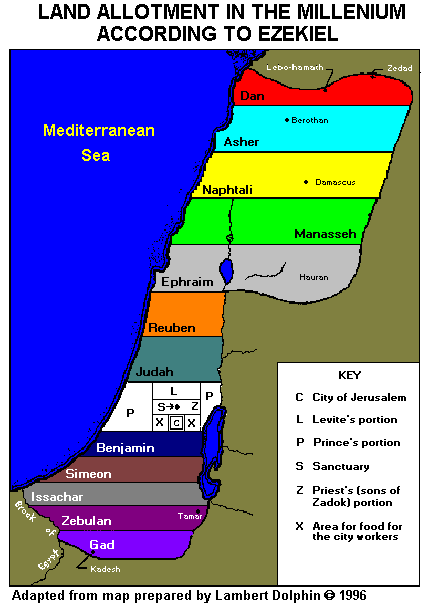
Jesus then sets up His Millennial Kingdom where Jesus and the Saints rule with a rod of iron over this world for 1000 years prior to its destruction, the second resurrection, the White Throne judgement, and God establishes a new heaven and new earth where only the righteous dwell.
Revelation 20 is devoted to Jesus’ Millennial Kingdom. The key features ofthis transition period are:
Satan is bound for most of the thousand years. What is shocking and revealing about mankind, is that when Satan is released, he is still able to gather an army of people whose number is like the sand of the sea to come against Jesus and the Saints. We are not told, but I assume that demons are also bound during Jesus’ Millennial reign.
Jesus and the Saints rule with a rod of iron during Jesus’ Millennial reign. Jesus rules from a new Jerusalem and Israel will be the lead nation of the world. The Saints will govern the nations and most of the rules and commandments that God established for His nation Israel will apply. The Sabbath, Shemitah, Jubilee, and most Feast days will be law. Nations that do not come up to Jerusalem to honour Jesus will suffer the consequences: there will be no rain on their land.
In the absence of Satan, is millennial life perfect? No. The millennium is still a time of sin, death, rebellion, and harsh judgment. Its true character seems to fall between the present age (the “church age”) and the future sinless coexistence of the redeemed in the new heaven and new earth (Rev. 21). With reference to death in the millennial age, we read: “No more shall there be in it an infant who lives but a few days, or an old man who does not fill out his days, for the young man shall die a hundred years old, and the sinner a hundred years old shall be accursed.Isaiah 65:20
“You (Jesus’ Disciples) are those who have stayed with Me in My trials, and I assign to you, as My Father assigned to Me, a kingdom, that you may eat and drink at My table in My kingdom and sit on thrones judging the twelve tribes of Israel. Luke 22:28-30
There will be no more wars, and disputes will be quickly resolved. Jesus and the Saints rule with a rod of iron. The wicked will be killed.
“For out of Zion shall go forth the law and the word of the Lord from Jerusalem. He shall judge between many peoples and shall decide disputes for strong nations far away, and they shall beat their swords into plowshares, and their spears into pruning hooks; nation shall not lift up sword against nation, neither shall they learn war anymore;” Micah 4:2-3
“He shall not judge by what his eyes see, or decide disputes by what his ears hear, but with righteousness, He shall judge the poor, and decide with equity for the meek of the earth; and He shall strike the earth with the rod of his mouth, and with the breath of His lips He shall kill the wicked.” Isaiah 11:3-4
“She gave birth to a male child, one who is to rule all the nations with a rod of iron,” Revelation 12:5
“From his mouth comes a sharp sword with which to strike down the nations, and He will rule them with a rod of iron.” Revelation 19:15a
“And Jesus said to them,The sons of this age (Millennials) marry and are given in marriage. But those who are considered worthy of taking part in that ageand in the resurrection from the dead will neither marry nor be given in marriage, and they can no longer die; for they are like the angels. They are God’s children since they are children of the resurrection.”Luke 20:34-36
“Blessed and holy is the one who shares in the first resurrection! Over such the second death has no power, but they will be priests of God and of Christ, and they will reign with him for a thousand years.” Revelation 20:6
“The one who conquers and who keeps my works until the end, to him I will give authority over the nations, and He will rule them with a rod of iron,“Revelation 2:26
“Behold, a king will reign in righteousness, and princes will rule with justice.” Isaiah 32:1
“Even the hotheads will be full of sense and understanding. Those who stammer will speak out plainly. In that day ungodly fools will not be heroes. Scoundrels will not be respected.” Isaiah 32:4-5 (NLT)
The offices of judge and counsellor will be reinstituted
“I will restore your judges as at the first, and your counselors as at the beginning. Afterward, you shall be called the city of righteousness, the faithful city.” Isaiah 1:26
“I will also make your officer’s peace and your magistrate’s righteousness.Isaiah 60:17
Jesus Millennial Kingdom is what is next on God’s agenda for this earth. We have had 6ooo years of man’s reign. Next is 1000 years with Jesus and the Saints ruling prior to God ending this world with fire. The start of 8000 years will be on the new earth where only the righteous dwell.
After Jesus Millennial Kingdom will be the second resurrection followed by the White Throne judgement. All unrepentant sinners are thrown into the Lake of Fire for punishment and the second death.
“Be faithful unto death, and I will give you the crown of life. He who has an ear, let him hear what the Spirit says to the churches. The one who conquers will not be hurt by the second death.’” Revelation 2:10-11
“Blessed and holy is the one who shares in the first resurrection! Over such the second death has no power, but they will be priests of God and of Christ, and they will reign with him for a thousand years.”
“Then Death and Hades were thrown into the lake of fire. This is the second death, the lake of fire. And if anyone’s name was not found written in the Book of Life, he was thrown into the lake of fire.” Revelation 20:14-15
“But as for the cowardly, the faithless, the detestable, as for murderers, the sexually immoral, sorcerers, idolaters, and all liars, their portion will be in the lake that burns with fire and sulfur, which is the second death.”Revelation 21:8
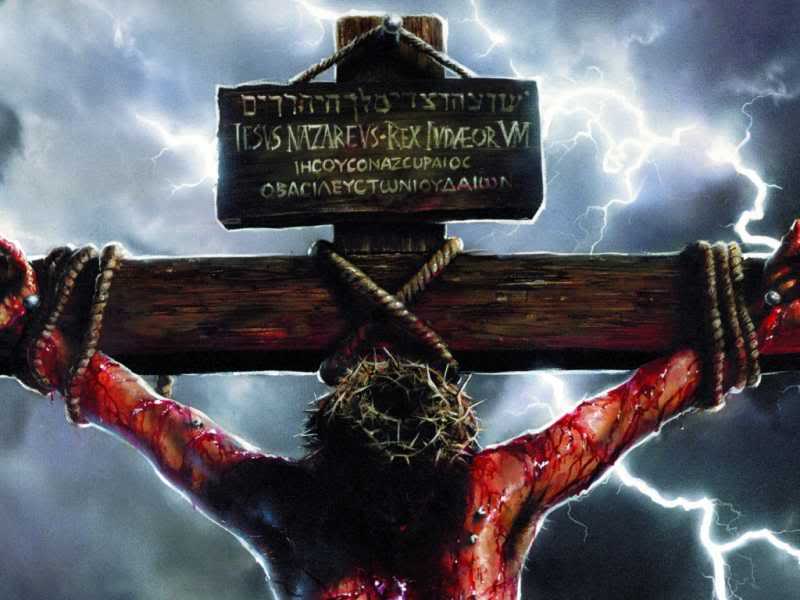
Why did Jesus of Nazareth endure a torturous death by crucifixion? After all, he could have just stayed in Heaven and left us all alone to pay the penalty for our sins. Instead, “he humbled himself and became obedient to death — even death on a cross”
“Who (Jesus), though he was in the form of God, did not count equality with God a thing to be grasped, but emptied himself, by taking the form of a servant, being born in the likeness of men. And being found in human form, he humbled himself by becoming obedient to the point of death, even death on a cross.” Philippians 2:6-8
But why? For one thing, God loves us dearly. All three persons of the Trinity were in agreement. God our heavenly Father was prepared to send His only Son to pay the penalty we deserve to pay. Jesus was prepared to make the tremendous sacrifice (incomprehensible) on our behalf and the Holy Spirit had to endure making it happen.
“God demonstrates his own love for us in this: While we were still sinners, Christ died for us” (Romans 5:8). Love is the biggest reason Jesus “endured the cross, scorning its shame” (Hebrews 12:2).
Jesus suffered and died on the cross so that you and I could be rescued from sin, death, resurrection to face judgment, punishment, and a second death in the Lake of Fire. If we could have saved ourselves by our own righteousness, it would have been utterly foolish for the Father to send his only Son to redeem us. The fact of the matter is that Christ’s crucifixion was the only way we could be rescued. “If righteousness could be gained through the law, Christ died for nothing” (Galatians 2:21).
I assure you that the Messiah didn’t endure crucifixion for nothing! It was the only way God’s worldwide rescue mission could be accomplished!
Do you realize what happens to a person after death if their sins are not forgiven? Jesus made it very clear that the wages of sin are death. And because God does not want you to go to Hell, but rather to Heaven, he did the one thing that would save us from punishment and a second death.
“The Father has rescued us from the dominion of darkness and brought us into the kingdom of the Son he loves, in whom we have redemption, the forgiveness of sins” Colossians 1:13-14
“Be faithful unto death, and I will give you the crown of life. He who has an ear, let him hear what the Spirit says to the churches. The one who conquers will not be hurt by the second death.” Revelation 2:10-11
“But as for the cowardly, the faithless, the detestable, as for murderers, the sexually immoral, sorcerers, idolaters, and all liars, their portion will be in the lake that burns with fire and sulfur,which is the second death.” Revelation 21:8
The Bible says “The message of the cross is foolishness to those who are perishing” (1 Corinthians 1:18). We simply don’t understand any of it. It must be illuminated by the Holy Spirit working through the Word of God. The Lord opens our minds to understand the Bible, just like he did with his first disciples. “Then he opened their minds so they could understand the Scriptures” (Luke 24:45).
The prophet Isaiah foretold the crucifixion of Christ some 700 years prior to Jesus’ birth,
“He was pierced for our transgressions, he was crushed for our iniquities; the punishment that brought us peace was upon him, and by his wounds, we are healed” Isaiah 53:5)
This prophecy clearly foretold the suffering the Messiah would endure. Nevertheless, many people refuse to believe Isaiah’s message. “The 17th-century Jewish historian, Raphael Levi, admitted that long ago the rabbis used to read Isaiah 53 in synagogues, but after the chapter caused ‘arguments and great confusion,’ the rabbis decided that the simplest thing would be to just take that prophecy out of the Haftarah readings in synagogues.” So much for Biblical inerrancy.
Meanwhile, don’t forget: If Jesus had sinned even one time, he would not qualify as anyone’s Savior. In that case, he would need someone to save him. Thankfully, “He committed no sin, and no deceit was found in his mouth” (1 Peter 2:22). A sinner cannot pay for anyone’s sins; a perfect sacrifice is required.
“For you know that it was not with perishable things such as silver or gold that you were redeemed from the empty way of life handed down to you from your forefathers, but with the precious blood of Christ, a lamb without blemish or defect” 1 Peter 1:18-19
God not only forgives our sins when we accept the Messiah by faith, but he also gives us a new heart with which to love and serve our Creator.
The death of Jesus on the cross pays for our sins and reconciles us to God. When we repent of our sins, trust Jesus to forgive our sins, and are baptized, we receive the third person of the Trinity into our souls to enable us to live the Christian life and be in a right relationship with God. Apart from the cross, we would remain rebels and would lack the Holy Spirit which enters our soul the moment we are spiritually reborn (John 3:1-18). Jesus endured the Cross so that all who receive him (John 1:12) will enjoy a relationship with the Lord forever.
Have you placed your faith in Christ’s sacrifice on the cross, or are you living under the delusion that your best efforts are enough to gain eternal life? If we could defeat sin and death with our own righteousness, then it would have made no sense for the Father to send his only Son to suffer such excruciating pain and unrelenting physical, spiritual, and emotional torment.
If you have not yet bowed your knee, repented, and surrendered your heart to Christ, this is a perfect time to do so. Turn away from your sins and believe that the Messiah’s death on the cross paid the full penalty for your sins.
Repenting your sins and accepting Christ as your Savior is the path to peace with God, whereas rejecting the Messiah leaves a person on death row facing punishment and second death.
Why should you be living eternally now? All believers will appear before the judgment seat of Christ and whilst our eternal destiny is safe what we have done will affect our rewards. For Christians that are raised in the first resurrection and are raptured with the living Saints, it is generally agreed that we will face the judgment seat of Christ during the time (Isaiah 34:8, Isaiah 61:2, Isaiah 63:4) we are in heaven before returning to earth with Jesus. If you disagree, keep in mind that these are not my words, but God’s. Jesus, speaking to both believers and unbelievers, said, “I tell you, on the day of judgment people will give account for every careless word they speak, for by your words you will be justified, and by your words, you will be condemned.” Matthew 12:36-37. Also, Paul said, “For we must all appear before the judgment seat of Christ, so that each one may receive what is due for what he has done in the body, whether good or evil”2 Corinthians 5:10
There are two different judgments in God’s Word: the judgment of faith, and the judgment of works. The judgment of faith relates to our eternal salvation, while the judgment of works relates to our eternal rewards.
For Christians, salvation took place in a moment in the past. It was free, it can’t be lost, it is the same for all Christians, and it is solely based on a faith that is ours by the grace of God alone. By contrast, future rewards are earned (by God’s grace), can be lost, differ among Christians, and are based on our efforts.
Salvation is about God’s work for us. Conversely, rewards are a matter of our work for God. When it comes to salvation, our work for God is no substitute for God’s work for us. God saves us because of Christ’s work, not ours. Likewise, when it comes to rewards, God rewards us for our work, not Christ’s. (Our good works are empowered by the Holy Spirit; nevertheless, we need to submit to Him so God refers to it as our work.)
Let me be sure this is perfectly clear. Christ paid the price for all of our sins, once and for all (Hebrews10:12-18). If we have trusted Him for that provision, we will not pay the eternal price, the second death. He has fully forgiven our sins, and we are completely secure in Christ’s love (Psalm 103:8-18; Romans 8:31-39). Our salvation is sure, and we will not undergo the judgment of condemnation (John 5:24; Romans 8:1).
But although the forgiveness of our sins has every bearing on our eternal destination, it has no automatic and effortless effect on our eternal rewards, apart from the fact that God’s sanctifying work comes out of our salvation, and therefore we should expect that the Holy Spirit’s presence in our lives should lead us to do good works that God will reward. But we must choose to do the works He prompts us to do. Neither does it mean our choices have no consequences in eternity. Forgiven people can still lose their rewards or forfeit eternal positions of responsibility they could have had if they’d served Christ consistently and faithfully before death.
Trust in Christ, lean on Him, and draw upon Him for power, for apart from Him we can do nothing. But if we hope to receive a reward, we must still do the necessary work. As our forefathers put it, to wear the crown we must first bear the cross.
Just as there are eternal consequences to our faith, so there are eternal consequences to our works.
What we do with our resources—including our time, money, and possessions—will matter not just twenty minutes, twenty days, or twenty years from now. It will matter twenty trillion years from now.
Though Paul insists we are saved by faith, not works (Titus 3:5), he also clearly states that the choices we make and the things we do have eternal implications, and that we will each answer to God for the works we have done in this life:
If anyone builds on this foundation [Christ] using gold, silver, costly stones, wood, hay or straw, their work will be shown for what it is, because the Day will bring it to light. It will be revealed with fire, and the fire will test the quality of each person’s work. If what has been built survives, the builder will receive a reward. If it is burned up, the builder will suffer loss but yet will be saved—even though only as one escaping through the flames. (1 Corinthians 3:12-15)
Those believers who have been less faithful and obedient in their walk with Christ will not suffer loss of salvation! But they will suffer loss of the reward that would have been theirs had they been more Christ-centered and faithful in their service to Jesus.
What 1 Corinthians 3 says is so sobering that a temporary loss doesn’t seem likely. This loss of rewards appears permanent, for while we will all serve God in our resurrected bodies on His New Earth, there appears to be a finality to the fact that after death comes judgment (Hebrews 9:27). If there are any future judgments for our service to God on the New Earth, we are not told about them in Scripture. Of course, we should anticipate for our future service He will say to all of his children, “Well done!” And yet, despite Scripture’s silence on this, I think it’s very possible that God, who is by nature a rewarder (), may continue to reward His people for faithful service on the New Earth. That resonates with me, and I don’t see anything unbiblical about it. It fully fits His nature as a Father who takes joy in saying “Well done” to His devoted children.
Earning Our Full Reward
First Corinthians isn’t the only passage that speaks of losing reward. The apostle John wrote, “Watch yourselves, so that you may not lose what we have worked for, but may win a full reward” (2 John 1:8, ESV).
To win a full reward would be glorious, wouldn’t it? But surely all of us will regret some of our decisions on that day when we “suffer loss” or “lose what we have worked for.” Anticipating standing before the judgment seat of Christ should motivate us to follow Him wholeheartedly and generate in us a proper fear of God.
All of us will be full of joy in Heaven, but those who served Him faithfully, particularly in the midst of adversity, will have been made, by God’s grace, into larger vessels. They won’t be fuller of joy, but they will have a greater capacity, and their fullness will accordingly contain even more joy. (Hence the special place in Revelation given to the martyrs.) There won’t be envy or regret, because of our new natures, and all will be full of joy, yet there will be true continuity and eternal consequence so that what we do—not just what we believe—in this life affects the next.
Maybe one way to say it is that the “loss” of rewards is in some sense permanent, but the “suffering” of that loss will be temporary. God will do away with the suffering (Revelation 21:4), but that is after the judgment, after we give an account to the Lord. The suffering of regret will be there at the judgment (how could it not be?) before entrance to the eternal state, but then comes the learning and purifying and eternal rejoicing. Perhaps we’ll offer a short, entirely sincere, “I regret my lack of faith and faithfulness,” expressing this to our God who graciously forgives. Then, with that forever behind us, we move on to eternal joy.
But there will be no ongoing suffering, for all our regrets about our past will be overshadowed by God’s grace. Yet if there were no reckoning, no “suffering loss” then the 1 Corinthians 3 passage would be meaningless (which is exactly what most teaching on the subject reduces it to). Some will object that this is a sort of Protestant purgatory, just shorter in duration than languishing in the flames of Catholic purgatory. But the suffering is not in the eternal state, only in a temporal judgment, and judgment must involve the negative as well as positive or it too is meaningless. The biblical statements of “giving an account” and that include “works done in the body, whether good or evil” are unmistakable in that regard. (Doing the evil will clearly have taken away from the rewards that would have come from doing good.)
Consequences without Condemnation
Since all who know Jesus go to the intermediate Heaven immediately when we die, it appears that whenever this judgment happens, it will be after we get there. So, while God will one day wipe away every tear from our eyes (Revelation 21:4), it seems likely that when we must give an account for our lives, there will be, for a time, some regrets and tears and a sense of that loss Scripture speaks of.
I realize this is hard to grasp. I am just trying to be true to all God’s Word says, instead of choosing only parts of it. This may sound like a sort of condemnation and punishment, but we are assured this isn’t the case, for “There is no condemnation for those who are in Christ Jesus” (Romans 8:1).
Ephesians 1:7 says, “In him [Jesus] we have redemption through his blood, the forgiveness of sins, in accordance with the riches of God’s grace”. The Bible teaches not only forgiveness of our sins but also consequences for our choices. These consequences apply despite our forgiveness. Forgiveness means that God eliminates our eternal condemnation; we will not be ultimately punished for our sins, but there may be immediate consequences in this world due to our sins. Forgiven people can still contract AIDS, go to jail for drunk driving, or suffer the death penalty, for example. A murderer or drug dealer can be fully redeemed and forgiven, and may still spend the rest of his life in prison. He may lose his family as well as his freedom. After all, the thief on the cross remained there despite his confession of faith.
In Heaven, God appears to say that while all our sins will be forgiven and there will be no ongoing shame or regrets, nevertheless at the judgment seat an initial and temporary sense of shame, regret and sorrow seems likely, though one that will soon be swallowed up by eternal grace and joy.
Prepared for Good Works
One of the most often quoted passages in Scripture states, “For it is by grace you have been saved, through faith—and this is not from yourselves, it is the gift of God— not by works, so that no one can boast” (Ephesians 2:8-9).
It’s a wonderful truth, but verse 10 immediately follows with more truth about works: “For we are God’s handiwork, created in Christ Jesus to do good works, which God prepared in advance for us to do.” God has prepared a lifetime of good works and we will give an account to Him for whether or not we have done them.
Surely each of these passages and others like them implies that while we will be fully forgiven in Christ and be forever totally cleansed and purified by His redemptive work, we will nonetheless be held accountable for what we have and haven’t done in this life.
It seems reasonable we won’t be joyful at the very moment we have to give an account for our sins, the careless words we have spoken, and all the wood, hay, and straw of our lives that will be consumed in the fire, that could have instead been gold and silver and precious stones. And at the same time, we will find great pleasure in the rewards God has given us, and we will celebrate the rewards He gives to others.
Embracing Paradox
But how does this all fit with the truth about the forgiveness of our sins? I think of the example of Charles Spurgeon, who didn’t try to reconcile every paradox or apparent contradiction in the Bible. Speaking of the truths of God’s sovereignty and human responsibility—which I also believe to be applicable to the truths of complete forgiveness and accountability at the judgment Spurgeon said this:
“These two truths, I do not believe, can ever be welded into one upon any human anvil, but one they shall bein eternity: they are two lines that are so nearly parallel, that the mind that shall pursue them farthest, will never discover that they converge; but they do converge, and they will meet somewhere in eternity, close to the throne of God, whence all truth doth spring.“
Spurgeon also wrote, “Those who will only believe what they can reconcile will necessarily disbelieve much of divine revelation.” Our desire for logical consistency, as we understand it, can become our God. Then we, not Scripture and not God, become our own ultimate authority. We end up ignoring, rejecting or twisting Scripture that doesn’t fit our chosen theology.
On the contrary, our theology should reflect Scripture itself, and wherever Scripture teaches apparently contradictory ideas, our theology should embrace those same ideas, rather than resort to a consistency that rejects part of God’s revealed Word.
Certainly, any and all of our regrets about our past will be overshadowed by God’s grace, which is the good news of the Gospel. There is comfort in 1 Corinthians 4:5, which says God “will bring to light the things now hidden in darkness and will disclose the purposes of the heart. Then each one will receive his commendation from God.” God will apparently find something to reward “each one” for. This makes sense, for no one can truly be born again without having demonstrated some fruit for which God can reward us.
Let’s Live in Light of Eternity Now
All of this argues for cultivating an eternal perspective in which we seek to live each day in light of eternity—not out of dread, yet with the right kind of fear of God and heartfelt love that desires to please our Lord and Savior.
In his book When Christ Comes, Max Lucado writes, “You can be certain you won’t regret any sacrifice you made for the kingdom. The hours of service for Christ? You won’t regret them. The money you gave? You’d give it a thousand times over. The times you helped the poor and loved the lost? You’d do it again. . . . You’d change the diapers, fix the cars, prepare the lessons, repair the roofs. One look into the faces of the ones you love, and you’d do it all again.”
An eternal perspective isn’t something we have to wait until Heaven to have. So I’ve often given readers and listeners this advice: live now the way that you will one day wish you would have. Don’t postpone obedience, holiness, purity, drawing close to God, and serving others.
Five minutes after we die, we’ll know exactly how we should have lived—it will be too late to go back and change anything. God has given us His Word so we don’t have to wait until we die to know how we should have lived. There’s no second chance for the unbeliever—but also no second chance for the believer! Just as missionary C. T. Studd said, “Only one life, ’twill soon be past; only what’s done for Christ will last.”
You and I have one life on this fallen earth in which to follow Jesus and invest in Heaven. Let’s not miss the opportunity. God will one day take away all our sorrows, but why go into eternity with regrets? Here’s a prayer for us: May what will be most important to us five minutes after we die become most important to us now.
Let me add KNOW YOUR WHY:
To bring glory to God
To know God’s will for your life
God wants to use me to bring people into His Kingdom
Adapted from the article: “Will We Have Regrets at the Judgment Seat of Christ?” December 5, 2022 by Randy Alcorn http://www.patheos.com
Living Eternally Now is available o Amazon or from me direct: ron@bakb.com.au





 LIVING ETERNAL NOW