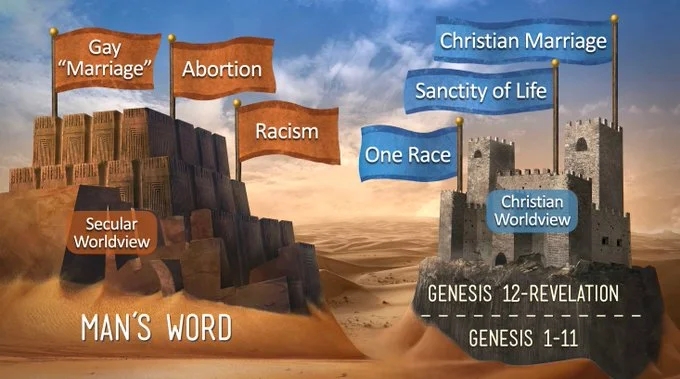
In the United States, June now brings a more sinister side. The nation celebrates June as “Pride Month.” Desecrated rainbows fill store displays and social media feeds. Sexual deviancy and perversion are celebrated as a virtue. Baseball teams host “Pride nights” at their stadiums. Government buildings are lit up with the colours of the rainbow. The US Navy joins in, changing their entire Twitter avatar and bio to boast of wickedness.
As Christians, we might easily look at June as a month where the darkness has overtaken the light, where godless people brazenly mock God by taking His rainbow and using it to celebrate what He describes as an abomination. But we do well to remember that God in His sovereignty rules over the darkness and that God is not mocked, no matter how vigorously men may try.
While the godless of society take this month to celebrate their ungodliness, we must acknowledge the sovereignty of God in that they label this celebration with a sin that is even worse than the one they are promoting: PRIDE. Proverbs 6:16-17 says, “There are six things which the Lord hates, Yes, seven which are an abomination to Him; Haughty eyes…” Haughty eyes are the visible, outward manifestation of a heart of pride. The Lord hates pride. The Lord says that pride is an abomination to Him. Peter wrote, “God is opposed to the proud, but gives grace to the humble” (1 Peter 5:5). To celebrate pride is to celebrate what God hates and to put yourself in a position where God is opposed to you. That includes all pride, not just pride in sexual immorality.
When our nation celebrates Pride Month, it is a manifest indication of God’s judgment against us. The reason it is such a clear indication of judgment is not because of the rejoicing in unrighteousness that occurs, although that in itself would qualify, but because this rejoicing in unrighteousness is done under the banner of another sin that God hates, the sin of pride. God’s judgment is manifest in taking those who love sin and doubling their guilt. They no longer are guilty before God for one sin — sexual immorality — but two sins that God hates, as pride becomes their adornment. The judgment of God is manifest when He not only condemns sinners in their sin but aggravates their condition so that they become even more guilty before Him.
We see this throughout all of Scripture. Pharaoh hardened his heart before God, and God hardened Pharaoh’s heart as well. When Pharaoh refused to repent, God hardened his heart to such an extreme that Pharaoh drove his army to their death in the sea (Exodus 14). We see this with Herod in Acts 12. Herod was guilty before God for executing the Apostle James. His unrepentant heart became so hardened that he exalted himself over God, and God executed him for it. When Eli rebuked his sons for their godless behavior, including sexual immorality, “they would not listen to the voice of their father, for the Lord desired to put them to death” (1 Samuel 2:25).
Besides the judgment of God, we also see the sovereign providence of God over all of these events. God is no mere bystander, watching helplessly or disinterestedly as His creatures defy His authority and flout His law. God is intimately involved in ruling His world and reigning over His creation. Part of that sovereign providence is bringing specific and terrifying judgment from which there is no escape. From that vantage point, we can say as Christians that pride month is not merely a manifestation of the wicked heart of man but an indication of the righteous judgment of God. That means as Christians we realize that God is sovereign over pride month and that He has a good purpose in what man means for evil.
A heart of pride might be the most terrifying judgment of all because it is the judgment from which there is no path of escape. The necessary element for salvation is the opposite of pride. God delights in a broken and contrite heart, not a proud countenance. Jesus said, “Blessed are the poor in spirit, for theirs is the kingdom of heaven. Blessed are those who mourn, for they shall be comforted” (Matthew 5:3-4). The poor in spirit are those who recognize their spiritual poverty, and they are connected with those who mourn because they grieve over their sins. They are not proud, and they do not celebrate what God condemns. Their hearts are broken over their sins, and they are humbled to the dust before a holy and righteous God who judges everyone impartially.
The only way anyone can be saved is by abandoning their pride, their self-reliance, their delight in disobedience to God’s Word, and humbling themselves before the cross of Christ, seeking mercy through faith in His sacrifice for sinners.
God’s judgment becomes clear when the Lord begins to aggravate people’s sinful condition so that one sin begins to pile on top of another. That is what is happening during pride month, and that is why June is for judgment. The USA is a nation already under judgment and with much of the church compromised with the world on gay marriage, LGBTQ, and transgender issues it will also be deceived by the false prophet when the Antichrist comes to power. How foolish, when Jesus’ return is so close first to rapture the Saints but then to pour out His wrath upon an unrepentant world.
The USA church is the church of Laodicea. The church that will be left behind to face the wrath of God.
“‘I know your works: you are neither cold nor hot. Would that you were either cold or hot! So, because you are lukewarm, and neither hot nor cold, I will spit you out of my mouth. For you say, I am rich, I have prospered, and I need nothing, not realizing that you are wretched, pitiable, poor, blind, and naked. I counsel you to buy from me gold refined by fire, so that you may be rich, and white garments so that you may clothe yourself and the shame of your nakedness may not be seen, and salve to anoint your eyes, so that you may see. Those whom I love, I reprove and discipline, so be zealous and repent. Behold, I stand at the door and knock. If anyone hears my voice and opens the door, I will come in to him and eat with him, and he with me.” Revelation 3:15-20
The church of Philadelphia represents the church that is raptured look what God says to it.
“‘I know your works. Behold, I have set before you an open door, which no one is able to shut. I know that you have but little power, and yet you have kept my word and have not denied my name… Because you have kept my word about patient endurance, I will keep you from the hour of trial that is coming on the whole world, to try those who dwell on the earth. I am coming soon.” Revelation 3:8, 10-11




 LIVING ETERNAL NOW