
Rolls-Royce SMR was successful in the Swedish nuclear selection process 12th June 2024. It has won a place on Vattenfall’s shortlist of just two SMR companies competing to potentially deploy a fleet of small modular reactors (SMRs) in Sweden.
Vattenfall, the Swedish multinational power company, has announced the shortlist of two SMR vendors as part of its plans to meet the rising electricity demand, adding nuclear capacity and helping Sweden achieve its goal of creating a fossil-free economy by 2045. The other successful SMR was GE Hitachi’s BWRX-300.
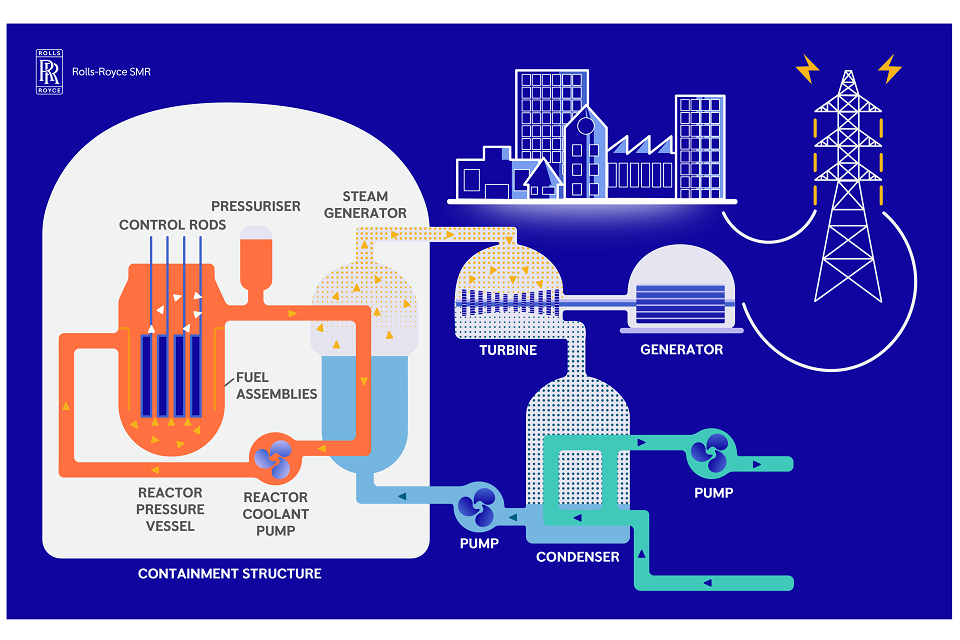
This selection follows a thorough assessment process in which Rolls-Royce SMR had the opportunity to present a fundamentally different approach to building nuclear projects and a modularisation strategy focused on risk reduction to Vattenfall, an experienced and technically respected energy utility.
Rolls-Royce SMR CEO, Chris Cholerton, said: “We are delighted to be one of the two SMR technologies selected by Vattenfall for further evaluation in Sweden. Success in reaching the final two, in such a fiercely competitive process, reflects the benefits of our integrated power station design, our approach to modularisation, and our use of proven nuclear technology.
“Rolls-Royce SMR is the fastest and most affordable way of bringing new nuclear power online and we are excited to work with utilities and industrial customers around the globe, to unlock sustainable sources of low-cost, low-carbon electricity for decades to come.”
Vattenfall’s focus will be deployment at the Ringhals nuclear site with a project that, at the earliest, is operational in the first half of the 2030s, with assessments for SMR and large-scale reactors ongoing.
Sweden has said it needs an additional 100-250 TWh of electricity production over the next 25 years and Vattenfall is poised to play a critical role in the country’s energy transition, including integrating new nuclear capacity into the energy mix.
Rolls-Royce SMR is on track to complete Step 2 and immediately enter Step 3 of the Generic Design Assessment by the UK nuclear industry’s independent regulators this summer. This will be the most important regulatory milestone to date – confirming Rolls-Royce SMR’s first-mover advantage as the leading technology in Europe.

 LIVING ETERNAL NOW