When Moses stood before the burning bush, his simple response – “Here I am” (Exodus 3:4)- wasn’t about location. It was about readiness, availability and willingness. Like Samuel, Isaiah, and so many who’ve answered God’s call, it wasn’t about having all the answers but simply saying yes.
When God called Moses, He knew Moses didn’t feel equipped. “I am slow of speech”, Moses protested. But God replied, “Who gave human beings their mouths?” (Exodus 4:11)
God wasn’t looking for perfection. He was looking for obedience. We all have something “in our hands” that God can use. What is the gift God has given you? Is it the ability to speak, write, encourage, give finances, or leadership skills in your community, workplace, or online skills?
The point isn’t what you have. The point is that you make it available to the Lord.
If necessary your best prayer is to ask God to strip you of everything so that you are totally dependent upon Him, even for your next meal. Can I suggest you listen to this Jamie Winship video; God stripped Jamie and his family of everything so they had to depend upon Him for all their needs for two years. Once you have lived this way you’ll never want to go back to living the world’s way of total reliance on your own ability. Jamie reveals how God showed him how to witness to Muslims. It will “blow your mind”.
Jamie also learned more about God and His ways by how He answered their prayers, which helped the family know how to pray. Jamie began to fully understand the meaning of being made in the image of God to be in communion with Him. To understand that God is perfection, unblemished by sin. He only does what is right. Jamie wants to please God, so he only wants to do what is right, like Jesus when He was on Earth.
“So Jesus said to them, ‘Truly, truly, I say to you, the Son can do nothing of his own accord, but only what he sees the Father doing. For whatever the Father does, that the Son does likewise.‘” John 5:19
Jesus made it possible for our Heavenly Father to send the Holy Spirit (the third person of the Trinity) to be our counsellor, teacher, comforter, and helper to enable us to live the Christian life.
What is the message of the Book of Job for us today?
First, our faith is sure to be tested. Pain may be inevitable, but misery is to an extent optional. We have no control over the weather that surrounds our lives, but we can do something about the climate of our inner life. What happens to us is less important than what happens in us.
Second, the book reminds us that human horizons are inadequate for a proper understanding of suffering and affliction. Job and his friends carried on their debate in total ignorance of the background exchange between Satan, the Accuser, and God. They were trying to fit the puzzle pieces together without having all of them. The book shows that any attempt to reduce the complex problem of suffering to some neat formula is misguided.
Third, the book gives guidance on how to comfort—and how not to comfort—those who suffer. Though well-intentioned, his friends’ advice was unhelpful. Job’s scathing rebuke of them is understandable:
“You whitewash with lies; worthless physicians are you all. Oh that you would keep silent, and it would be your wisdom!” Job 13:4–5
Job’s friends did more for him in their silent presence (Job 2:13) than in their speaking.
Finally, we should not be too quick to import New Testament ideas into our reading of the book. It yields its treasures most readily to those who let Job speak from his own perspective.
His hands reach out to grasp the more tangible forms of revelation that God would graciously offer in the future. Yet he is poignantly aware that they evade his grasp.
In wishing fervently for an intermediary, Job “drew attention to the vacuum that existed, the need that every troubled heart recognizes. In this respect, he anticipated the incarnate Saviour.” Through his undeserved suffering, Job gave an ‘advance echo’ of Jesus Christ, who would live a perfect life, yet endure pain and death in order to win a great victory for all who repent and put their lives in His hands – totally trusting in Him.
Abstract from article WHEN FAITH IS TESTED – THE BOOK OF JOB by Peter Howe in the latest Creation Magazine Volume 45, Issue 3, 2023
“And the Lord restored the fortunes of Job when he had prayed for his friends. And the Lord gave Job twice as much as he had before. Then came to him all his brothers and sisters and all who had known him before, and ate bread with him in his house. And they showed him sympathy and comforted him for all the evil that the Lord had brought upon him. And each of them gave him a piece of money and a ring of gold. And the Lord blessed the latter days of Job more than his beginning.” Job 42: 10-12
I have already put up two posts relating to walking with God. Can I suggest that if you cannot remember them that you go take another look? As we approach Jesus’ second coming, we need to be walking with God or we will not be an overcomer and part of His Millennial Kingdom.
1. Cultivating God’s Presence: It focuses on what Jesus has done to enable us to walk with God. It also looks at Enoch’s walk with God and what that teaches us. Finally, Matthew’s Gospel links our eternal destiny with the way we live now. It is why this website is called Living Eternal Now.
2. Getting in Step with God: It teaches that in just about all situations God takes the initiative. Hence, it is important for us to learn how to identify what that is in every situation, and to get in step with Him.
This post will look at the challenge that God’s will is not always easy to embrace. Fortunately, the O.T. prophets and Jesus’ disciples were good examples for us. They show us that walking with God requires us to have the single-mindedness of an athlete, one determined to train hard and to perform well on the day. The temptation to relax or give up is a constant.
For example, Abraham’s family set out from Ur, under the leadership of Terah, Abraham’s father. The biblical record shows us that they quickly got waylaid. Once they arrived in Haran they became settlers. It was only when Teruah died and Abraham got a fresh call from God that he resumed their journey (Genesis 11:31-12:3). It is not always easy to continue our journey and we tend to seek the familiar rather than embrace the vulnerability that walking with God entails. Jeremiah 12 recounts a story where the prophet is fed up with finding himself in yet another vulnerable situation. He had already been through the mill and he had had enough. His complaints to God are seen as evidence of his being a glass half-empty-person. But, who would not complain when he found himself imprisoned and not feel peeved in such circumstances? God’s initial call to Jeremiah seemed to imply that he would experience continual deliverance coupled with being given great authority in speaking to those in power (Jeremiah 1:8-10). Moreover, God’s response to Jeremiah’s prayer of complaint might seem lacking in sympathy to us. Jeremiah is told to toughen up because he would find himself in even more vulnerable situations in the future: ‘If you have raced men on foot, and they have wearied you, how will you compete with horses?’ (Jeremiah 12:5). Jeremiah was called to walk with God and embrace the journey, whatever the circumstances, and wherever his pilgrimage might lead, as indeed are we.
The prophets of Israel needed to exhibit greater than average stability or they would not have survived their calling for any longer than a month or so if that. They demonstrated exceptional perseverance in circumstances that must have created a huge sense of personal threat. Most of us would have looked for a way out of the call, as in the case of Jonah. However, God gave all of them the end of the story. They all saw their Messiah ruling and reigning the nations from a magnificent Jerusalem. I am sure this was in large part why they persevered.
For most of us on our faith journey, we really do feel vulnerable and our faith is usually a mixture of active trust and insecurity. Our memory of the past, the story of how God turned up the last time we trusted him, can sometimes help, but a previous positive experience doesn’t always make things easier the next time around. We need the stories of men and women of faith in the Bible to inspire us; we need to look to the example of Jesus, who looked to the joy set before him at the end of the journey.
“Therefore, since we are surrounded by so great a cloud of witnesses, let us also lay aside every weight, and sin which clings so closely, and let us run with endurance the race that is set before us, looking to Jesus, the founder, and perfecter of our faith, who for the joy that was set before him endured the cross, despising the shame, and is seated at the right hand of the throne of God.” Hebrews 12:1-2
Attachment to material possessions can often be a stumbling block, acting as a distraction to the main thing, which is knowing and following God. We are given the example of the early church where believers shared their possessions.
“And all who believed were together and had all things in common. And they were selling their possessions and belongings and distributing the proceeds to all, as any had need.”Acts 2:45
Their heightened awareness of the presence of God following Pentecost appears to have freed these early disciples from having to find security in their possessions. An unprecedented outpouring of generosity is a sign of – and the result of – the presence of the Holy Spirit. Generosity is also the natural response to the realization that God’s gifts to us are wholly unmerited. The fact that we are recipients of God’s generosity can also enable us to love ourselves more. After all, if God is so outrageously kind to us, if he welcomes us with open arms, perhaps it is true that we are loved extravagantly.
One way to express generosity is to practice regular financial giving. A rule can include the decision to give away a certain proportion of income to specific causes, individuals, or organizations. Having a rule actually simplifies our lives, saving us from constantly having to make decisions about where and how much to give. Of course, regular giving as part of a rule does not preclude additional giving to other causes.
“Each one must give as he has decided in his heart, not reluctantly or under compulsion, for God loves a cheerful giver. And God is able to make all grace abound to you so that having all sufficiency in all things at all times, you may abound in every good work.” 2 Corinthians 9:7-8
Also utilizing the gifts of the Holy Spirit will draw us closer to God in our walk with Him:
“Having gifts that differ according to the grace given to us, let us use them: if prophecy, in proportion to our faith; if service, in our serving; the one who teaches, in his teaching; the one who exhorts, in his exhortation; the one who contributes, in generosity; the one who leads, with zeal; the one who does acts of mercy, with cheerfulness.” Romans 12:6-8
“I appeal to you therefore, brothers, by the mercies of God, to present your bodies as a living sacrifice, holy and acceptable to God, which is your spiritual worship. Do not be conformed to this world, but be transformed by the renewal of your mind, that by testing you may discern what is the will of God, what is good and acceptable and perfect.” Romans 12:1-2
It will be extremely important as we come closer to the prophesied last seven years prior to Jesus’ second coming when persecution of Christians will escalate that we draw closer to God and our every step is guided by the Holy Spirit.
“Then they will deliver you up to tribulation and put you to death, and you will be hated by all nations for my name’s sake. And then many will fall away and betray one another and hate one another. And many false prophets will arise and lead many astray. And because lawlessness will be increased, the love of many will grow cold. But the one who endures to the end will be saved.” Matthew 24:9-13
Keep in mind that what you will be doing, and the role Jesus assigns to you in His coming Millennial Kingdom will depend upon how you live your life now. You need to be living eternal now.
We observe in Acts 10 and 11, God, rather than the apostles, took the initiative in most situations. The apostle’s involvement invariably requires their availability in prayer. God had heard Cornelius’s prayer and He also, with some considerable difficulty, sought to guide Peter as he prayed. Both Cornelius and Peter experienced the presence of God in a vision (Acts 10:2-3 and 9). Peter was rather slow to understand what was going on, trying hard to keep up with the God who had already gone before him. He eventually realised that he should visit Cornelius, but was astonished to find that God had already been working well beyond the bounds of the Church. To Peter’s amazement, he got halfway through his talk when the Spirit took over. The account reads as if the Spirit is rather impatient, perhaps even bored by Peter’s sermon, and doesn’t wait for him to finish (Acts 10:44)!
Even on the day of Pentecost, Peter was simply keeping up with God’s action and he did not initiate anything himself. He just happened to be present and took the opportunity to explain the events unfolding before his eyes, starting with a disclaimer to drunkenness (Acts 2:15).
God often makes his presence known to people, despite our slowness to ‘cotton on’ to whatever He is doing. We play our part, but very much as junior partners who are trying to keep up.
Our partnering with God is good for our mental health. It saves us from feeling we have the overwhelming responsibility of carrying the weight of the world on our shoulders. It releases us to walk with the Lord, in the confidence that He has both gone before us and that we carry His presence with us. Our part is to be attentive and to look for signs of the Holy Spirit’s activity as we fulfil our call to have an impact on people and communities. Doing this by seeking to discern the presence and activity of the Spirit is a different approach to what most of us have been taught which seemed to put the onus on us.
On occasions, walking with God means we have to ‘walk on the water’. Like the disciples, as we set out from the security of the shore, we do not realise all that the journey will entail. The story of Peter walking on water revealed how rash he was, but it also shows us the level of his faith in Jesus compared to his companions who stayed in the boat ‘Peters’ are people who are more desperate to join Jesus than those of us who always weigh up the risk. We need to avoid recklessness, but when it’s in response to having heard the prompting of the Holy Spirit, faithfully stepping into a vulnerable situation will get us closer to Him.
Much of this post is extracted from Richard Brown’s book Cultivating God’s Presence
Groundwire is really good at reaching those people that would not say they are atheists but do not believe God is relevant to our lives today. They are seeing tens of thousands of young people turn to Christ each year, and the positive pattern is showing no signs of slowing down. “We’re not going after the atheists,” Sean Dunn, president of Groundwire, told Faithwire. “The media would want us to believe that everybody’s an atheist, but, truthfully, 71% of Millennials [and] Gen Z believe that God’s a real being.” Still, young people, despite believing in God, tend to ignore Him, especially in today’s chaotic culture. That’s why Groundwire, a group that seeks to help youths enter into a personal relationship with Christ, uses popular media channels to connect with Millennials and members of Gen Z in the digital spaces through which they currently engage. Find out how Groundwire is reaching so many young people with Christ.
If you invest in the right treasury (eternal, not temporal), adopt the right perspective, and serve the right Master you have nothing to worry about. In contrast, those who invest in the wrong treasury (temporal, not eternal), adopt a here-and-now perspective, and serve the wrong master (money, not God) have every reason to worry.
“For you did not receive the spirit of slavery to fall back into fear, but you have received the Spirit of adoption as sons, by whom we cry, “Abba! Father!”Romans 8:15
Since we cannot serve two masters, our fear of not having enough reveals our true master.
Jesus specifically tells us not to worry about life’s necessities—food, drink, and clothes. Then He says,
“But seek first the kingdom of God and his righteousness, and all these things will be added to you” Matthew 6:33
According to our Lord, giving isn’t what leaves us short of material provision. Jesus promises to provide for givers in full measure.
“Give, and it will be given to you. Good measure pressed down, shaken together, running over, will be put into your lap. For with the measure you use it will be measured back to you.” Luke 6:38
How about this promise in Malachi?
“Bring the full tithe into the storehouse, that there may be food in my house. And thereby put me to the test, says the Lord of hosts, if I will not open the windows of heaven for you and pour down for you a blessing until there is no more need.” Malachi 3:10
When we give away our treasures, we are seeking God’s Kingdom first. And therefore, “all these [material needs] will be added to” us.
available on Amazon as an ebook and trade paperback edition
Paul told the Philippians, “I have received everything in full, and I have an abundance. I am fully supplied, having received from Epaphroditus what you provided—a fragrant offering, an acceptable sacrifice, pleasing to God”Philippians 4:18, CSB
Their financial gifts were gifts to God. Since they gave so generously to provide for him and his work, Paul was confident God would provide the same for them: “My God will supply all your needs according to his riches in glory in Christ Jesus” (Philippians 4:19, CSB). This is a familiar promise, but most people don’t realize that in context, it is specifically for givers who have stretched themselves to become sacrificial partners in Kingdom ministry. “For even in Thessalonica you sent gifts for my need several times” (v.16).
RANDY & NANCI ALCORN’S TESTIMONY
In some cases, God’s provision is obvious—we get an unexpected check in the mail or are given something we thought we’d have to buy. One time Nanci and I discovered an error we’d made in our bank balance, finding we had significantly more money than we realized.
In other cases, God’s provision is less obvious but equally generous. A washing machine that should have broken down a decade ago keeps working. A car with more than two hundred thousand miles runs for three years needing no repairs. A checking account that should have dried up long before the end of the month somehow makes it through. As God miraculously stretched the widow’s oil supply in Elisha’s day (2 Kings 4:1-7), and as He made the Israelites’ clothes and sandals last forty years in the wilderness (Deuteronomy 8:4), I’m convinced He sometimes graciously extends the life of things that would normally need replacement.
The God who fed a million-member family in the wilderness for forty years, fed five thousand with one boy’s lunch, and who is perfectly capable of turning water into wine and stones into bread, will not have any trouble providing whatever He knows you need.
Adapted from the article by Randy Alcorn, “If We Fear God, We Can Trust His Provision” August 8th, 2022 http://www.patheos.com
Josef Tson: What His Suffering for Christ in Communist Romania Taught Him, and Can Teach Us
This article by Randy Alcorn www. patheos.com July 21, 2022 is very applicable to the “end times ” persecution that is unfolding in our time.
I opened the Scriptures with Josef in 1988, with a group of theologians discussing eternal rewards. Twenty years later, writing my book If God Is Good, I remembered his stories and insights and called him again, in order to share his insights with others. Josef explained to me how the belief that God doesn’t want His people to suffer once corrupted the Romanian church. In the interests of self-preservation, he said, they failed to speak out against injustice, tyranny, and the idolatry of turning men into gods. He recalls joining the crowd on the streets and crying, “Glory to Stalin.”
God convicted Josef. As a pastor, he refused to glorify communist leaders and started to speak out boldly for Christ. Interrogators threatened him with death every day for six months. Finally he told them, “Your supreme weapon is killing. My supreme weapon is dying. My preaching will speak ten times louder after you kill me.”
Josef said, “During the time I was expecting to be crushed by the Romanian secret police interrogators, God became more real to me than ever before or after in my life. It is difficult to put into words the experience I had with God at that time. It was like a rapture into sweet and total communion with the Beloved. God’s test for me then became the pathway to a special knowledge of the reality of God.”
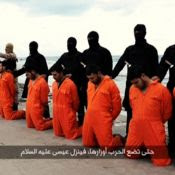
21 Coptic Christians beheaded by Isis in Tripoli, Libya
Finally, in 1981, the Romanian government exiled him. After facing much evil and nearly being martyred in Ceauşescu’s Romania, Josef told me, “This world, with all its evil, is God’s deliberately chosen environment for people to grow in their characters. The character and trustworthiness we form here, we take with us there, to Heaven. Romans and 1 Peter 3:19 make clear that suffering is a grace from God. It is a grace given us now to prepare us for living forever.”
He also told me he believed that 95 percent of Christians pass the test of adversity, while 95 percent fail the test of prosperity.
In the West, with our conspicuous prosperity and ease, Christianity’s popularity continues to shrink. In Africa, Asia, and South America, with much greater adversity and suffering, it continues to grow.
Josef Tson believes, “The gospel will never be spread without someone suffering.” He said our first question in suffering should not be, “Why?” but, “God, what do you want to do in the world through my suffering?”
Josef continues, “God achieves great things in the world through the one who accepts His way of suffering and self-sacrifice. In the end, however, it turns out that the greatest things are achieved in the sufferer himself. The one who sacrificially expects to be a blessing for others discovers that, in the final analysis, he is the one who has harvested the greatest blessings.”
Suffering can help us know God and prepare us to trade a shallow life not worth keeping for a deeper life we’ll never lose.
When interrogators worked Josef into exhaustion for ten hours a day, one of his persecutors made a strange statement: “Pastor Tson, when I interrogate people I am used to feeling their hatred for me. But you do not hate me. It has become a delight for me to be with you.”
Jesus saw our suffering as an opportunity to share the gospel, do you?
“Jesus said to them, nation will rise against nation and kingdom against kingdom. There will be great earthquakes and in various places famines and pestilences. And there will be terrors and great signs from heaven. But before all this they will lay their hands on you and persecute you, delivering you up to the synagogues and prisons, and you will be brought before kings and governors for my name’s sake. This will be your opportunity to bear witness. Settle it therefore in your minds not to meditate beforehand how to answer, for I will give you a mouth and wisdom, which none of your adversaries will be able to withstand or contradict. You will be delivered up even by parents and brothers and relatives and friends, and some of you, they will put to death. You will be hated by all for my name’s sake. But not a hair of your head will perish. By your endurance, you will gain your lives.” Luke 21: 10-19
Josef viewed his suffering as God’s means to accomplish God’s purpose. He told of guards coming to Christ while beating Christian prisoners, then confessing their faith and being imprisoned and tortured themselves. As a result, the gospel his persecutors tried to dismiss touched them instead.
Sadly, most people simply have no genuine desire to submit themselves to the God who declares all things to be under His rightful jurisdiction. Thus, the natural disposition of most is to cast off the fetters of an antiquated belief system they no longer desire to subscribe to. The reality is that true Christianity has become an antiquated belief system to most.
What we are witnessing is the same sin as our federal head, Adam, who simply rejected the will of His Creator in favor of expressing his own sinful desires. In the case of Adam and Eve, they also played the blame game – blame-shifting responsibility on something or someone else. Indeed, Adam blamed God Himself. Likewise, Eve blamed Satan (manifesting as a serpent).
“He drove out the man, and at the east of the garden of Eden he placed the cherubim and a flaming sword that turned every way to guard the way to the tree of life.” Genesis 3:24
ADAM: “The woman whom you gave to be with me, she gave me fruit of the tree, and I ate.” Genesis 3:12
EVE: “The serpent deceived me, and I ate.” Genesis 3:13
However, we are without excuse for rejecting God and His values.
“For what can be known about God is plain to them, because God has shown it to them. His invisible attributes, namely, his eternal power and divine nature, have been clearly perceived, ever since the creation of the world, in the things that have been made. So they are without excuse.” Romans 1:19-20
I have come to be more and more convinced that the vast majority of those who reject the Christian faith do so on the basis of intellectual laziness, intellectual dishonesty, or simple ignorance. Evolution has been a major stumbling block for many but the evidence now for complexity and design in biology and the universe is overwhelming. They either don’t care to find the answers, they don’t care to hear the answers, or, they don’t know where to even begin. If the latter is the case and they earnestly desire to know God and the truth, the Holy Spirit will convict them and provide the means for them to find the truth about God and His Son. The means may well be you as one of His disciples.
“And when He (Holy Spirit) comes, He will convict the world concerning sin and righteousness and judgment: concerning sin, because they do not believe in me; concerning righteousness, because I go to the Father, and you will see me no longer; concerning judgment, because the ruler of this world is judged.” John 16:8-11
No one can live the Christian life unless they have repented of their old life, died to self (baptism), and received the Holy Spirit to enable them to live the Christian life.
“When the Spirit of truth comes, He will guide you into all the truth, for He will not speak on His own authority, but whatever He hears He will speak, and He will declare to you the things that are to come. He will glorify Me, for He will take what is mine and declare it to you. All that the Father has is mine; therefore I said that He will take what is mine and declare it to you.” John 16:13-15
This is an important message from Torben Sondergaard (thelastreformation.com) and it will challenge many Christians as to what it means to be obedient to God’s call on our lives. He exposes the truth about much of the church in America. There is so much lukewarmness in the church – it is the church of Laodicea,
“I know your works: you are neither cold nor hot. Would that you were either cold or hot! So, because you are lukewarm and neither hot nor cold, I will spit you out of my mouth. For you say, I am rich, I have prospered, and I need nothing, not realizing that you are wretched, pitiable, poor, blind, and naked. I counsel you to buy from me gold refined by fire, so that you may be rich, and white garments so that you may clothe yourself and the shame of your nakedness may not be seen, and salve to anoint your eyes, so that you may see. Those whom I love, I reprove and discipline, so be zealous and repent. Behold, I stand at the door and knock. If anyone hears my voice and opens the door, I will come into him and eat with him, and he with me. The one who conquers, I will grant him to sit with me on my throne, as I also conquered and sat down with my Father on his throne. He who has an ear, let him hear what the Spirit says to the churches.” Revelation 3:15-22
Torben is right, he says it is time to be serious with God, time is short, so it ultimately comes down to, do we trust God for the next step. If you do, life will be exciting beyond belief but make no mistake it will also be challenging. Thank goodness we have people like Torben who are leading the way and giving us an example to follow.



 LIVING ETERNAL NOW