
We are living in a world that no longer believes God exists and in fact some believe that we can become Gods. Peter Diamandis is intelligent and it is difficult for me to understand how he still believes in evolution. By most measures it is a failed theory. Sadly, it seems the following Scripture defines Peter Diamandis: “And since they did not see fit to acknowledge God, God gave them up to a debased mind to do what ought not to be done.” Romans 1:28
Excerpts from: We Are As Gods – A Survival Guide for the Age of Abundance, By Peter H. Diamandis & Steven Kotler
A man walks into a hospital, legally blind. Eighty minutes later, he walks out able to see faces. That’s not science fiction. That’s not a hundred years from now. That’s Monday morning in 2026.
His name doesn’t matter. What matters is what happened inside that operating room. A surgeon implanted a two-millimeter photovoltaic microchip containing 400 light-powered pixels into his retina. The chip—called PRIMA—works like a solar panel, converting infrared light into electrical signals that stimulate surviving neurons. Those neurons transmit signals along the optic nerve to the visual cortex, where the brain constructs them into images. The surgery took 80 minutes. What were the results? Biblical.
Before the procedure, this man’s vision measured 20/450: legally blind by U.S. standards. And after? 20/160. The difference between seeing darkness and seeing faces. Between isolation and connection. Between blindness and sight.The blind can now see. And if that phrase sounds familiar, it should. Because according to the New Testament, the restoration of sight to the blind is one of the defining miracles – proof in the mathematical sense, of divine power.Which raises an interesting question: If we can perform miracles of biblical proportions, what exactly does that make us?
“We Are As Gods and Might as Well Get Good at It”
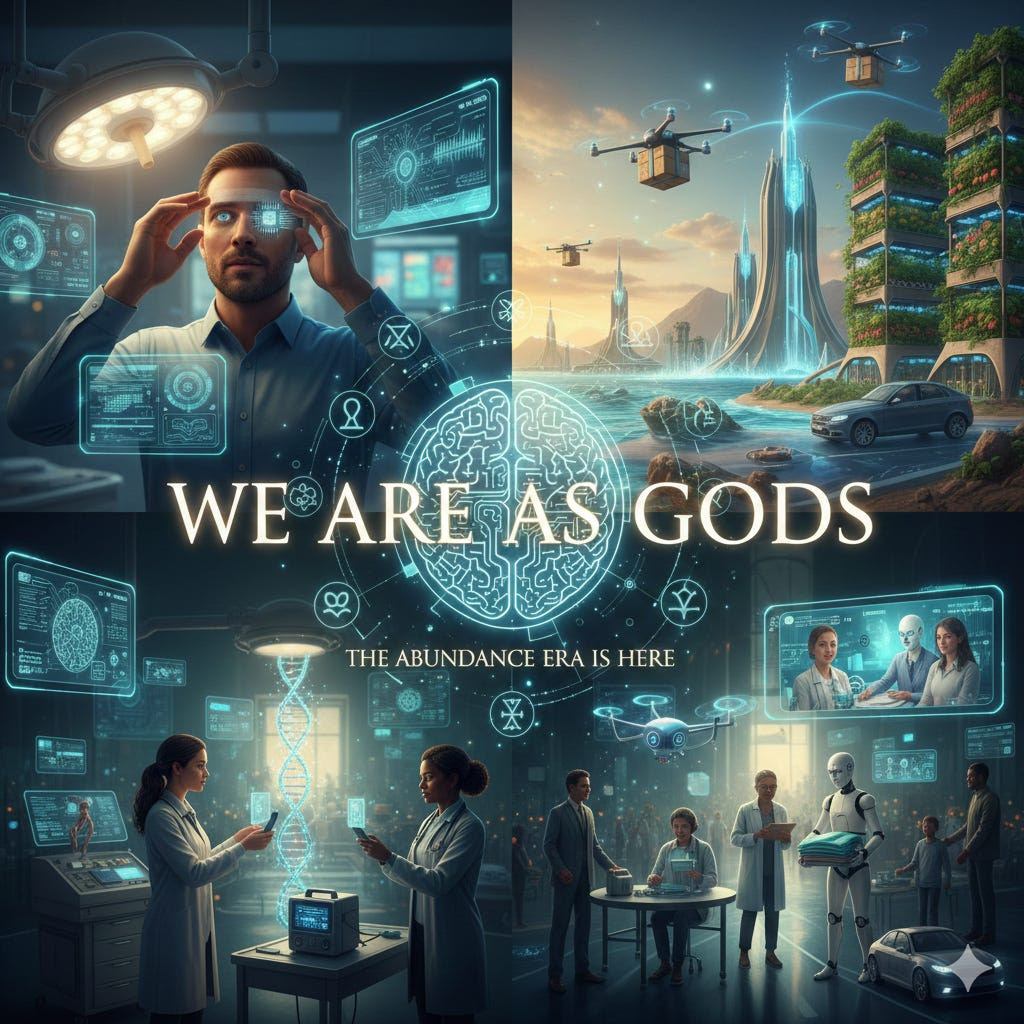
In 1968, Stewart Brand wrote those words in the first edition of the Whole Earth Catalog. He was talking about technology, and it was a tall order. Consider what it would actually take to match the gods. Creation ex nihilo: the creation of something from nothing. That feat is reserved. Only supreme deities need apply. Yahweh pulled it off. So did Brahma, Atum, Pangu. The ability to drag light, land, and life out of the void. Or omniscience – the ability to know all things. Omnipresence – the ability to exist everywhere at once. “Praecognitio” – Latin for the power to foretell the future. Shape-shifting. Resurrection. The power to heal the sick, control the weather, and part seas. If you count the miracles in the Old Testament alone, you get 83 supernatural acts divided into ten categories: Creation, Provision, Nature, Healing, Resurrection, Judgment, Protection, Prophecy, Communication, and Victory in Battle. That’s a lot of miracles.
And in 1968, when Brand made his proclamation, we weren’t quite there. We were gods in training. Mainframe computers the size of oil tankers were the rule. The microchip had just been invented. Color television was a neat trick. NASA managed to orbit the moon with men in a can, but Neil Armstrong’s small step was still a year away. We were not gods. Not yet. But what nobody expected… we were very fast learners.
The Miracle Inventory
Let me show you something. If you measure modern technology against the Old Testament’s miracle categories, here’s what you might find:
CREATION MIRACLES
Synthetic biology creates new forms of life or modifies existing ones. CRISPR edits genes with precision. 3D printing brings matter into being layer by layer: literally building something from almost nothing. Generative AI creates virtual worlds populated by self-directed agents capable of forming economies, religions, and societies.
We create life. We create worlds. We create intelligence.
PROVISION MIRACLES
Vertical farming produces food with 95% less water and 99% less land than traditional agriculture. Desalination turns seawater into drinking water at scale. Lab-grown meat provides protein without slaughter. Solar-powered systems provide clean water, cooking, and sustainable protein even in deserts. Drones deliver meals and medicine where supply chains fail.
The miracle of provision—feeding multitudes, turning scarcity into Abundance—is no longer metaphor. It’s operational.
HEALING MIRACLES
Gene therapy cures disease at the genetic level. Stem cells repair what injury destroys. Telemedicine enables remote diagnosis and treatment. Advanced diagnostics detect disease before symptoms appear – often catching seven out of the top ten causes of death early enough to intervene. AI-powered drug discovery accelerates cures for cancer and rare genetic disorders.
The blind see. The paralyzed walk. The dying are healed.
RESURRECTION MIRACLES
Cryonics preserves the dead in hope of future revival. Stem cells create new organs. Organ perfusion technology keeps donated organs viable for days instead of hours. CPR and drone-delivered defibrillators revive people in cardiac arrest.
We raise the dead. Maybe not permanently. Not yet. But we’re getting there.
The list goes on. And on. And on.
In 1968, when Stewart Brand made his proclamation, these capabilities were fantasy. Today, they’re infrastructure. Miracles have become utilities. We are, by any reasonable definition, gods.
Why We Don’t Feel Divine
So, if we’re literally walking the Earth in an age of miracles, why don’t we feel like gods?
The answer lies in how our brains process novelty – or more accurately, fail to process it.
In the 1980s, Northwestern University cognitive scientist Dedre Gentner ran experiments asking people questions like: “How is a solar system like an atom?”
Most people answered: “Electrons orbit the nucleus like planets orbit the sun.”
Gentner discovered something profound about how the mind works: a process she called structure-mapping. To understand the unfamiliar, humans don’t just make surface comparisons. We map deep relational similarities between domains. We use analogies as cognitive infrastructure.
The brain to a computer. The internet to a web. Genes to code. The universe to a network.
Analogy is how we compress novelty into familiarity. It’s how we make sense of the world when it starts changing faster than we can keep up.
But here’s the problem: Our comparison machinery has run out of comparisons.
Godlike powers in our pockets? What’s the analogy? Curing blindness with microchips? Resurrecting the dead with defibrillators? Creating life from stem cells?
There are no easy grounds for comparison. Without analogies, we can’t parse the world. The result is cognitive vertigo: the sense that the world is moving faster than we can make sense of it.
And when analogies fail, humans start hunting for deeper patterns—what Carl Jung called archetypes.
The Rise of Archetypal Media. Jung argued that archetypes are universal patterns embedded in humanity’s collective unconscious, primal symbols that evoke powerful reactions across cultures. The Hero. The Shadow. The Great Mother. The Wise Old Man.
In the early twenty-first century, we find ourselves awash in Jungian archetypes. And if you want to track the psychological impact of technological acceleration—the failure of analogy—just count the gods, goddesses, superheroes, and supervillains populating our screens.
Start in 1968. The next decade produced one notable cinematic release: Superman. Television gave us Wonder Woman.
The 1980s saw a step-function increase: ten superhero films and six TV shows.
The 1990s doubled: twenty major releases and nearly as many shows.
Between 2000 and 2010? The numbers tripled: sixty films and thirty television series.
Jung would argue this surge is an unconscious response to the psychic destabilization brought on by radical acceleration in human potential. With each technological leap, we need new symbols and myths to anchor our understanding of our growing power.
Archetypes provide narrative coherence and moral clarity. As Spider-Man says: “With great power comes great responsibility.”
We live in a world of abundant archetypes because we live in a world of abundant miracles.
The Information Apocalypse
There’s another reason we don’t feel divine: information overload.
In 3000 BCE, if you measured all the data in the world—papyrus scrolls, clay tablets, the works—you’d total about one gigabyte. The equivalent of 4,000 books.
In 2012, when we published Abundance, the world produced 2.8 zettabytes of data. A zettabyte is a trillion gigabytes. That’s 4,000 trillion books.
By 2025? 181 zettabytes. We don’t have an analogy for that number. And that’s the point. Information impacts the nervous system, and we’re living through the biggest information surge in history. The result is a mismatch between the data storm outside and the prediction engine inside. Our ancient brains don’t have the bandwidth, and our imagination has been hijacked by the apocalypse.
No wonder we don’t feel divine.
The Miracles in Your Pocket. Let’s bring this home. You carry miracle technology in your jeans and handbag. You can summon a chariot of the gods disguised as an Uber with a finger tap. You can conjure a feast via Uber Eats with another.
You have answers to nearly every question in seconds—omniscience on demand.
You can see anyone, anywhere, anytime through video calls—omnipresence as a feature, not a bug.
Translation. Navigation. Simulation. Creation. Communication. It’s all at your fingertips.
The grandiosity of “omnipresence” and “omniscience” has been replaced by the prosaic “Zoom” and “Google,” but the underlying superpowers are the same.
These divine powers are everywhere and everywhen.
In 2012, we predicted a future that included autonomous cars, flying cars, delivery drones, and humanoid robots. It sounded like science fiction.
Today? Over 30 autonomous car companies are operational. Waymo operates robotaxis with zero safety drivers in San Francisco, Phoenix, and Los Angeles. Tesla Full Self-Driving has over one million users.
Flying car companies—eVTOL vehicles—are conducting commercial test flights in Dubai, Los Angeles, and Singapore. Joby Aviation expects to launch commercial operations offering 15-minute flights from LAX to downtown LA (versus 60-90 minutes by car).
Nearly every major retailer has robots running their warehouses. Zipline makes thousands of drone deliveries every day, transporting lifesaving medicines and saving tens of thousands of lives in the process.
Humanoid robots? Google “Tesla Optimus.” You’ll find videos of robots folding clothing, serving drinks, and holding yoga poses.
We’ve gone from hard-to-believe stories to commercial operations in just over a decade.
The Survival Guide for the Age of Abundance
Here’s the thing: Stewart Brand was right. We are as gods. But he left out the hard part. We have to get good at it.
Because the same exponential forces that gave us godlike powers are also overwhelming our nervous systems, hijacking our attention, and triggering bias cascades that blind us to miracles.
Our capabilities have far outstripped our wisdom.
As Ray Kurzweil writes in his endorsement of We Are as Gods:
“Peter Diamandis and Steven Kotler show that while exponential technologies deliver the capability for radical abundance, the real challenge lies in upgrading our consciousness to match our accelerating power. This is more than a survival guide—it’s a manual for optimizing our destiny.”
That’s the paradox. We have the power to cure blindness, create life, and command machines with our thoughts.
But we’re still running Stone Age prediction software in our heads. Our ancient brains don’t have the bandwidth to process miracles at scale.
So we feel anxious instead of abundant. Overwhelmed instead of empowered. Burned out instead of divine.
The solution isn’t less power. It’s a consciousness upgrade.
The Abundance era has arrived. The miracles are here. The blind can see. The paralyzed can walk. We create life from stem cells and resurrect the dead with technology. But without upgrading our consciousness to match our godlike capabilities, we’ll miss it entirely. We’ll keep doom scrolling through the apocalypse, blind to the fact that we’re living through the most extraordinary transformation in human history.
The Choice
You have a choice. You can keep seeing the world through the lens of negativity bias, confirmation bias, and cognitive overload – where every headline is a disaster and every change feels like a threat. Or you can update your operating system. You can learn to see the miracles you’re living through. You can train your brain to recognize Abundance even when it’s wrapped in disruption.
You can, in Stewart Brand’s words, get good at being gods.
The tools are here. The data is clear. The miracles are multiplying. The only question is: Will you see them?
Eric Schmidt, former CEO of Google, put it this way:
“Diamandis and Kotler’s bestseller Abundance helped shift the global conversation from fear to possibility. Now, We Are as Gods reveals that the forces they predicted—AI, clean energy, digital biology—are scaling at a pace few could imagine. This book argues persuasively that the Abundance era has arrived and challenges leaders to use these capabilities responsibly and ambitiously.”
The Abundance era has arrived. The blind can see. The paralyzed can walk. We create worlds with code and life with CRISPR.
We are as gods. The question is: Are you ready to get good at it?
It is Babel all over again. Is it any wonder why Jesus has to return to restore righteousness. Be prepared for what is next on God’s agenda for planet earth go to http://www.millennialkingdom.net
 LIVING ETERNAL NOW