Jennifer Lahl, Founder and President of the Center for Bioethics & Culture summed up the battle — transgenderism isn’t simply a political or cultural attack but one that is satanic in its origins.
“I don’t believe in transgenderism,” she said. “I think that’s a lie from the devil.”
Jeff Myers, Ph.D., the president of Summit Ministries and co-author of a recent e-book with Showalter, titled Exposing The Gender Lie, said Christians must first acknowledge the urgency of the issue and the threat it poses.
“We realized we can’t be silent on the issue of gender ideology because it is an attack on the very idea of truth itself,” said Myers.
He said he’s “very concerned” about transgenderism and pointed to some 6,500 catalogued biological differences between males and females.
“The idea that you can be a boy and become a girl is a lie; it is a lie about biology and it is a lie about personhood,” he said.
Myers pointed to the teaching of the postmodern view that words are reality — a teaching that stretches back nearly three decades, when university students were being taught that no objective reality exists, only “knowable perceptions.”
“So instead of saying people should seek the truth, now people say you should ‘speak your truth,” he explained. “So if words have no relation to reality, then words like ‘male’ and ‘female’ don’t matter anymore.”
That application, said Myers, underpins the entire ideology of transgenderism, which “twists language” to threaten the livelihoods of those whose very job is to communicate facts and data.
“You’re a journalist, you’ll get fired if you don’t do this,” he said. “If you refer to biological men who identify as women as transgender women, you must use that terminology.
“If you’re in the corporate world and don’t do it, you’ll be fired.”
God’s love for us should be the motivation that drives our life. Paul was able to say that the love of Christ controlled him, and other believers, and he gave us the reason why it did.
“For the love of Christ controls us because we have concluded this: that one has died for all … and he died for all, that those who live might no longer live for themselves but for him who for their sake died and was raised.
Let me add the other major reason: Jesus made it possible for our Heavenly Father to send the Holy Spirit to indwell our Spirit to be our counsellor, teacher, and comforter. The Holy Spirit produces the fruit of the Spirit in our lives: love, joy, peace, patience, faithfulness, gentleness, goodness, kindness, and self-control (Galatians 5:22). He also provides all nine gifts of the Spirit for ministry.
“God also bore witness by signs and wonders and various miracles and by gifts of the Holy Spirit distributed according to his will.” Hebrews 2:4
“Now there are varieties of gifts, but the same Spirit; and there are varieties of service, but the same Lord; and there are varieties of activities, but it is the same God who empowers them all in everyone. To each is given the manifestation of the Spirit for the common good. For to one is given through the Spirit the utterance of wisdom, and to another the utterance of knowledge according to the same Spirit, to another faith by the same Spirit, to another gifts of healing by the one Spirit, to another the working of miracles, to another prophecy, to another the ability to distinguish between spirits, to another various kinds of tongues, to another the interpretation of tongues. All these are empowered by one and the same Spirit, who apportions to each one individually as he wills.” 1 Corinthians 12:4-11
If you do not know the truth about God’s love for you, then you are missing a single most powerful force that has driven every man and woman of God who has ever walked this planet. When you realize how much God loves you, you will never lack for motivation to serve him with all your heart.
“Beloved, let us love one another, for love is from God, and whoever loves has been born of God and knows God. Anyone who does not love does not know God, because God is love. In this, the love of God was made manifest among us, that God sent his only Son into the world so that we might live through him.” 1 John 4:7-9
Note what Paul prays that our Heavenly Father will provide for us: that the Holy Spirit will enable us to comprehend the breadth, length, height, and depth of the love of Christ so that we are filled with the fullness of God.
“He (Heavenly Father) may grant you to be strengthened with power through His Spirit in your inner being, so that Christ may dwell in your hearts through faith—that you, being rooted and grounded in love, may have the strength to comprehend with all the saints what is the breadth and length and height and depth, and to know the love of Christ that surpasses knowledge, that you may be filled with all the fullness of God.“
Paul understood this when he prayed this prayer for all the believers. Then they would be filled up to all the fullness of God so that the Spirit would work in them to do exceedingly abundantly beyond all that they had ever asked or imagined. Of all the doctrines described in God’s Word, if you miss the doctrine of love, you have missed God.
Mike Signorelli, pastor of V1 Church in New York City, recently told CBN’s Faithwire about his deliverance efforts in the video below. He responds to critics’ questions and explores what it means to achieve spiritual healing.
“The word ‘deliverance’ is not in the Bible; it’s a newer word,” Signorelli said. “You’re not going to find a deliverance ministry in the Bible. What you will find is Jesus casting out demons, you’re going to find His disciples casting out demons, you’re going to find Him commissioning 70 people to go do it.”
While some people’s only frame of reference for evil is Hollywood’s presentation of intense exorcism — a phenomenon many faith leaders note is rare — Signorelli said these spiritual issues might present themselves in starkly different ways.
Possession indicates ownership of sorts, though oppression is more of a spiritual pressure exerted on a person, not necessarily indicative of the types of full spiritual control seen in films like “The Exorcist.”
“In the New Testament, where someone has a demon, the Greek word [is] actually ‘demonized,’ which really means ‘to be under the influence of a demon,’” he said. “And so it helps to understand the difference between oppression and possession.”
Watch Signorelli explain these concepts. you will be glad you did:
The human genome is much more complex than anyone imagined. In fact, the level of complexity argues directly against any sort of evolutionary origin for the code that makes us. This episode features Dr Rob Carter and Gary Bates. This a must-watch video, just 19 minutes, particularly for young people to show that there is a master designer that has produced this incomprehensible complex universe. To my mind, no rational person could look at this video and think we were created by mutation and natural selection. And no one who is intellectually honest could do anything but be in awe of the genius of God.
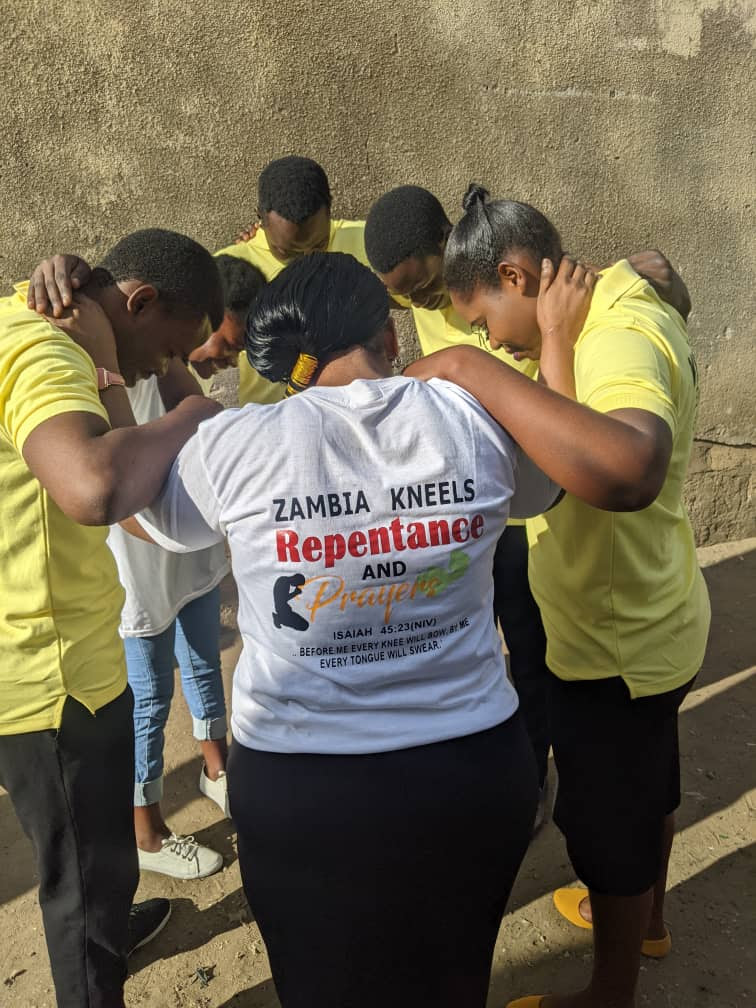
Without repentance there is no forgiveness of sins so it is encouraging to see Repentance Movements being established and thriving in African nations. The following is a report on Zambia but it is just one of the countries in Africa where God is moving powerfully.
Repentance preaching is breaking out in Africa! Old pagan strongholds and old, tired religious traditions without the Holy Spirit are giving way to The Way, inspired by the youth!
The latest example is in Zambia. They are in the midst of a 4 day youth Zambia Kneels conference. Please take two minutes to watch this noisy but sincere repentance of these young people in the video below; they’re not playing church; as they each repent and come into His Kingdom, His Body is growing:
Every Thursday, God willing, Jeff Daly and the National Repentance group hold a 2 hour Africa Kneels Zoom meeting for pastors and worship leaders in Africa. Every session includes private time with the Holy Spirit to consider an old sin pattern that each person wants to remove, to cleanse, to be that much more ready for His soon return as our Bridegroom.
Instead of sitting passively in a church building week after week, God calls us to experience, and then preach, by our new Godly conduct, repentance, and the remission of sins to bring in new disciples. This follows the command of the Risen Yeshua/ Jesus Christ. One of His last words before His ascension:
” Thus it is written, and thus it was necessary for the Christ to suffer and to rise from the dead the third day, and that REPENTANCE and remission of sins should be preached in His name to all nations, beginning at Jerusalem.” Luke 24: 46-47
It is no coincidence that the Dead Sea Scrolls were discovered in 1947 just prior to Israel being re-established as a nation in 1947. The Dead Sea Scrolls provided proof of Israel’s right to the land they were about to occupy and what is ahead for God’s nation. Jesus will eventually rule all the nations of the world from a renewed expanded Jerusalem. Israel will be the prime nation of the world during Jesus’ Millennium Kingdom.
There is one prophecy in the Dead Sea Scrolls that explains all of history from Noah to Jesus to the Tribulation and even to the Millennial Kingdom. Known as Enoch’s 10 Weeks Prophecy (200 BC), it is amazing in its accuracy about all the seasons of man’s history from the antediluvian period, the flood, the founding of Israel to Jesus to where we are today to the Tribulation. Whilst the Book of Enoch is not in the canon of Scripture the 10 Weeks Prophecy is accurate to date so we need to look at what it says about the age we’re in today and the coming Tribulation. Watch this Nelson Walters video to find out.
The Apostle Paul brought his intellect to bear against the best-of-the-best philosophers and religious practitioners of his day on Mars Hill in Act 17. At that time, Athens was the religious center of Greece and was marinating in every faith and philosophy that existed.
When he was delivering his address to that diverse audience on Mars Hill, Paul highlighted a few things all those in attendance had in common — their shared humanity and inherent religious nature — but then he took a hard right turn into the particulars of the Christian faith that makes it distinct from all others.
One important thing that the assertion “all religions are the same” ignores is the key distinction between universals and particulars. Universals are typically said to be abstract whereas particulars are concrete; i.e., a universal is something particulars have in common, but that commonality in no way means all particulars are the same thing.
No one does a better job of humorously pointing this out where religion is concerned than the English writer and poet Steve Turner in his short work called “Creed”:
We believe that all religions are basically the same. At least the one that we read was. They all believe in love and goodness. They only differ on matters of Creation, Sin, Heaven, Hell, God, and Salvation.
And, of course, the central difference in all religions that Paul highlighted to the Athenians was Christ Himself, which is exactly how you and I should deal with the “all religions are the same” argument as well.
If there was ever a time for a Christian leader to declare in a speech that we all believe the same thing and that every road leads to God, it was then. But that’s not what Paul did.
Why and how Christianity is distinct
Think about every religion you know without Christianity. The vast majority, if not all, take an approach to our human predicament that is either epistemic, pragmatic, or existential, with some blending two or all three.
The epistemic path is one that says, “If I just learn something, then I’ll be better.” For example, Buddhism has its four noble truths, its 8-fold path to enlightenment, etc. To the epistemic, knowledge leads to salvation.
The pragmatic approach says, “If I just do something, then I’ll be OK.” Nearly every religion other than Christianity follows this works-based plan, with a good example being Islam and its concept of the deeds scale. The pragmatist earns their salvation by the sweat of their brow.
The existentialist thinks, “If I just experience something, then I’ll be fine.” Those involved in spiritist and/or new-age faiths always look for a vision, a breakthrough, or some spiritual event that moves them from their current life to one that’s better.
But Christianity is different. It is not epistemic, pragmatic, or existential, but instead is something else.
The Christian faith is ontological.
Christianity rests completely on a Person — Jesus Christ. The prophets of other religions admit their faith does not depend on them to be true, i.e., you can take them out of the equation and the religion remains intact.
But if you take Christ out of Christianity, it completely collapses. Moreover, Christianity subsumes the approaches found in other religions and pours them all into the person of Christ.
As an example, the epistemic gains knowledge through words. And what do we read at the beginning of John’s Gospel?
“In the beginning was the Word, and the Word was with God, and the Word was God. And the Word became flesh, and dwelt among us, and we saw His glory, glory as of the only begotten from the Father, full of grace and truth” (John 1:1, 14). Jesus is the knowledge of God personified.
With respect to pragmatism and a works-based approach, Jesus was once asked: “What shall we do, so that we may work the works [plural] of God?” Jesus’ answer to them was, “This is the work [singular] of God, that you believe in Him whom He has sent” (John 6:28-29).
Lastly, existentialism concerns itself with experience and life. To that end, Jesus said, “I have come that they might have life and have it abundantly … I am the way, and the truth, and the life; no one comes to the Father but through Me” (John 10:10; 14:6).
Christianity diverges from all other religions because it is built upon the person of Christ, who, in His Person, embodies all approaches to spiritual truth.
Paul acknowledged this unique and ontological nature of Christianity when he spoke on Mars Hill and also when he wrote, “for I know whom [not what] I have believed … For God, who said, “Light shall shine out of darkness,” is the One who has shone in our hearts to give the Light of the knowledge of the glory of God in the face of Christ” (2 Tim. 1:12; 2 Cor. 4:6).
In other words, Christianity is Jesus. Period.
This post was taken from a great article by Robin Schumacher CP VOICES | MONDAY, APRIL 03, 2023 “All religions are the same and other lies”
The ‘no evidence for God‘ claim is an interesting one. It often works to frame the discussion in such a way that only creationists have a burden of proof. It allows the unbeliever the comfortable position of the skeptic: they get to poke holes in our case without ever having to make a case for anything themselves. Plus, skeptics regularly demand airtight arguments practically anyone would have to accept before they would believe in God (Agnosticism). As such, we almost certainly won’t convince them. But then that supposedly means that our faith in God isn’t reasonable. The game is rigged from the start. Heads, the skeptic wins; tails, we lose.
How should we respond?
CMI suggests you flip the script. Instead of you presenting a case for God, make them present what they think a case for God should look like. The simplest way to do this is to ask them: ‘What sort of evidence would you expect God to give?’
Many skeptics will say things like, ‘Well, none of the arguments I’ve seen convince me.’ Or they may just continue to demand that you convince them. Don’t let them off the hook. Hold their feet to the fire. Say something like: ‘Well, if I don’t know what would convince you, why should I bother trying? How do I know that anything I might say wouldn’t just fall on deaf ears?’
You want them to give you something concrete. But, failing that, your goal is to make them feel the irresponsible dogmatism of their skepticism. If skeptics hate anything, it’s looking like a gullible dogmatist. If they continue to avoid the question then walk away. The Holy Spirit may prompt you to pray for them but otherwise do not waste more time.
But if they do give you something concrete, then play the skeptic. What you want to do is to show them that even the case they expect would convince them has the same sort of holes they think exist in the case we make for God exists.
EXAMPLES:
Many skeptics will say things like: ‘Well! if I saw an amputee healed in response to prayer, that would convince me.’ Response: ‘Really? How do you know God would’ve done it?’ ‘The prayer’, they’ll respond. Your response: ‘That could just be a coincidence. Besides, it’s just a one-off event. What if it never gets repeated?That doesn’t sound scientific. Plus, how do you know something other than God didn’t step in to heal the amputee? Maybe aliens did it! At least we know aliens can exist, since we exist. But God? You’re just linking events that have no demonstrable link and labelling it with ‘God did it’ to cover for your lack of a scientific explanation.’ This sort of response is a real stinger because it’s exactly how most skeptics respond to cosmological and design arguments for God.
Some of them might say, ‘Well, if God appeared to me right here and said, “Here I am, believe in me!” then I would.’ Response: ‘So, you’d bow the knee at a vision that may very well just be a dream? How would you know for sure you didn’t hallucinate?’
Some might say, ‘If the stars read “God exists. Worship him”, I would believe.’ Response: ‘That would only be useful to people who knew the language the message was written in. Nevertheless, how do you know the stars don’t say that in a language you’ve never encountered? At any rate, why not other beings that want to deceive us? It’s not something we could say that only God could do, so why should we trust a message in the sky with practically no context? Besides, why should you expect God to arrange the stars just to sate your curiosity about his existence? Is that really reasonable to expect of God? Are we the centre of his universe?’
With such responses, you’re not trying to show that God doesn’t exist. Rather, you’re trying to show that we can always come up with reasons to doubt that will sound plausible to someone, no matter what evidence is put forward. And if they say, ‘Well, that’s what would convince me.’ Respond with: ‘So what? You can’t guarantee that it would convince every rational person. You didn’t say, “There’s no evidence for God that convinces me”; you said, “There’s no evidence for God”, period. If all you’re aiming to do is convince yourself, how can anyone else be sure that you’re really looking for the truth? And this isn’t just about trusting you. This is also about whether you’re even competent to look for the truth about God.’
At this point, they might start saying things like, ‘Well, all I can do is look at the evidence and do my best to figure out the truth. You have to do that for yourself, too.’ At which point you can respond with: ‘Exactly! That’s all I’m trying to do, too. But I genuinely think that things like the following are best explained by the existence of God (click on the links for a detailed explanation of each).
‘I see those things and more as evidence for God. I’m not saying that other explanations can’t be offered, or even that smart and sane people can’t disagree with me. Maybe you don’t find these to be conclusive proofs, but it’s a gross overstatement to say that they don’t qualify as evidence. Furthermore, when I look at them as honestly and critically as I can, I still think God is the best explanation for them. But when you say, ‘there’s no evidence for God’, you seem to imply I’m less than rational and/or honest when I say that. Is that fair?’
After all, that’s the real effect of this ‘no evidence for God’ claim. If they hold it consistently, they have to admit that you’re essentially irrational just for being a theist. But hopefully, by this point, they feel the unjustified dogmatism of their view, and walked it back a bit to admit that theists aren’t necessarily failing to reason properly when they believe in God. If you manage to do that, then you’ve won a huge victory. And that might be a good place to end the discussion for the time being. People often need time to process these sorts of things, so bombarding them with everything in our arsenal all at once is just unhelpful. For a start, they are probably not ready to hear most of it with an open mind. Rather, we try to deal with the person where they are at and try to nudge them a little bit in the right direction.
This information was assembled by Shaun Doyle of Creation Ministries International (CMI) in answer to the many queries CMI receives on how to answer skeptics’ arguments. http://www.creation.com
In relation to sex and gender, regardless of our linguistic machinations, our sex as male or female is stamped on nearly every cell of the body. No matter what linguistic tools are employed to achieve this end, it is a vain effort that will fail. Changing sex is impossible. No amount of chemical intervention or surgery can change a person’s sex. The XX chromosomes remain XX. The XY chromosomes remain XY.
But there is also damage done to language itself when we begin to refer to biological males or females by opposite-sex pronouns and act as if, by our words, we can change reality. The twisting of language is a deadly serious problem.
At base, the splitting of sex and gender is a distortion of language to change how people see reality. Behind the distortion is a belief that no truths about the world can be known with certainty. Rather, truth is up to the individual. In the United States, a majority now believes this. If nothing about reality is knowable, then no meaningful difference exists between male and female (or truth or a lie, or justice or injustice, or any other distinction, for that matter). Words bear no clearly identifiable relationship to anything knowable. At root, the gender ideology battle is a battle over the very meaning of words. It is a twisting of language to change how people see the world. The change from what we use to label transsexual to transgender was so deceptive I believe it was satanically driven. The shift was cunning and one that was intended to mainstream transgenderism and even apply it to children.
The prefix “trans” means “to change,” and the individuals who experienced some kind of body dysmorphia that manifested in confusion about one’s sex were, until recent years, known as “transsexuals.” For many, the word connotes something extremely odd — perhaps a sexual fetish. But with the introduction of the idea that gender is malleable, people were led to question whether the distinction between male and female even exists or matters.
Among the most pernicious aspects of twisting language is that people are required, if they want to be socially acceptable, to participate in lies. It is an undoing of the very idea that the words we use refer to anything real.
The gender ideology movement insists that for humans to be free to pursue their fullest self-interest, reality itself must be deconstructed. God has given them up to depraved minds.
“And since they did not see fit to acknowledge God, God gave them up to a debased mind to do what ought not to be done.” Romans 1:28
Adapted from article Nashville massacre proves twisting language and reality has deadly consequences By Brandon Showalter and Jeff Myers, Op-ed contributor Christian Post, April 10th 2023
When we hear the word ‘hospitality’ we often think of providing food, but for many of us, particularly males, we are not equipped or inclined to do it.
A more constructive view of hospitality is to see it as intentionally making space for others. The heart of hospitality is being welcoming and attentive to other people. This can, in itself, be something we may need to learn, but thought of in this way, hospitality can demonstrate God’s attitude towards others through the way we are. I know of one senior Christian leader, who as a young man from a secular background, was welcomed warmly by Christians into their home. Their hospitality towards him not only made a deep impression on him but actually opened up the start of his Christian journey.
Monasteries developed in the so-called Dark & Middle Ages and many offered shelter to travellers. By seeking to meet the needs of strangers they believed they were offering hospitality to Jesus himself (Matthew 25:40). This view reframes our simple acts of kindness, giving them great dignity. It transforms the value we put on performing menial, ordinary actions and it alerts us to the presence of God in others, particularly his presence with us in the shape of those in need.
Making the other person the centre of our attention can only happen when we ourselves withdraw and make space – either literally giving time to others, or metaphorically by focusing on another person, removing ourselves from the centre of attention.
Hospitality involves welcoming and attending to others. Most of us, even from a very early age, are naturally hospitable: children spontaneously chat with other children, making contact quite unselfconsciously. The desire to be hospitable carries its own reward in terms of friendship, even though, at times, it may be rejected. Whether our offer of hospitality is accepted or not, we are still cultivating God’s presence: Jesus liked a hospitable atmosphere and he is still attracted to the company of hospitable people.
Hospitality should come to characterise our churches and our lives. Hospitality cannot be formulaic and it doesn’t work if we try to imitate other people’s gifts – the important thing is that we welcome others in whatever way comes naturally to us. This will often be rewarding for us because we have a sense of fulfilment whenever we use our God-given gifts. Hospitality is best done when it expresses the genuine desire to serve others in our own unique way. It is less attractive when it is done as a dutiful exercise in self-sacrifice.
Once we discover our natural hospitality niche we experience for ourselves that it genuinely is more blessed to give than to receive (Acts 20:35). We can, of course, put on an act of being hospitable, simply to prove to ourselves we are good people, but genuine hospitality will always focus on the other person, not on the part we ourselves play.
Practising hospitality can have a further beneficial side effect: it enables us to become better people, despite our all-too-obvious imperfections. Acting hospitably can increase our sense of self-worth, as we often find we like ourselves better when we act hospitably. Furthermore, hospitality takes us beyond any tendency to introspection, since making someone else the centre of our attention helps us be less obsessed with ourselves. As we move away from self-absorption, the more likeable we become to other people and, again, their response to us will have a beneficial effect on our sense of self-esteem. Hospitality creates this virtuous circle.
The writer to the Hebrews encouraged us to be hospitable to strangers, holding out the tantalising possibility that we might be entertaining angels though being unaware of the fact (Hebrews 13:2). This injunction is in keeping with a long tradition among Semitic peoples, who count it a duty to provide hospitality to passers-by. The fact that we might, unknowingly, be entertaining a messenger of God suggests we might miss out on all that God has for us if we neglect hospitality. What is more, hospitality is a way of imitating God, as hospitality is the heart of the Gospel.
Once we were outsiders, but God shows his love towards us by inviting us into his inner circle; an act of pure hospitality. The parable of the prodigal son continues to be one of the most well-known stories told by Jesus. It demonstrates that motivated by (undeserved) kindness, the Father is truly hospitable, welcoming us into his presence with outstretched arms. even despite our bad choices (Luke 15:20). He has made it possible for us to become part of his family and continues to include us, forgiving our faults, often on a daily basis.
Having freely received such unmerited kindness our response is to express that same kind welcome to others so that hospitality is a way in which our gratitude naturally finds an outlet. In this way, our experience of God’s grace gets passed on to others. We see a similar dynamic in our everyday encounters: if when driving, someone lets you out of a side road you are then yourself more inclined to do the same for other drivers. How much greater than this is the debt of love we owe to the Father?
Hospitality is the natural outflow of our having experienced the Gospel. Grace causes us to be gracious. Once we begin to view situations or decisions through the lens of hospitality we become aware that it is everywhere in the Bible. It pervades the Scriptures and if we keep the word hospitality in mind when reading the Bible we become aware that different facets of hospitality are encapsulated in a variety of biblical stories and teachings. The main one was spoken by Jesus at the Final Judgement.
“Depart from me, you cursed, into the eternal fire prepared for the devil and his angels. For I was hungry and you gave me no food, I was thirsty and you gave me no drink, I was a stranger and you did not welcome me, naked and you did not clothe me, sick and in prison and you did not visit me.’ Then they also will answer, saying, ‘Lord, when did we see you hungry or thirsty or a stranger or naked or sick or in prison, and did not minister to you?’ Then he will answer them, saying, ‘Truly, I say to you, as you did not do it to one of the least of these, you did not do it to me.’ And these will go away into eternal punishment, but the righteous into eternal life.”




 LIVING ETERNAL NOW