AI, PROSPERITY AND JOBS

Prosperity in the USA is, remarkably, broadening. American Enterprise Institute (AEI) finds 31% of Americans are now upper middle class, up from 10% in 1979, and its share of income doubled. Also tech job openings have doubled since mid-2023 to a three-year high, quietly refuting the obituaries for software engineering. AEI finds that the “core” middle class has shrunk, but only because more families have become upper-middle class over time. AEI finds that the “core” middle class has shrunk—but so too has the share of Americans with income too low to reach the middle class. The shrinking core middle class is due to a booming upper-middle class. Only the relatively worse-off parts of the middle class have shrunk—and by less than the upper-middle class has grown.

The US jobs report on Friday was surprisingly strong. That’s not the only part of the job market that’s doing better than expected.

My recent post Generative AI is About to Cause Humanity to Fork is one of my most looked at posts. It is about an article by Peter Diamandis of YouTube Metatrends and Moonshots fame. Let me quote the opening paras of his article “Humanity is About to Fork”.

The choices you make in the next five years will determine which branch of the human story you inhabit. Here’s what’s coming, and how to position yourself on the right side of every fork. Peter addresses five major splits that will cleave humanity into groups with dramatically different futures, capabilities, and lifespans: Fork 1. Creators versus Consumers, 2. Fork 2. Longevity Escape Velocity, Fork 3. Brain Computer Interface, Fork 4. Earth versus The Stars, Fork 5. Digital Consciousness (i.e. uploads). Peter then explores the bigger picture and how he intends to face each of these forks. It is a fascinating article. If you have not seen it I suggest you take a look.

Satan has done a devastating job of changing the world’s understanding of the true history of the Cosmos. He has used people like Charles Darwin to convince the world that it did not need a Creator. A Big Bang and Natural Selection is all you need.

When you look at the complex laws that govern the universe and just the complexity of the human body it is difficult to comprehend how scientists cling to the theory of evolution. Fortunately, many scientists like Dr Dean Kenyon, former Professor of Biochemistry at Stanford University and in 1969 was co-author of the book Biochemical Predestination which was adopted in the USA as a graduate textbook and was regarded as the seminal work on the naturalistic formation of living cells from chemicals of the earth. By the 1980’s Kenyon came to the conclusion that intelligent design was needed for life’s beginning. He said the discovery of DNA and the electron microscope rang the death knell of evolution. Why? Because DNA is complex information which cannot be made from matter or energy. Its only source in intelligence of the highest order. Also, the electron microscope revealed that inside every cell there are complex machines to make the chemicals the body needs and transport devices to move them around and they are all controlled by the information on the DNA . There is no way this can evolve by random chance. It is nonsense. Go to http://www.creation.com and http://www.answersingenesis.org for more information on creation versus evolution.

Check out this short video by Dr Dean Kenyon on intelligentdesign.

GOD, AI AND THE END OF HISTORY

I love John Lennox. He is a gem, a gift to the Christian world of teaching.

This video is Professor John Lennox on the subject of God, AI, and the end of history. Largely it is about understanding the book of Revelation in an age of intelligent machines. For those that do not have time to watch the video I have reproduced most of the content below.

“I’m your host, Dr. Peter Saunders. I’m the chief executive of ICMDA, which is the International Christian Medical and Dental Association. And this webinar is brought to you tonight in combination with the Forum of Christian Leaders as well. ICMDA brings together about 60,000 Christian doctors and dentists from over 100 affiliated movements.

So John, it’s a pleasure to have you here. John is professor of mathematics emeritus at Oxford University and fellow in mathematics and philosophy of science at Green Templeton College Oxford. As we know John has debated a number of prominent atheists including Richard Dawkins, Christopher Hitchens and Peter Singer. But tonight we are exploring a question that sits at the intersection of theology, technology, and human identity. How should Christians think about artificial intelligence in the light of scripture? And particularly in the light of the book of Revelation, we live in a moment of extraordinary technological acceleration. AI is now diagnosing disease. Is it shaping economies, influencing behaviour, and increasingly mediating how power is exercised in all spheres? And for many Christians, this raises urgent questions. Are these developments morally neutral tools? Do they echo biblical warnings? Or are we in danger of reading tomorrow’s headlines too quickly into ancient prophecy? So, our guest, Professor John Lennox, has spent decades helping believers think clearly at the interface of science, philosophy, and faith. And in his recent book, God, AI, and the End of History, he brings that same clarity to one of the most understood, misunderstood, and often sensationalized areas of the Bible, the book of Revelation. So our goal tonight is is not speculation, fear, or date setting, but rather it’s discernment, understanding what scripture actually teaches, what AI truly is, and how Christian hope, ethics, and wisdom should shape our response in an age of intelligent machines.

Professor Lennox, thanks so much for for joining us tonight. It’s my pleasure to be with you. So you have debated leading atheists and you’ve written extensively on science and faith. Why did you feel compelled at this stage of your life, at this stage in history, to write about AI and revelation?

Well, some years ago, there was a great deal of discussion on the Genesis claim that human beings are created in the image of God versus the claims of technology to enhance humans by AI to such an extent that we might need to revisit what we meant by a human being. And a conference of Christian leaders was arranged in London to discuss this. And I was asked to give the opening talk on what Genesis taught about human beings. The invitation made me curious to delve into the technology and I saw very rapidly that AI was going to raise some very big questions not only for Christians but for everybody. And that’s how I got started on the book entitled 2084 which appeared in 2020. Now in that book since much of the talk about AI was concerned with the future I began to compare the promises of the transhumanists with biblical teaching about the future. And I pointed out that some of the futuristic AI scenarios envisaged by people like physicist Max Tegmark in his book Life 3.0, I pointed out that they were uncannily parallel to biblical teaching on the future, in particular in the book of Revelation. And this aspect of my book generated a lot of interest. And so I thought that I should try to write something to demystify the book of Revelation and make it accessible and to link it with a book that I had already written on the prophecy of Daniel, a book entitled Against the Flow.

The publishers of my book on Revelation were very enamoured with the bits on the technology and so they wanted it inserted in the title and hence we’ve got this title God AI and the end of history but that has confused many people to think that this is my latest book on artificial intelligence. So, let me clear that up. First of all, Peter, it isn’t. My latest book on AI was published last in 2024, and it’s the updated version of 2084. How AI shapes our future. It’s twice as large as the original book and shows just how much has been happening in those four years. That is my most recent book on AI. This book is an exposition of the book of Revelation, but with a careful eye on technology. And so it really is an exposition of the book of Revelation in an age of intelligent machines. So that’s where it comes from. We’re going to get into the book of Revelation uh fairly shortly, but but uh let’s just think about definitions first of all before we talk about revelation. What is artificial intelligence actually and and what is it not? Well, the first thing to realize that artificial intelligence is artificial. It’s not real. In other words, take the simplest kind of AI system. It is essentially computing and it’s a system designed to do one and only one thing that normally requires human intelligence. So the intelligence is simply the simulation. To use the words of Alan Turing who was the genius that really started computing off and raised these questions during the wartime when he built and solved the problem of the enigma machine. It plays a simulation game and one of the big problems with it is it uses words like intelligence, like machine learning and so on that anthropomorphize what is a mechanical and computing system and make people think that it is conscious. It is not conscious. The genius of God in creating human beings that he has linked intelligence to consciousness. These machines are only intelligent in the sense that they can mimic what normally takes human intelligence. Now there are two sorts. There’s narrow AI, which is the AI that we’re mostly familiar with. And then there’s a more speculative artificial general intelligence. And that is the attempt to create a system that can replicate everything that a human being can do, but do it much faster and do it much more expertly and so on. So that there’s a big push in that direction, but at the same time it’s the side of the whole topic that lends itself to science fiction and a great deal of hype. And one of my reasons for writing Peter was to try and demystify it and say what AI is and what it is not. Now let’s give concrete examples just briefly because medicine is one of the areas that has benefited hugely from narrow AI. Let’s take a system that works very well. We have a large database and in it are X-ray pictures of man lungs exhibiting different lung diseases and they’re labelled by the best experts in that field in the world. Those are put in a database. Let’s say there are a million X-ray pictures in the database. Then an X-ray is taken of your lungs because you’re worried about your breathing. And very quickly, the AI sifts through by using pattern recognition statistical techniques and compares your lung X-ray with the million in the database and very rapidly says you are most likely to be suffering from this particular disease. And as a diagnostic tool, very often this will be much better than you get at your local hospital. Now that is being rolled out over very wild fields of medicine with very great success. So that is one positive example. But just to go on the negative side immediately to show that there’s an ethical problem here. pattern recognition, facial recognition technology is very advanced at the moment. It can pick a terrorist out of a football crowd and is therefore very useful to a police force. But that kind of recognition can be used for intrusive surveillance of a population, perhaps a minority population such as is happening in Sing Jang in China with very horrifying results. So what enables criminals to be recognized which we would say this is positive can be used for controlling populations. So that even narrow AI which is so sophisticated snow that it can recognize a person not simply from the front by their face but from the rear by their gate scan be used to control populations. So immediately we’re straight into the ethical problem and the argument is you give up your privacy and we’ll give you security. So that’s a whole debate in its own right. So That’s an example of um narrow AI and there are many many examples but of course we’re pushing forward very rapidly in putting narrow AI systems together and there is advance on many many fronts and one of the big steps forward has been the introduction of so-called large language models like chat GPT And this year it has taken a quantum leap forward just within a month or so. So that it is quantitatively very different from what has happened before and we can discuss that as we can as we go on. So, artificial intelligence is capable of a huge range of different task and and that’s changing exponentially month by month as we go on. But what is what is AI not capable of doing? Well, of course, negatives are very difficult to quantify and there are several things that it was felt would never been so would never be solved. And one of them in science which is a fascinating question is how do protein structures fold? That was a 50-year-old problem. And the amazing thing is that an English mathematician, a genius, he won the Nobel Prize for it. Deus Hassabis solved the problem so effectively that she was able to work out the folding of over 200 million proteins which is staggering. So what people say one day is impossible turns out to be possible the next day and chat GPT has refined its capacities absolutely amazingly. For example, just recently I was asked to do a film illustrating what Jesus meant in John 11 when he said to the disciples who were scared of going back to Jerusalem because it was suicidal. And Jesus said to them, “Are there not 12 hours in the day? If a person walks in the day, they don’t stumble because they see the light of this world that is the sun. But if they walk at night, they stumble because the light is not in them. In other words, we are not bioluminescent. So I asked GPT, please construct a scenario that would get this across. And what it produced in about 30 seconds was absolutely brilliant and usable. So it then asked me, it said, “Since you want to film this, would you like directions for the cameras?” And it spouted a whole scenario, how many cameras, where they should be situated, and all the rest of it. And this is quite amazing. But what it can’t do, I think it’s important since this is not real intelligence. It’s not conscious. So it’s not aware. So the main thrust here is this. As human beings made in the image of God, we can experience what are called quailia. We can smell the wonderful scent of a rose. We can feel the sea breeze on our faces. We can perceive the beauty of the universe as we look through a telescope. Quailia are unknown to an artificial intelligence. It can have no idea of them. It has no ideas at all because it doesn’t think in the same way as human beings do. And so although AI has been used and is increasingly so to produce some level of robotic companionship, it can never replace, I believe, the fellowship that is possible between human beings. And of course, and we’ll probably talk about this later on, when it comes to relationship with God, of course, AI knows nothing of God. So, as you said, the book of Genesis tells us that human beings are made in the image of God. You’ve alluded to consciousness, sensation. What other uniquely human things will AI never be able to do? Well, the question of values, AI knows nothing about values or right or wrong. And human beings are moral beings made in the image of God. And if I may say so, this is one of the places where the transhumanist vision of using AI to perfect humans and to make them into God’s fails. No utopia can ever be built without facing the problem of human sin and rebellion against God. Those two concepts mean nothing for an artificial intelligence. And so one of the richest kinds of human experience from a Christian perspective is that relationship with God through Christ where we understand that Christ has died for our sins and has taken our guilt away and we can have a relationship with God. AI can never replace it or come near it or know anything about it. Which means, Peter, I think that we need to step up much more in emphasizing these absolutely uniquely positive things about the Christian faith that give human beings dignity because AI is very rapidly reducing human dignity. One of the main areas where this is happening is the area of work. Dario Amado Amade is the CEO of Anthropic, one of these multi-billion dollar companies. and he has written an essay just a week or two ago which is well worth reading warning that possibly within 2 years from now the advances in AI are such that 50% of all white collar jobs will be taken over by artificial intelligence in the medical world in the legal world for example there they set up a test and had a very complicated legal legal brief considered and examined by an AI system and by 16 lawyers, top lawyers. The lawyers got 60% of it right, whereas the AI got 96% of it right. And these things for which lawyers are paid a great deal, conveyancing, setting up contracts, all this kind of thing are now at the stage where they can be reproduced almost instantaneously. One of the most interesting things is an article that appeared in the Times last week by Matt Selman who was writing. He is a software developer and creates apps and he runs an AI company and he came to a realization as a result of the leap forward this year that is at the beginning of February, beginning of this month. He said, “I spoke in English and dictated what I wanted from this particular app.” He said, “I left it and came back a number of hours later and found the thing ready for use. The AI had written thousands of lines of code. It had then set up the app and tested it as a human would do, pressing all the buttons, refining the things that were inadequate and so on. And this is the key thing because up until now most of us have regarded AI as a tool rather than an agent. But AIS are now showing signs of agency in a very restricted but real sense. And he said this particular system was making decisions about how human beings might use this that I’d never thought about. And the thing was perfect. And he said, I suddenly realized I haven’t got a job anymore. And he says, it’s coming to all of you. And we need to really be very realistic about this, Peter. This is more scary than anything for people with all of these jobs. It used to be said a few years ago that if you wanted to keep up with the curve, you went into computer science. But now the coding can be done by the AI system. It can think of the codes and put them in. But this scary agency thing I’d like to say something about because it needs Christians to think very carefully about this that the AI that he was using. He said one of the problems and he gave an example is this. If you feed into the system a very big overarching goal, make money for example, and what the system is dealing with is feeding young people with material in their smartphone. It will investigate all sorts of ways of maximizing not only their attention to keep doom scrolling but also their attachment which is now a major feature. So that it will use all kinds of things that the designers of the AI system itself never thought of including going into the dark world to keep their attention and to make profit. It’s a version of the old story of the AI told to make paper clips and it turns the whole universe into a paperclip sourcing factory and regards humanity as irrelevant and destroys them all. But there’s a serious aspect to that and this is why you have even Nobel Prize winners in this field stepping up and saying that they are scared that they can’t control this stuff. They don’t really know what it’s doing or what’s happening. And that poses a huge problem because the control of it is being vastly outpaced by the developments. So those are some of the things that we need to factor into our thinking.

A SUPERSONIC AI TSUNAMI IS COMING

Elon Musk describes what’s coming as a Supersonic Tsunami of converging exponentials. AI isn’t improving linearly anymore. We’re watching three exponential curves hit their inflection points simultaneously: compute scaling, model capabilities, and infrastructure deployment. When exponentials converge, you don’t get incremental progress. You get phase shifts.

Let me give you the raw numbers that demonstrate just how fast this is moving. What’s happening with AI revenue right now is unprecedented in the history of business. Anthropic hit $14 billion in annualized revenue in February 2026, growing from $1 billion just 14 months earlier. That figure has since surpassed $19 billion, more than doubling from $9 billion at the end of 2025. There is simply no precedent for this in B2B software.

And yet most people do not know who Anthropic is and what they do. Also, to understand what that means: Anthropic’s monthly revenue run rate is now roughly $1.6 billion per month, and it keeps accelerating. Anthropic projects as much as $70 billion in revenue by 2028.

OpenAI reached $25 billion in annualized revenue at the end of February 2026, up from $21.4 billion at year-end 2025, with full-year 2025 revenue coming in at $13.1 billion. Both companies are now valued in the hundreds of billions, Anthropic at $380 billion following its $30 billion Series G. OpenAI’s most recent private round in February 2026 valued it at approximately $730 billion, with an IPO potentially targeting a $1 trillion valuation.

Nvidia’s, Jensen Huang recently finalized a $30 billion investment in OpenAI and a $10 billion investment in Anthropic, and told investors these will likely be Nvidia’s last private investments in either company, because both are heading toward public markets. Think about that: the CEO of Nvidia, who has better visibility into AI infrastructure demand than anyone on Earth, made $40 billion in bets on these two companies as his final pre-IPO move.

What’s driving this revenue? It’s not IT budgets anymore. The models — Claude from Anthropic, GPT-5 from OpenAI — have crossed a threshold. They’re now competing with labour budgets.

Companies aren’t buying AI to replace servers. They’re buying AI to augment and ultimately displace human labour.

What’s the breakthrough use case? Coding. Claude Code (Anthropic’s agentic coding tool) now has run-rate revenue above $2.5 billion, having more than doubled since the beginning of 2026. Business subscriptions have quadrupled since the start of the year, and enterprise use has grown to represent over half of all Claude Code revenue.

Now you can buy intelligence on a metered basis. Pay per token. No recruiting, no vetting, no retention, no equity. Just intelligence as a utility. Consumers pay $20/month. Enterprise power users pay $200/month. And companies are spending millions per year because the ROI is there.

The Infrastructure Equation

Here’s the infrastructure reality that almost nobody is talking about loudly enough.

The five largest US hyperscalers — Microsoft, Alphabet, Amazon, Meta, and Oracle — have collectively committed to spending ~$690 billion on capital expenditure in 2026 alone, nearly doubling 2025 levels. The vast majority is directed at AI compute, data centers, and networking.

Total global AI spending is forecast to hit $2.5 trillion in 2026, a 44% increase over 2025, according to Gartner. Data centers, GPUs, power generation, chip fabrication. This is the largest infrastructure buildout in the history of technology, by a wide margin.

The rule of thumb in this industry: roughly $50 billion per gigawatt of infrastructure, and approximately $10 billion of annual revenue per gigawatt. Energy equals intelligence.

On a recent earnings call, Jensen Huang estimated that between $3 trillion and $4 trillion will be spent on AI infrastructure by the end of the decade. TechCrunch

This isn’t hype. This is capital deployment at a scale that rewrites the rules of what’s possible. When you’re spending $50 billion on a single data center and generating $10 billion a year in revenue from it, you’re not building a product… you’re building a new economic substrate. You’re building the electricity grid of the 21st century.

The tsunami is here. The question is whether you’re building on the wave or getting buried by it.

AI: The Capability Jump

Those revenue numbers I just showed you are driven by real capability breakthroughs happening right now.

Start here: neuromorphic chips just solved complex physics simulations at 1,000x better energy efficiency than supercomputers. That’s not 10% better. That’s three orders of magnitude. When compute gets that cheap, you don’t just do the same things faster. You do entirely new things that were economically impossible before.

Drug discovery moves from weeks on supercomputer clusters to hours on desktop chips. Climate modeling that required national labs runs on university hardware. Real-time protein folding for personalized cancer treatment becomes viable. This is Dematerialization, demonetization, and democratization followed by disruption (four of the Six D’s) in action.

Meanwhile, China’s DeepSeek launches V4 next-gen models through Huawei and Cambricon instead of U.S. chips. The AI race is officially multi-polar. OpenAI is preparing for the largest AI IPO in history.

And NVIDIA releases Alpamayo — the “ChatGPT moment for the physical world” — bringing reasoning to autonomous vehicles.

What it means: AI just moved from virtual to physical, from U.S.-dominated to globally distributed, and from expensive to radically cheap. All in the same week. And the revenue is proving it’s not experimental anymore: companies like Palantir, the U.S. military, and NVIDIA are running this in production for existential wartime operations.

Energy: Solving the Bottleneck

The elephant in the room: AI requires massive power. Those $50 billion data centers being built need gigawatts of electricity – and the grid was never designed for this.

Global electricity demand from data centers is set to more than double by 2030, reaching around 945 terawatt-hours: roughly equivalent to Japan’s entire annual electricity consumption. In the United States alone, data centers will account for nearly half of all electricity demand growth between now and 2030. AI will drive most of this increase, with electricity demand from AI-optimized data centers expected to more than quadruple by 2030.

Lawrence Berkeley National Laboratory projects U.S. data center electricity demand will grow from 176 TWh in 2023 to between 325 and 580 TWh by 2028 — representing up to 12% of total U.S. electricity consumption.

The grid was simply not built for this. Interconnection queues are backed up two to three years, transmission permitting takes a decade, and the power plants needed don’t yet exist. In just northern Virginia, a 2024 voltage fluctuation triggered the simultaneous disconnection of 60 data centers, a preview of what grid strain at scale actually looks like.

But look at what’s happening to solve it.

Nuclear Fusion is converging – fastChina’s “Artificial Sun” EAST reactor recently breached a major fusion plasma density barrier that researchers had long considered impossible to cross. In 2025, France’s WEST tokamak sustained plasma for over twenty minutes, while EAST maintained high-confinement plasma for nearly eighteen minutes — demonstrating the levels of stability required for commercial operation.

On the private side, the race has never moved faster. Commonwealth Fusion Systems has raised nearly $3 billion, including investments from Nvidia and Google, with the ultimate goal of a 400-megawatt power plant — enough to power around 280,000 average U.S. homes. CFS’s SPARC demonstration machine is expected to produce its first plasma in 2026 and achieve net fusion energy shortly after — the first commercially relevant design to produce more power than it consumes. That paves the way for ARC, their grid-connected power plant, targeted for the early 2030s.

Helion Energy has also begun construction of its first commercial fusion plant, designed to supply power directly to Microsoft’s data centers starting from 2028.

Private fusion investment has mushroomed, growing to $10.6 billion between 2021 and 2025, with the number of private fusion companies more than doubling from 23 to 53 in the same period.

The timeline is compressing. “Fusion in 30 years away” is becoming “Fusion this decade.” Fusion timelines are collapsing in real time — and AI is actually helping accelerate the plasma physics research itself. The irony: the technology that creates the power problem may also be helping solve it.

The wild card: Tesla Terafab: On March 14, 2026, Elon Musk announced on X that the “Terafab Project launches in 7 days” (March 21st).

So, what is Terafab? Musk first outlined the concept at Tesla’s 2025 shareholder meeting, describing a chip fabrication facility comparable in scale to TSMC’s largest plants. During Tesla’s January 2026 earnings call, he confirmed the company would “have to build a Tesla TeraFab: a very big fab that includes logic, memory and packaging, domestically” to avoid hitting a hard ceiling on chip supply in three to four years.

The facility is designed to produce between 100 and 200 billion custom AI and memory chips per year, with an initial target of 100,000 wafer starts per month and an ambition to scale toward one million, roughly 70% of TSMC’s total output, concentrated in a single U.S. facility. The project carries an estimated cost of approximately $25 billion. Tesla’s fifth-generation AI chip, AI5, is expected to be among the first products fabricated at Terafab, with small-batch production in 2026 and volume production projected for 2027.

To be precise: March 21st almost certainly marks the formal kickoff: a groundbreaking or announcement event, not a fully operational fab. Semiconductor fabs of this scale take years to build and commission. But the signal matters enormously. Tesla is joining Apple, Google, Amazon, and Microsoft in a new category of tech company: one that controls its own silicon. When the largest AI compute consumers own their own chip supply chains, the semiconductor industry is permanently restructured.

What It All Means: The energy bottleneck that threatened to constrain AI is being attacked from every direction simultaneously: fusion physics breakthroughs, private capital pouring into next-generation reactors, nuclear power plant revivals, and vertical integration of the chip supply chain. This is abundance thinking in action. When problems get big enough, fast enough, the solutions scale to match.

The constraint isn’t permanent. It never was.

The Supersonic Tsunami: How It All Connects

Here’s what Elon understood: these are not separate trends. They’re one interlocking system.

Neuromorphic chips make AI 1,000x more efficient → inference becomes cheap enough to deploy everywhere → agentic systems run locally in robots and cars. Fusion energy solves the power bottleneck → enables massive AI training clusters → next-gen frontier models get deployed in humanoids → robots work in any environment and can be launched to orbit on Starship for space manufacturing.

And the capital is already flowing. $1 trillion in infrastructure. $50 billion data centers generating $10 billion annually. Companies going from $1 billion to $14 billion in 14 months. This is not speculation…. it’s deployment at a scale that’s rewriting the rules.

The companies being built right now aren’t competing with 2024 business models.

Today’s companies are competing in an “Abundance Economy” where everything becomes possible, where intelligence is free, energy is abundant, labour is robotic, and orbital access is cheap.

As well, the professions are capitulating faster than the machines can replace them. An AMA survey found 81 percent of physicians now use AI, more than double the 2023 rate. New US Senate guidelines permit aides to use Gemini, ChatGPT, and Copilot for official work.

 Large language models, multimodal reasoning systems, and humanoid robots are not displacing one type of work — they are displacing all types of work, and the economic value of human time itself, across every sector, simultaneously.

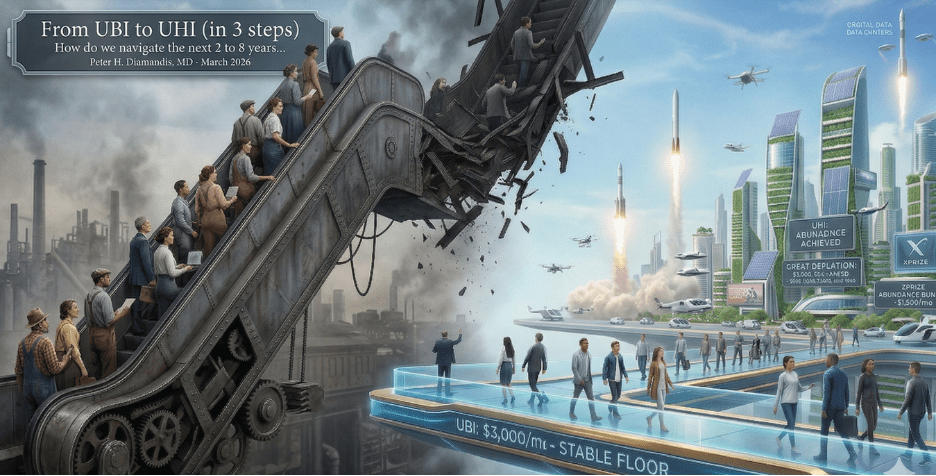
There is no adjacent labor category to retrain into. The escalator that carried workers from disrupted industries to new ones for two centuries has no destination… it is crumbling.

That future isn’t ten years away. It’s arriving now and deploying over the next 12-24 months.

This will cause chaos particularly for Gen Z. How do they prepare for work in the AI era? Biblical prophecy reveals that in this world that no longer believes that God is in control. and that a spiritual war is intensifying as Satan the prince of this world does his utmost to retain rulership of the world, people worldwide will embrace Satan’s Antichrist ruler that has supernatural powers and promises peace and prosperity. Watch as Biblical end times prophecies unfold in our time.

GENERAL-PURPOSE HUMANOID ROBOTS

Peter H. Diamandis, MD, is the Founder of XPRIZE, Singularity University, ZeroG, A360 and Dave Blundin is the founder & GP of Link Ventures. Both men are well known for the roles on Peter’s, Moonshots blog.

In this video Peter & Dave sit down with Brett Adcock to discuss the future of Figure AI and Humanoid Robots. Brett Adcock is the founder of Figure AI, an AI robotics company developing general-purpose humanoid robots.

Brett Adcock (born April 6, 1986) is an American technology entrepreneur and billionaire who is the founder and chief executive officer of Figure AI. In 2018, Adcock co-founded Archer Aviation, five years after he co-founded Vettery. In 2023, he established Cover. As of June 2024, Forbes estimated his net worth as US$1.4 billion.

In 2026, Figure AI will be working with companies to introduce robots in their companies to replace humans for manufacturing, and all other functions including warehousing and distribution. Figure has 55 companies knocking on the door ready to spend big bucks which will help them scale up their robots manufacture. However, he did say that with neural net his company can produce general-purpose humanoid robots and he is keen to produce them as is Elon Musk with Optimus Robots.

The disruption that robotics will cause to employment in 2026 will just increase the lawlessness we are already seeing in developed countries where for the most part, people, particularly the younger generation have accepted evolution and the Big Bang theory as the origin of life and the Cosmos. For them, God and His commandments are part of myths and legends. Their lives have no meaning or purpose. For Christians who know their Bibles and Biblical end times prophecy realise this is just part of what God has revealed to prepare us for the tribulation that precedes Jesus second coming to earth to usher in His Millennial Kingdom. For more on what is next on God’s agenda for planet earth go to http://www.millennialkingdom.net.

https://youtu.be/S_fXhVT67Uw?si=1zxPN77X7gyB1T4_

WHY JESUS NEEDS TO COME BACK

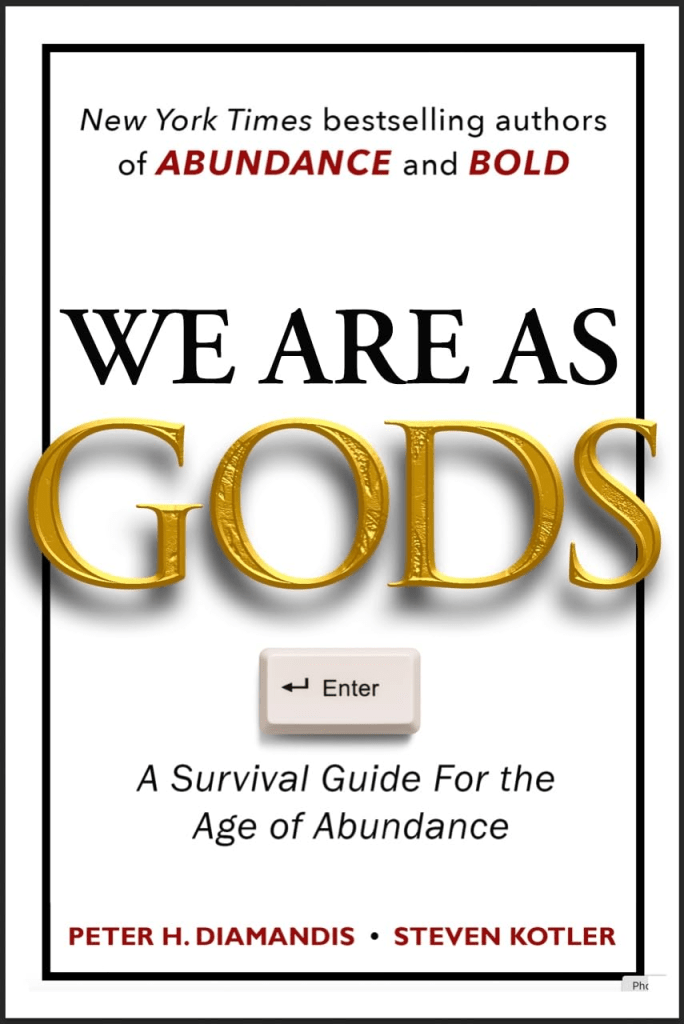
In 1968, Stewart Brand declared: ‘We are as gods – and we might as well get good at it.’ Half a century later, that prophecy has come true.

We can rewrite genes, edit embryos, build artificial minds, extend life, and terraform worlds. The old miracles – omniscience, omnipresence, even resurrection – are becoming standard operating procedure. But the real question isn’t whether humanity can play god. It’s whether we can do it wisely.

In this book, the bestselling authors of Abundance and Bold return with a sweeping exploration of our species’ next great transformation. Blending hard science with vivid storytelling, Peter Diamandis and Steven Kotler chart humanity’s ascent from scarcity to superabundance – and the psychological, ethical, and existential challenges that come with it.

Across breakthroughs in AI, robotics, genetics, longevity, and consciousness research, they reveal a paradox at the heart of progress: as our external power expands, our inner resilience must evolve to match. Abundance without meaning leads to collapse. Intelligence without wisdom leads to extinction. To thrive in a world of everything, everywhere, all the time, we must learn to wield our godlike powers with humility, creativity, and flow.

Equal parts warning and invitation, We Are As Gods is a map for flourishing in the exponential century. Because the future won’t be built by those who fear what’s coming, but by those who know how to turn chaos into creation.

Abundance is here. Are you ready?

This book “We Are As God’s” explains why Jesus will return shortly as the Bible prophecies. It says, “we can now rewrite genes, edit embryos, build artificial minds, extend life, and terraform worlds. The old miracles – omniscience, omnipresence, even resurrection – are becoming standard operating procedure. But the real question isn’t whether humanity can play god. It’s whether we can do it wisely.”

In this book, the bestselling authors of Abundance and Bold return with a sweeping exploration of our species’ next great transformation. Blending hard science with vivid storytelling, Peter Diamandis and Steven Kotler chart humanity’s ascent from scarcity to superabundance – and the psychological, ethical, and existential challenges that come with it.

Across breakthroughs in AI, robotics, genetics, longevity, and consciousness research, they reveal a paradox at the heart of progress: as our external power expands, our inner resilience must evolve to match. Abundance without meaning leads to collapse. Intelligence without wisdom leads to extinction. To thrive in a world of everything, everywhere, all the time, we must learn to wield our godlike powers with humility, creativity, and flow.

Equal parts warning and invitation, We Are As Gods is a map for flourishing in the exponential century. Because the future won’t be built by those who fear what’s coming, but by those who know how to turn chaos into creation.

This article by Peter Diamandis shows he is totally ignorant of God and His Word. God has shown us in His Word that we are fast approaching Jesus return to restore righteousness and fulfil the covenant He made with Abraham, Isaac and Jacob, The nation God established for His purposes Israel will finally fulfil its destiny when Jesus, Israel’s Messiah will rule the nations of the world from a newly constructed Jerusalem, Go to http://www.millennialkingdom.net for more information on Jesus Millennial Kingdom because it is next on God’s agenda for planet earth.

ATHEIST VIEW OF AI VERSUS CHRISTIAN VIEW OF AI

Naturalistic evolutionists argue that non-material things such as consciousness and emotion must be computable because humans experience these. This argument rests on the faulty assumption that humans are nothing more than meat-based computers. In such thinking our conscious experience of reality is merely the neural networks in our brain performing mathematical calculations through electrochemical reactions. They claim that everything we think, dream about, desire, and plan to do is determined by the laws of physics and chemistry. This is called eliminative materialism, or atheism taken to (consistent) extremes.10 Thus, since eliminative materialists believe that such things are all the result of pure computation in our brains, they see no reason to doubt that a computer could one day do these.

The Bible makes it clear, however, that there is more to us than our material body. We have a non-material spirit, and soul, and our consciousness is more than just electrochemical reactions in our brain.

The spirit of man is the lamp of the Lord, searching all his innermost parts.Proverbs 20:27 As the spirit of a man is the lamp of the Lord, it requires oil to function. It was always meant to be the vessel of the Holy Spirit. When we repent and accept Jesus as our Lord and Saviour God the Father sends the Holy Spirit to once again indwell our spirit (the lamp of the Lord). We can then function as the Lord intended.

“And as her (Rachel’s) soul was departing (for she was dying)…” Genesis 35:18. Rachel’s soul departed and went to Sheol which before Jesus’ resurrection was the holding place of all souls.

There is also substantial and tantalizing evidence from the work of brain researchers that the mind in some way exists independent of the brain. The pioneering work of Wilder Penfield, built on by fellow neurosurgeon Michael Egnor, is notable in this regard.11 The argument that such things can be computable because humans experience them is thus unsound because it is based on a faulty premise.

As a very powerful tool, AI can and will be used for evil purposes—like the internet has been. It may also lead to substantial social upheaval, as AI supplants many jobs. Many of these will be ‘white-collar’ roles once thought safe from robotic takeover.

However, just like the internet, AI will also be used for great good and to greatly improve our lives. I encourage fellow Christians to approach AI with wisdom, being aware of its risks and limitations, but willing to embrace its potential to be a very powerful tool for God’s kingdom.

Adapted from the article The AI revolution – What does it mean for you? by David Thomas http://www.creation.com

ChatGPT produced this response to my question on the Millennial Kingdom

I put the following question to the app ChatGPT and was amazed at the Biblical answer given but of course with qualifications. It demonstrates what AI is capable of doing. I was prompted to go to ChatGPT after I had watched a video by Jordan Peterson on AI. I will post the AI video next. It reveals the potential of AI is both amazing and terrifying. E.g. The jobs of a whole team of PhD-level financial analysts are at risk after a new AI model outperformed them. An acquaintance in PR uses Chat-GPT to write emails to colleagues she suspects are doing the same thing – the humans are intermediaries in a robotic correspondence. Australia’s school curriculum chief has warned of a “dystopian future’’ for children struggling to separate fact from fiction, as artificial intelligence (AI) transforms knowledge.

This was further confirmation for me that we are living in the Biblical prophesied “end times” prior to Jesus’ return.

What does the Bible reveal about the coming Millennial Kingdom with Jesus and the resurrected Saints ruling and reigning with a rod of iron?

Chat GPT response:

“The concept of the Millennial Kingdom, where Jesus and the resurrected Saints will rule and reign with a rod of iron, is a doctrine found in Christian eschatology and is based on a literal interpretation of certain passages of the Bible. The term “millennium” refers to a thousand-year period mentioned in Revelation 20:4-6, during which Christ and his saints will rule the earth.

According to the Bible, the Millennial Kingdom will be a time of peace, prosperity, and righteousness on earth. The book of Isaiah describes a world where weapons of war will be turned into tools of agriculture, and the knowledge of the Lord will fill the earth as the waters cover the sea (Isaiah 2:4; 11:6-9; 65:20-25).

Revelation 20:4-6, says that the souls of those who had been martyred for their faith in Christ and had not worshipped the beast or its image or received its mark during the Great Tribulation will come to life and reign with Christ for a thousand years. This is commonly known as the first resurrection, and those who participate in it are said to be blessed and holy.

During this time, Satan will be bound and thrown into the bottomless pit, and the earth will be restored to its original state before the Fall. The nations will come to Jerusalem to worship the Lord, and there will be no more sickness, death, or sorrow (Revelation 20:1-3; 21:1-5).

Christ and his saints will rule with a rod of iron, which means that they will exercise authority with absolute justice and righteousness (Revelation 2:27; 19:15). Those who rebel against Christ’s rule will be punished severely, and the earth will be cleansed of all unrighteousness (Revelation 20:7-15).

It is important to note that not all Christians agree on the timing or the nature of the Millennial Kingdom. Some believe it is a literal thousand-year reign of Christ on earth, while others interpret it symbolically as a period of time between Christ’s first and second comings. Regardless of the interpretation, the Bible teaches that Christ will return to establish his Kingdom on earth, and all who believe in him will reign with him in glory.”

The degree to which AI has been developed is both astounding and terrifying. I would strongly urge you to watch the video I will post next of Dr. Jordan B. Peterson and Brian Roemmele discussing the future of human civilization: a world of human androids operating alongside artificial intelligence with applications that George Orwell could not have imagined in his wildest stories. I was impressed by the answer I got to the question I put to ChatGPT above, but you will be “blown away” by what you learn from the video. I was convinced that it demonstrates that we are in the Biblical prophesied end times.

Want to know more about the coming Millennial Kingdom? Go to my website http://www.millennialkingdom.net