The recent discovery of a coin was made in Jerusalem that dates before the destruction of the temple that has changed how the world looks at the State of Israel. Christians are not surprised because this discovery alone proves yet again that God’s word is true and the land of Israel belongs to the Jews.
The proposed two State solution being considered by the UN next month is confronting God head on and like the coin confirms Biblical end times prophecy and the Bible as God’s Word.
Secular archaeologists have spent 200 years attempting to establish that the Bible is a collection of mythology and Jewish/Christian propaganda, yet archaeological evidence is more consistent with the Bible as an accurate historical document. In Unearthing the Bible, Dr. Titus Kennedy isolates and illuminates 101 archaeological discoveries that buttress the thesis that the Bible is a reliable historical record by the traditionally recognized authors at the traditionally accepted times they lived.
Kennedy’s book should be in the hands of everyone serious about the historical study of the Bible. Sketching 101 intersections between God’s Word and archeological evidence, Kennedy crafts a sturdy structure of information and argument that makes clear that belief in the truth, accuracy, and reliability of the biblical narrative is not merely possible, but it is sensible and rational. Indeed, it takes a full dose of willful blindness and/or intellectual dishonesty to refuse to acknowledge the legitimacy and implications of some of these artifacts. Complete with photographs and translations of ancient inscriptions, a helpful principle of organization, and explanations that are clear and coherent, the book is a genuinely useful tool. No fair-minded reader can deny the book’s success in demonstrating that ancient events left behind extensive evidence that the biblical narrative is accurate.
As Kennedy notes on page 9, “The Bible has been routinely attacked and disregarded based on history or archeology.” Unearthing the Bible challenges those attacks and dismissals head-on. The book cites the biblical passages related to each artifact, anchoring the archaeological context with the date and location of each piece’s discovery, a note on the biblical period in question, keywords, and citations of related biblical passages. The reader’s sense and understanding of the relevance of each artifact to the scriptural record grows as the array of archaeological discoveries increases in number and characteristic. In the end, a reader hostile to a biblical worldview may still ‘attack’, but ‘disregarded’ is no longer an option.
In some cases, Kennedy cites a piece of archaeological evidence not as demonstrably connected to a specific biblical character, but as proof that a particular name was, in fact, in use at a particular time. On pages 38–39, Kennedy points out that
“27 scarab seals bearing the name ‘Yaqob’ (Jacob) and the element ‘El’ (perhaps meaning ‘protected by God’) have been discovered in Egypt, Canaan, and Nubia, dating to around 1800–1600 BC.”
Sumerian King List dating back to about 2000 BC
He notes that this period is in line with the time of Jacob’s migration to Egypt, but that the name was not used either before or after this time. Without trying to make more of the evidence than the evidence allows, Kennedy points out that it is significant that the archeological evidence of the name’s use corresponds dramatically with the biblical account.
Altogether, Kennedy cites 19 cases of names used at a time in the Bible that corresponds with the time that a particular name was in common use. This list contains both Old and New Testament names. Some of these cases have made the popular press, such as the ‘James Ossuary’ described on pages 224–225. This may, or may not, be the same “son of Joseph and brother of Jesus” that we know in the Bible, but, because all three names are in their proper timeframe and could be common, it certainly is possible.
Unearthing the Bible: 101 Archaeological Discoveries that Bring the Bible to Life is a valuable Bible study tool, but, beyond that, Kennedy’s book is a collection of convincing illustrations that scientific evidence does not contradict God’s Word. Just as biology, geology, chemistry, and physics are consistent with the Bible, the evidence found in archaeology is consistent with the Bible. Moreover, fulfilled Bible prophecies demonstrate its authors were divinely guided by the Holy Spirit.
Can archaeology help show that the Bible is true? In this episode of “Basics of Biblical Archaeology,” Dr. Doug Petrovich discusses the importance of archeology to Christian apologetics. Apologetics is the art of defending the Bible. Archeology is an amazing help. This is part 2 of a 12-part series entitled “Basics of Biblical Archaeology.” If you have not watched part 1. then I suggest you do so as it lays the foundation with “What is Biblical Archaeology. Can I also suggest two websites for more information on Biblical inerrancy: http://www.creation.com and http://www.answersingenesis.com. Thank goodness new technology is uncovering more of the complexity of this Cosmos and human life, demonstrating that an intelligent designer is the only explanation that makes any sense. Natural selection and random chance only produce chaos.
To fund more classes like this one, consider donating to the Genesis Fund. The Genesis Fund was started last year to support Creation Science education and research. To learn more about how you can help support creation science, go to https://bit.ly/genesis-fund
Secular archaeologists have spent 200 years attempting to establish that the Bible is a collection of mythology and Jewish/Christian propaganda, yet archaeological evidence is more consistent with the Bible as an accurate historical document. In Unearthing the Bible, Dr Titus Kennedy isolates and illuminates 101 archaeological discoveries that buttress the thesis that the Bible is a reliable historical record by the traditionally recognized authors at the traditionally accepted times they lived.
Kennedy’s book should be in the hands of everyone serious about a historical study of the Bible. Sketching 101 intersections between God’s Word and archeological evidence, Kennedy crafts a sturdy structure of information and argument that makes clear that belief in the truth, accuracy, and reliability of the biblical narrative is not merely possible, but it is sensible and rational. Indeed, it takes a full dose of willful blindness and/or intellectual dishonesty to refuse to acknowledge the legitimacy and implications of some of these artifacts. Complete with photographs and translations of ancient inscriptions, a helpful principle of organization, and explanations that are clear and coherent, the book is a genuinely useful tool. No fair-minded reader can deny the book’s success in demonstrating that ancient events left behind extensive evidence that the biblical narrative is accurate.
As Kennedy notes on page 9, “the Bible has been routinely attacked and disregarded on the basis of history or archeology.” Unearthing the Bible challenges those attacks and dismissals head-on. The book cites the biblical passages related to each artifact, anchoring the archaeological context with the date and location of each piece’s discovery, a note on the biblical period in question, keywords, and citations of related biblical passages. The reader’s sense and understanding of the relevance of each artifact to the scriptural record grows as the array of archaeological discoveries increases in number and characteristic. In the end, a reader hostile to a biblical worldview may still ‘attack’, but ‘disregarded’ is no longer an option.
Kennedy’s book is a collection of convincing illustrations that scientific evidence does not contradict God’s Word. Just as biology, geology, chemistry, and physics are consistent with the Bible, the evidence found in archaeology is consistent with the Bible.
SUBMERGED RUINS OF 3,400-YEAR-OLD MITANNI CITY REVEALED BY DROUGHT
One reason this location is of great interest is that Mitanni is mentioned in the Bible’s book of Judges. In standard dating, the Mitanni kingdom ruled the northern Tigris-Euphrates region from before 1600 BC until about 1350 BC when it was overtaken by the Assyrian Empire. It became a weakened province of Assyria for about a century before fading from the historical record.
Mitanni’s history makes a strong argument against a late Exodus date (also known as the Rameses Exodus date) in the 1200s BC since there is good evidence that Othniel, one of Israel’s first judges, was fighting against a Mitanni invasion in Judges 3. A Rameses Exodus date would put the judge Othniel in the 1100s BC and about two centuries after Mitanni ceased to be a strong kingdom, thus showing that the Exodus must have been much earlier.
The following video produced by Creation Ministries is helpful in understanding the Bible and the archaeological discoveries that support Biblical events and dates. Can I suggest you go to http://www.creation.com and search “Bible and archaeology” where you will find that many archaeologists have found the Bible to be an accurate historical document.
Were the Bible’s stories made up long after the fact, or do the accounts preserve eyewitness testimony? See how archaeology supports the Bible.
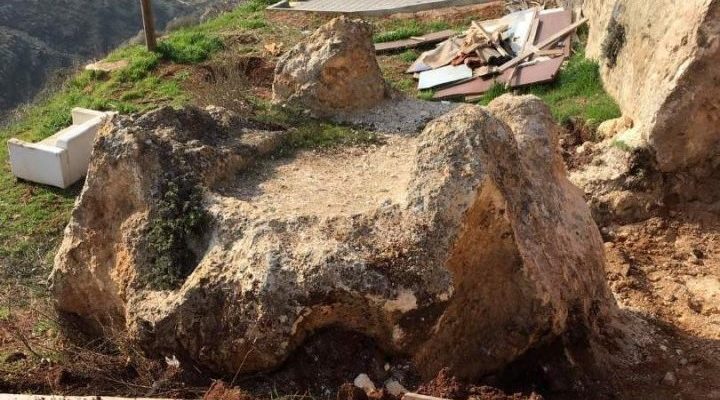
An ancient horned Israelite altar dating back 3,000 years that was in danger of being destroyed will now be protected after having been damaged by recent building activity at the site, Makor Rishon reported.
The altar, hewn from stone, is one of only three discovered in Israel to date and the most perfect of them, according to Prof. Yoel Elitzur of the Hebrew University of Jerusalem, who discovered the altar 17 years ago together with attorney Doron Nir-Tzvi.
Elitzur has struggled for a year to protect the altar in the wake of construction in the area that has damaged it. At one point, a metal cable was attached to one of the horns. Also a large stone fell on it damaging two of the horns, Makor Rishon reports.
Its dimensions fit those mentioned in the Bible (“five amot long and five amot wide… and make horns upon it”).
The altar is located in Givat Harel in the Binyamin region of Judea and Samaria. It has a flat surface for sacrifices and four horns, one on each corner. Its dimensions fit those mentioned in the Bible (“five amot long and five amot wide… and make horns upon it”).
Several weeks ago, the settlement of Givat Harel and the Binyamin Regional Council took an interest in the altar. The large rock that had damaged it was removed and they are developing the area as a tourist attraction.
“The discovery of the altar is profound expression of our meaningful connection to the land. It’s evidence before the whole world of our historical right to Judea and Samaria,” Binyamin Regional Council head Israel Gantz told the paper.
Also noteworthy is that the altar is located at the base of a slope and not on the hilltop as in keeping with pagan worship in which altars were place on the tops of mountains and hills.
Prof. Elitzur is also trying to save one of the other altars, the one located in the Shimson Industrial Zone. He discovered a few months ago that the altar is in danger of being lost due to the industrial development around it.
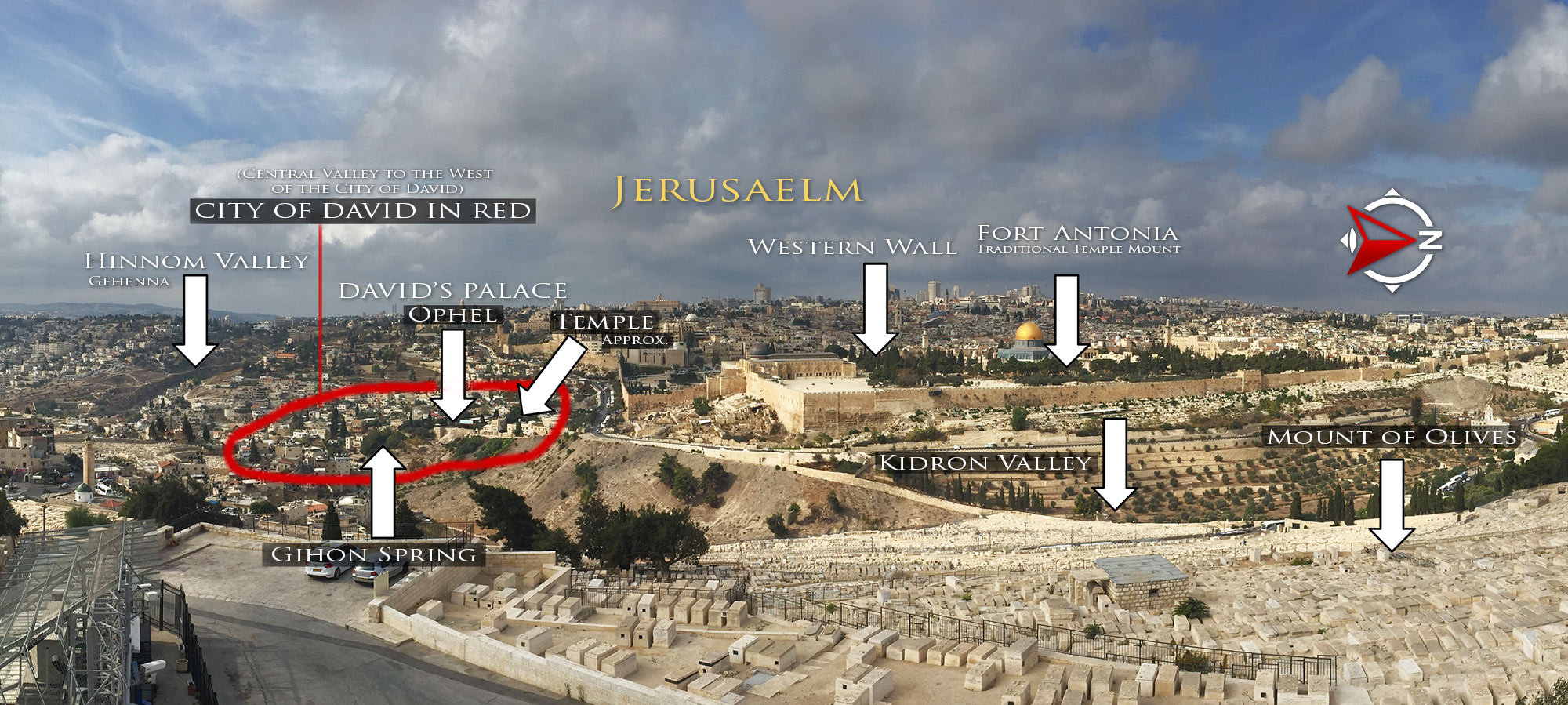
As seen in the graphic, we can see several important geographical features, including the Mount of Olives, the traditional Temple Mount, the Kidron Valley, the Central Valley, the Gihon Spring, and the current site for the city of David. Below is additional information on each of these locations:
The Mount of Olives is a mountain ridge on the east side of the city of Jerusalem. At one point, it had olive trees covering its slopes. Today there is a Jewish cemetery with approximately 150,000 graves. This mountain ridge was a significant location during Yahshua’s ministry. It was the place where He delivered His Olivet Prophecy and where He retreated hours before His death, i.e., the Garden of Gethsemane.
The traditional Temple Mount is where many believe the Jewish temple once stood. Again, Muslims call this place the Haram esh-Sharif, translated as, “the Noble Sanctuary.” Both the Al-Aqsa Mosque, Islam’s third holiest site, and the Dome of the Rock reside on the traditional Temple Mount.
The Kidron Valley separates Jerusalem, including the city of David and the traditional Temple Mount, from the Mount of Olives. This valley continues east through the Judean Desert and toward the Dead Sea.
The Central Valley, also called the Tyropoeon Valley and the Valley of the Cheesemakers, is a rugged ravine on the west side of the City of David or the ancient city of Jerusalem and marks its western boundary, as the Kidron Valley does on the east.
The Gihon Spring is along the Kidron Valley near the ancient City of David. The name “Gihon” comes from the Hebrew gihu, meaning, “gushing forth.” It is one of the world’s largest intermittent springs and made life possible for ancient Jerusalem. While the water from the spring was used for irrigation in the Kidron, it was also central to temple worship. We will explore the Gihon further in this article.
The City of David is the location for the ancient Jebusite City that David conquered and renamed to the City of David or Jerusalem. It is approximately 12 acres in size. It begins at the Millo (i.e., a ravine that separated the City of David from the Ophel, which Solomon filled in during his reign) and extends southward.
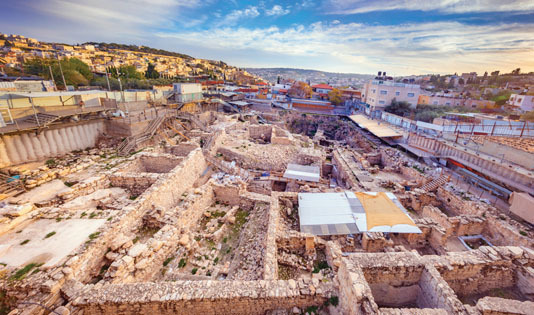
Today the City of David is an Israeli national park and a major archaeological site. Archaeologists have discovered many subterranean tunnels, reservoirs, and possibly an ancient room that was used for animal sacrifices. Also discovered underneath the City of David is Hezekiah’s tunnel and the Gihon Spring. On the southwest side of the city is the Pool of Siloam.
City of the David = Zion
We begin our investigation for the real temple mount by turning to the Bible. As with so many other truths, Yahweh’s Word holds the key in unlocking the truth as to where the original temple stood. Following is a compilation of Scripture confirming that the city of David and Mount Zion (i.e., the location of the temple) are synonymous: “Nevertheless David took the strong hold of Zion: the same is the city of David,” 2 Samuel 5:7.
This passage clearly states that Zion and the city of David are the same. This point is critically important, as Scripture also shows that Mount Zion was the location of the temple.
“And the inhabitants of Jebus said to David, Thou shalt not come hither. Nevertheless David took the castle of Zion, which is the city of David,” 1Chronicles 11:5.
As noted in the previous passage, 1 Chronicles 11 confirms that Zion is also the city of David. The word “castle” here comes from the Hebrew matsuwd and refers to a place of defence. Because Jebus was located between the Kidron and Central valleys, it was a well defensible area.
“In Salem also is His tabernacle, and His dwelling place in Zion,” Psalm 76:2.
The word “Salem” derives from the Hebrew shalem. Strong’s states that this word is “an early name of Jerusalem.” This passage is critically important, as it shows a connection between the ancient city of David, the temple, and Zion and offers indisputable evidence for the temple being located within ancient Jerusalem and not on the Haram esh-Sharif.
Remember that the old City of David only included the 12-acre plot of land between the Kidron and Central valleys. It did not include the 36-acre Temple Mount located a third of a mile north. The current Temple Mount platform was developed much later.
Using only the Bible as a roadmap and knowing the location for the ancient city of David, a strong case can be made for the temple being located within the City of David and not on today’s Temple Mount. However, this is only the tip of the iceberg.
The Akra, Millo, and Ophel
When it comes to the location of the temple, there are three terms to understand – the Akra, Millo, and Ophel. The Akra was another name of the City of David. The Millo was a ravine that King Solomon filled in. And the Ophel is where the temple was originally located.
In 2 Samuel 5:9 we find a description of the boundaries of ancient Jerusalem during the reign of King David: “So David dwelt in the fort, and called it the city of David. And David built round about from Millo and inward.”
The word “fort” refers to the impregnability of the City of David. This was due to its location between the Kidron and Tyropoeon valleys. We see that David built his city from the Millo inward. Tis ravine separated ancient Jerusalem from the Ophel.
Scripture records that Solomon later filled in this ravine: “And this was the cause that he lifted up his hand against the king: Solomon built Millo, and repaired the breaches of the city of David his father,” 1Kings 11:27.
The word “repaired” here comes from the Hebrew cagar and is a primitive root meaning, “to shut up,” Strong’s. By filling in the Millo, Solomon shut up the ravine known as Millo. In doing so, he also connected the City of David with the Ophel.
This is why Psalms 122:3 describes Jerusalem as a city “compact together.” The word “compact” comes from the Hebrew chabar and according to Strong’s means to “join.” When Solomon filled in the Millo, he enlarged the City of David by joining it with the Ophel.
Now what connection do the Millo and Ophel have to the temple? According to 1 Maccabees 13:52 the Ophel is the location of the temple. The KJV with Apocrypha reads, “…Moreover the hill of the temple that was by the tower he made stronger than it was, and there he dwelt himself with his company.” As a secondary reference, the Catholic Study Bible states, “…He also strengthened the fortifications of the temple mount alongside the citadel, and he and his people dwelt there.”
Even though Maccabees is not considered inspired or part of the canon of Scripture, it still offers invaluable historical insight during the time of the Maccabees and Hasmoneans.
As seen in the above citation, the biblical temple mount or “temple hill” was located alongside the tower or citadel. As 2 Samuel 5:9 shows, the “fort” or “citadel” refers to the City of David: “So David dwelt in the fort, and called it the city of David….”
This provides conclusive evidence for the temple being located on the Ophel and alongside the City of David. This also places the biblical temple mount approximately a third of a mile south from the traditional Temple Mount.
I will do another post on the Old City of David as it is an important end times sign.
U.S. envoys Jason Greenblatt and David Friedman attended the inauguration of a Jewish heritage site in eastern Jerusalem on Sunday. This move signals support for Israel’s hold over parts of the city that Palestinians want for a future state.
“The City of David brings biblical Jerusalem back to life,” Friedman said at the event. “It enables every one of us to stroll the corridors where the ancient prophets of Israel gave voice to revolutionary ideals of freedom, liberty and human dignity.”
“It is our unique privilege as Americans to walk together with our Israeli counterparts on the just unveiled Pilgrimage Road, where our shared ancestors ascended the flagstone steps in prayer and blessing,” he said.
Sara Netanyahu, Jason Greenblatt and David Friedman tour Pilgrimage Road
Earlier Friedman and Greenblatt slammed the activists who had protested their cooperation in the event, with Friedman saying that discovery “brings truth and science to a debate that has been marred too long by myths.”
All of the recent discoveries at the old City of David are proof indeed at this time when many are denying Israel’s right to the land. Watch this short important video. We certainly do live in exciting times
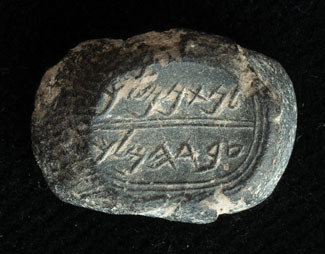
Archaeologists were excited by the discovery of a seal and a small clay seal impression (bulla), with ancient Hebrew script on them on the western slope of the City of David, Jerusalem.
This wonderful find serves to connect another specifically named individual from the Bible to real physical history in the correct time period, confirming that we can be confident the Bible is reliable.
The 2,700-year-old seal impression translates as “[belonging] to Nathan-Melech, Servant of the King”. In 2 Kings 23:11, Nathan-Melek is named as an official of the godly King Josiah of Judah (7th century BC).
The items were found inside the remains of a large public administrative building that was likely destroyed during the Babylonian destruction of Jerusalem in 586 bc. Archaeologist Dr Yiftah Shalev of the Israel Antiquities Authority explained, “What is important is not just that they were found in Jerusalem, but [that they were found] inside their true archaeological context. It is not a coincidence that the seal and the seal impression are found here.”
Borschel-Dan, A., Tiny First Temple find could be first proof of aide to biblical King Josiah, timesofisrael.com, 31 Mar 2019.
JERUSALEM, Israel – Driving along the route known as the Way of the Patriarchs in Samaria, the heart of biblical Israel, you’ll come to ancient Shiloh.
The Bible says this is the place where Joshua parcelled out the promised land to the 12 tribes of Israel. It’s also where the tabernacle of the Lord stood for more than 300 years.
Dr. Scott Stripling directs the excavations at Shiloh. Along with dozens of volunteers, he and his crew are digging into history.
“Welcome to ancient Shiloh,” Stripling greeted us. “This is the first capital of ancient Israel, and it’s a sacred spot because the Mishkan was here, the tabernacle, where people came to connect with God.”
“We’re dealing with real people, real places, real events,” he continued. “This is not mythology. The coins that we excavated today—we’re talking about coins of Herod the Great, Pontius Pilate, Thestos, Felix, Agrippa the First, Agrippa the Second. The Bible talks about these people. We’ve got the image right here.”
That “image” includes a fortified wall built by the Canaanites. The team finds a treasure trove of artefacts there, which includes ancient coins and some 2,000 pieces of pottery a day.
Stripling said, “Archaeology doesn’t set out to prove or disprove the Bible. What we want to do is to illuminate the biblical text, the background of the text, so to set it in a real world culture to what we call verisimilitude,” he explained.
“So, we get an ancient literary description. Now, we have a material culture that matches that,” he continued. “Chris, you’re sitting where Samuel and Eli and Hannah and these people that we have read about, they came just like us, needing answers, needing to connect with God, needing forgiveness.”
Stripling says they dig into the past and find lessons for the present.
One of the faith lessons for us is that God is the potter and we are the clay. And even if our lives are broken like these vessels are, God told Jeremiah after He had told him to go to Shiloh and see what He had done, He told him to go to the potter’s house and look at a flawed vessel and see how the potter puts it back on the wheel and works out the imperfections. So my faith lesson is this: Yes we’re imperfect, but if we will allow God, He wants to put us [on] His potter’s wheel and make us a vessel of honour.”
Stripling often cites Psalm 102:14
“O Zion, your servants take delight in its stones and favour its dust.”
“For me this is sacred soil. This is where the Mishkan was that answers the most basic of all human questions: ‘How do I connect with God?’ And I think that’s their most basic question,” he said.
“I know I messed up. I know that God is holy. How do I bridge that gap when I sin against other people, when I sin against God. Ultimately, if the Bible is true, then the God of the Bible has a moral claim on our lives. And as we establish the veracity of the biblical text, I hope that everyone watching would just think about that – that God loves us and He has a moral claim on our lives.”




 LIVING ETERNAL NOW