HOW RELEVANT IS THIS WORD FOR THESE LAST DAYS?

Jesus revealed to the disciples in Matthew 24 what we can expect to experience in the last days before His second coming. Moreover, God is revealing to those who are seekers after the truth in His Word, the many prophecies in both the OT and NT that are unfolding in our time and hence, also, what is to come before His second coming.

James Goll has identified  a number of KEY paradigm shifts: breakdown of the denominational barriers and structures. Part of that is a multitude of prayer networks that are emerging, that cross those denominational barriers. I am involved in one that has just started up in the Southern Region of Sydney – South Eastern Sydney Prayer Network – contact Ps Ron Brookman 0425 225 386 or myself on 0414412740 to get on the mailing list.

James Goll originally wrote this twelve years ago but has just up dated it. I have not reproduced the entire article but what I believe is relevant for today.  Sadly, as prophesied, we are also going to see a great falling away in the denominational churches as persecution intensifies.

“Then many false prophets will rise up and deceive many. And because lawlessness will abound, the love of many will grow cold. But he who endures to the end shall be saved.” Matthew 24 11-13

Only those who are totally sold out for Jesus, and who recognise we are in the “end times’, and are prepared to face whatever persecution comes there way, in the knowledge that to die in Christ is GAIN, will be saved.

Paradigm Shifts for the 21st Century

James W Goll

by James W. Goll

As we have crossed the threshold of a new era in the Lord, there will be a lot of shifting taking place in the church and the world. It is the time of completing unfinished business, a time of cleansing, and a time to get prepared for a “spiritual church-quake” to transpire in the life of what some prophetic voices call the “Third Day Church”.  With this view in mind, let me present some bullets on Paradigm Shifts for the 21st Century.

  • An Apostolic Relational Mandate is being released emphasizing “networking” versus vertical authority structures. This fresh emphasis on cross-pollination will replace much of the inbred church associations, which are strife ridden by the spirit of competition and control.
  • While in worship I was given the following phases: “When the Apostolic is Made Personal (AMP) there will be Mighty Authority in the Prophetic (MAP) in that day. The Lord will amplify His voice in those relational renewal centres and the Holy Spirit will put them on His map.”
  • Confrontation shall come with the “political spirit”. Even as the “prophetic movement” exposed and confronted the “religious spirit” in the church, so an “apostolic movement of grace and truth” will expose and lay an axe at the historical root of the “political spirit” in the church.
  • The restoration of David’s Tabernacle as prophesied in Amos 9:12 and Acts 15:16-18 shall escalate resulting in authentic 24-hour houses of prayer and praise, worship and intercession sprinkled across the nations. New creative songs and sounds shall emerge as it was with the radical ministry of William and Katherine Booth’s Salvation Army bands. Praise, once again, will not be confined to the “four walls of the church” but will spill out into the open-air arena.
  • In the church world, there will be a continued theological shift away from the false theory of cessationism (spiritual gifts passed away with the closing of the cannon of scriptures and/or the second generation apostles of the early church.) In other words, cessationism is going to cease!
  • A new Signs and Wonders Movement is growing. Healing Rooms and Centres will be instituted in many cities devoted to praying for the sick and casting out evil spirits (Luke 10). Parades of people healed of various diseases will once again occur as in the days of life of John G. Lake in the 1920’s.
  • A renewed Quietest Movement will emerge as believers in Christ find the “secret place” of the Most High to truly be their dwelling place (Ps. 91). A fresh revelation of intimacy with God, communion with their lover/husbandman and master will come forth. A generation in the spirit of Mary of Bethany will arise and gladly “waste their life” on the Lord!
  • A fresh Holiness Movement will spring up in the church worldwide. Its emphasis shall be one of the Father’s mercies mixed with an authentic spirit of conviction of sin (John 16) causing many to repent and their stained garments to be experientially cleansed by the power and blood of the Lord Jesus Christ.
  • The body of Christ will awaken to her call and responsibility to reach and lift up the poor and oppressed as stated in Isaiah 58:7-12. Finances will be released to care for the widow and the orphan as declared in James 1:27. Chains of orphanages will come forth as the church awakens from her self-centered life styles and hilarious, joyful giving is restored.
  • We will see tremendous transfers of wealth into the Kingdom of God through the ministry of “market place apostles and prophets”. Those with anointing for business, administration and creativity shall be blessed – not resisted – by the church. The wall between clergy/laity and secular market place/spiritual ministry shall come down.
  • An extravagant Youth Movement is coming to the global body of Christ that will “rock the nations”.  Public events will be led by youth to pray and fast for revival, which will spread rapidly around the nations. This will be a “trans-generational anointing” where the hearts of the fathers are turned to the children and the hearts of the children to the Father (Mal. 4:5-6).
  • A wave of “Identificational Repentance” will overwhelm a remnant of the Gentile church causing her to repent of her historical wrongs against the Jewish people. In response to this, a revelation of the “Sabbath rest” shall be released from the throne of grace that will be non-legalistic and result in healing for many.
  • It is the devil’s strategy to precipitate another type of holocaust – but God will raise up trumpeters like Mordecai who shall prepare the corporate Esther (the church) for such a time as this. Radical prayer will open a hedge of protection for the Jewish people as the shields of the earth belong to the Lord.
  • A “Convergence of the Ages” shall come upon us. The anointings of Pentecostal fire, the healing and deliverance crusades, the Latter Rain presence, the Evangelical burden for the lost, the Charismatic Gifts, the Jesus People zeal, the Third Wave credibility, the revelation of the Prophetic movement and the relational networking of the Apostolic Reformation shall all merge together into a tidal wave that will be greater than the impact of “reformation of 500 years ago.” This will ultimately create what could be called The Great Revolution in the Church“.
  • Radical deeds of identificational repentance, acts of mercy to the poor and the oppressed, presence and power encounters to the sick and the demonized, warrior praise and intercession arising over cities will mount as a Revolution comes upon the global body of Christ and creates a great societal awakening! If history books are written of the years that lie ahead, they might be termed “The Days of His Glorious Presence“.

(Note: James wrote this 12 years ago and it was published in his book The Coming Prophetic Revolution. He has looked at these declarations again, edited them slightly and thought it would be good to post them for you once again.)

source: James W. Goll

CHRISTIANITY STANDS OR FALLS ON THE HISTORICAL ACCURACY OF GENESIS

How did Christ and His Apostles view the Old Testament?

According to Jesus, “Scripture cannot be broken” (John 10:35) and “not an iota, not a dot, will pass from the Law until all is accomplished” (Matthew 5:18). When referring to the Old Testament, He would often assert, “It is written”, making clear that He considered Scripture to be the final authority in all matters of faith and life. Along with the Pharisees He regarded the Old Testament as truly God’s Word. When quoting Genesis 2:24, for example, He affirmed that it was God speaking (Matthew 19:45) even though the passage itself does not specifically state this.6

Looking for Answers pic

In his second letter to Timothy, the Apostle Paul wrote, “All Scripture is breathed out by God and profitable for teaching, for reproof, for correction, and for training in righteousness” (2 Timothy 3:16). Commenting on this verse, and the New Testament in general, Frederick C. Grant, Professor of Biblical Theology at Union Theological Seminary wrote, “Everywhere it is taken for granted that what is written in scripture is the work of divine inspiration, and therefore trustworthy, infallible, and inerrant.”7

From this it might be understood that Professor Grant held to a similarly high view of Scripture. Not at all! In fact, he believed much of the Bible to be based on myths. Despite this, and along with many other liberal theologians, he recognised the Apostles’ unswerving commitment to the Old Testament as the Word of God and as unquestionably trustworthy in everything it teaches.

It is not difficult to see why scholars understand this to be true.8,9 In the Apostle Paul’s thinking, the Jews had been “entrusted with the oracles [the very words] of God” (Romans 3:2). When referring to the Old Testament he had no hesitation in affirming, “The Holy Spirit was right in saying to your fathers …” (Acts 28:25). Similarly, when quoting from the Psalms, the Apostle Peter stated that, while the words came from the mouth of David, it was the Holy Spirit speaking (Acts 4:2425). Moreover, he affirmed that “no prophecy was ever produced by the will of man, but men spoke from God as they were carried along by the Holy Spirit” (2 Peter 1:20–21).

Both Jesus and His Apostles undoubtedly regarded Genesis as history. Jesus, for example, affirmed the creation of Adam and Eve (Matthew 19:4), the murder of Abel (Luke 11:5051), the Noahic Flood (Matthew 24:37–39) and the destruction of Sodom and Gomorrah (Matthew 10:15). Moreover, for Him, these were not simply interesting stories; rather they provided the basis for understanding important spiritual truths. Similarly, the Apostle Paul built his teaching on events recorded in the Old Testament, such as the doctrine of Original Sin (Romans 5) and the role of men and women in the church (1 Timothy 2:12–14). The writer to the Hebrews referred to the accounts of Abel, Enoch and Noah as real events that happened to real people (Hebrews 11). Significantly, this letter was written to encourage Christians who were facing serious persecution; but what use are mythical characters to those potentially facing death? The idea that anyone would think that such people might be helped by reminding them of stories suitable only for Sunday School children is absurd. The writers of the New Testament undoubtedly accepted the first book of the Bible as historical and Huxley was right: if Genesis is wrong, Christianity was built upon no more than “legendary quicksands”.

Where does your church, your denomination stand on the inerrancy of scripture? Ask your pastor to get one of the excellent PhD speakers from Creation Ministries to come speak at your church on the evidence for the Genesis account of Creation. His response may surprise you.

IS THE BIBLE TOO HARD TO DEFEND? SADLY, EVANGELICAL PASTOR ANDY STANLEY THINKS SO

Evangelical pastor preaches that the Bible isn’t the foundation for the Christian faith.

Pastor Andy Stanley has a church network of over 30,000 people in the Atlanta area, and his church was rated the fastest-growing in America in 2014 and 2015.

andystanley

The Bible’s historical reliability is one of the most important considerations when it comes to whether people  will accept the Bible’s claims about Jesus—and they’re right! If the Bible is demonstrably wrong regarding its history, it is not a reliable record, and the claims the Bible makes about Jesus are so extraordinary that it requires the Bible to be a supernatural, inspired, inerrant book. This is of course what it claims to be. Creation Ministries found it necessary to counter this serious challenge to the authority of God’s Word with this excellent article by Lita Cosner and Scott Gillis.

Pastor Andy Stanley says, “If the Bible is the foundation of our faith, it’s all or nothing. Christianity becomes a ‘fragile house of cards’ religion. Christianity becomes a fragile house of cards that comes tumbling down when we discover that perhaps the walls of Jericho didn’t.”2

Stanley’s message is clear as to the ‘unnecessary reason’ youth have left the faith:

So, if you stepped away from Christianity because of something in the Bible, if you stepped away from the Christian faith because of Old Testament miracles, if you stepped away from the Christian faith because you couldn’t reconcile 6,000 years with a 4.5 billion year old earth and something you learned in biology, I want to invite you to reconsider, because the issue has never been, ‘is the Bible true?’.2 (Emphasis added)

While he hopes to persuade people to come back to church, the route he took is actually more likely to deconstruct the faith of the young people he wants so much to keep in the church. In our experience (which to be honest, is much more wide than his own—speaking in over 1000 churches of varying denominations each year), people think the Bible’s historical reliability is one of the most important considerations when it comes to whether they will accept the Bible’s claims about Jesus—and they’re right!

What most people have commented on is the third part of his sermon series. Stanley begins that message by saying:

“In Sunday School we learned the song, “Jesus loves me, this I know, for the Bible tells me so.”

He goes on to say,

“You grew up, but your faith didn’t grow up with you. You grew up, but you outgrew your faith. Your childhood god could not stand the rigors of adulthood, the questions of adulthood.”2

The reason he thinks this is a problem is:

“If the Bible is the foundation of our faith, it’s all or nothing. Christianity becomes a ‘fragile house of cards’ religion. Christianity becomes a fragile house of cards that comes tumbling down when we discover that perhaps the walls of Jericho didn’t.”2

To call Scripture a ‘house of cards’ (and elsewhere in the same sermon he calls it a ‘fragile thread’) reveals a troubling attitude for a pastor to have towards Scripture, which Jesus and the Apostles presented as the absolute foundation for our faith. After all, if he cannot be sure about Scripture, how can he be sure about the One that Scripture is ultimately all about, and moreover, the Bible’s history that necessitated Jesus becoming our Saviour.

Too hard to defend it

One reason Stanley argues we need this change in perspective is that Scripture is too hard to defend:

“What your students have discovered, and if you read broadly you’ve discovered, it is next to impossible to defend the entire Bible. But if your Christianity hangs by the thread of proving that everything in the Bible is true, you may be able to hang onto it, but your kids and your grandkids and the next generation will not. Because this puts the Bible at the center of the debate. This puts the spotlight right on the Bible. Everything rises and falls on whether not part, but all the Bible is true. And that’s unfortunate, and as we’re going to discover today, it is absolutely unnecessary.”2

Among the things he specifically states are indefensible and not supported by evidence:

  • Israel’s Exodus from Egypt
  • The walls in Jericho fell down
  • The earth is 6,000 years old
  • The chronological information in 1, 2 Kings, 1, 2 Chronicles, and 1, 2, Samuel
  • The global flood in Noah’s day

But as apologist James White pointed out in his rebuttal to Stanley, if the Bible is wrong, Christianity is untrue.4 Jesus’ own view was that the Scriptures could not be broken (John 10:35), and the New Testament authors referred to the Old Testament’s history as the foundation for New Testament theology. If the Bible is wrong about historical events, the basis for New Testament teaching vanishes. Worse still for Stanley, if Jesus is wrong about the very Scripture Stanley says is not defensible, then how can he still encourage faith in Jesus and His (historical) resurrection?

Did the early church have the Bible?

Stanley bases his argument that Christianity does not stand or fall with the Bible by his absurd claim that, for the first several hundred years of Christianity, they didn’t have the Bible: “For the first 300 years of the existence of Christianity, the debate centered on an event, not a book.” While they may not have had all the New Testament books bound together under one cover and called it ‘the Bible’, the entire Old Testament and many of the New Testament books functioned authoritatively from the beginning of the Church and were the central source of their theology, used to settle the doctrinal controversies of that time. In fact, there are over 100 references in the New Testament to the book of Genesis, let alone many other Old Testament events. So much of our Christian doctrine, and even Jesus’ own teaching, are centered on those biblical historical events.

Astonishingly, however, Stanley suggests that Peter might have responded to historical questions about the Old Testament as follows:

“Peter would have looked at you like, ‘I’m not really sure what you’re talking about, but I followed a man for three years who spoke like no other man spoke. He was arrested and crucified and we thought, Game over, because he said too much to be a good teacher, he claimed too much about himself to be a good teacher. Game over. We’re all in hiding; a bunch of women come babbling that “The tomb is empty, the tomb is empty”. I looked into an empty tomb, and do you know what I concluded? Somebody stole the body. And a few days later I had breakfast with my risen friend on the beach. So I’m not sure about 6,000-year-old earth, I’m not sure about archaeological evidence, I’m not sure about all that. The reason I’m following Jesus is because I saw him die, and I saw him alive, and I went into the streets of Jerusalem to say, God has done something among us.”2

But this does not match up with what Peter actually said in Acts 2 (by the way, it should be noted that Stanley purposely references no actual Scripture in his first several sermons). In Peter’s sermon as recorded by Luke, he included a lengthy quote from the prophet Joel and two Psalms, because he wasn’t arguing from his personal testimony and experience, but that the history they witnessed was a fulfillment of the Scriptures. And, even when he did appeal to his own eyewitness testimony, he tied this to a confirmation of the Scriptures (2 Peter 1:16–21)—the very Scriptures Stanley argues Christianity didn’t emphasize until 300 years later.

In Part 5 of the sermon series, Stanley dedicates an entire session to the reasons people leave the faith due to injustice in the world. Although Stanley does make some pertinent points, at no time does he state the foundational, historical event of Adam’s Fall as the cause of death and suffering in the world. In a self-labeled ‘footnote’, Pastor Stanley implies that a belief in evolution does not challenge the Gospel’s big picture when he states “Francis Collins actually embraces what we would consider macro-evolution and yet he is still a conservative Christian. If you didn’t think a person could believe in evolution and be an evangelical Christian, you should read this book. If science is the reason you have walked away from faith, I highly recommend his book, The Language of God [see our review].” Francis Collins would agree with Stanley when he stated in this sermon series, “And when religion and science conflict, at the end of the day if you are an honest person, science must win.” When people compromise on the historical account of creation they are unable to effectively explain the existence of death and suffering if God created a very good world. And Francis Collins along with his former organization BioLogos actually believes that Jesus could be wrong about His statements about biblical history and the historical Adam and Eve. See It’s not Christianity!.

Just another ‘New Testament Christianity’

It is interesting to note how Stanley defends the historical reliability of the New Testament and the historical trustworthiness and early composition of the New Testament documents. But as is shown by the list of Old Testament events that he claims are indefensible, he is all too ready to give up on the historical reliability of the Old Testament, which Jesus and the New Testament authors quoted constantly in all sorts of contexts, always taking it as completely authoritative and true.

We have pointed out that you can’t have a New Testament-only Christianity, because the Christians during the time of the New Testament used the Scriptures—the Old Testament.

Will this approach bring people back to the faith?

The saddest thing about this attempt to justify Christianity apart from the Scriptures is that it won’t work. We’ve come into contact with many young people with questions, and most aren’t interested in a ‘squishy’ Christianity that takes all the ‘hard’ passages of the Bible metaphorically while only holding on to some sort of a belief in Jesus.

The answer is not to so easily abandon the authority and the inerrancy of Scripture, but rather to learn how we can know that the Bible is reliable.

Andy Stanley is obviously passionate, and we would agree that a simple “the Bible tells me so” faith will likely not sustain people when they encounter objections to the faith. But the answer is not to so easily dismiss the authority and inerrancy of Scripture, but rather learn how the evidence supports the historical account of the Bible.

Many Sundays, after hearing a creation presentation, people will come up to one of our speakers and be so excited that they realize they can trust the entire Bible! By hearing that the Bible’s history is reliable, and that there are answers to all the objections that they’ve heard, believers are more confident to share their faith.

It takes effort, but it is not too hard to defend the entire Bible; we’ve been defending Scripture from the first verse for over 30 years. That is the key to keeping young people in the church. And the effort has eternal consequences. Given the wealth of scientific and archaeological support and information that is available today to support the Bible’s history, it is a shame that Stanley did not take the time to research it, before so readily abandoning the Bible as the inerrant source for the Christian faith.

WHAT IS GOD DOING IN YOU & YOUR CHURCH?

Us Christians, we should be continually astounded by what God has done and is doing for us and those in the world around us. Consider just a few of his mind-boggling blessings:

  1. You have been forgiven. If you’re a Christian, you carry absolutely no guilt for your past sins. Like a criminal who was released from death row, you have been declared not guilty, and you no longer face punishment. When you wake up every morning, you should pinch yourself as you realise how merciful God was to pardon you!
  2. The Father has adopted you. Adoption is a foreign concept in many cultures. There is not even a word for adoption in some languages. Yet God loved you so much that He brought you into His family, called you His child and shared His eternal inheritance with you. Have you taken time to ponder what that means?
  3. You can read and treasure God’s Word. There are still many people today who do not have the Bible in their language. There are others who live in countries where Bibles are restricted. Do you realize how high a price was paid by previous generations so you could have the Bible now? Do you read it with a sense of grateful humility? Do you realise it prepares us for coming events? There are more prophecies about Jesus second coming, than there were of His first coming, and there were over sixty of those. The Pharisees and Sadducee’s did not get His first coming, what about the church and His second coming. Is the church asleep, as were the ten virgins in that parable, five had oil in their lamps but all were asleep at the time of their Lord’s coming? I believe we are in the “last days” and as we watch events unfold, particularly in the middle east, we can line them up with the O.T. and N.T prophecies. As the world descends into increasing darkness, just as the Bible prophesied, is your church preparing you for these events?
  4. You have continual access to God’s presence. In the days of the Old Covenant, people who worshipped the true God could only do it from a distance. They stood outside the door of the temple while priests made sacrifices for them. You should pinch yourself now! Because we live in the New Covenant era, every born-again Christian can approach the throne of God with confidence. We worship the Lord in “spirit and truth” as Jesus prophesied to the Samaritan woman at the well.
  5. The Holy Spirit lives in your Spirit. Before Jesus came, the Holy Spirit only “came upon” certain people—prophets, kings or special messengers and sometimes only for a specific purpose or season. But today, because of Jesus’ atonement, the Father sent the Holy Spirit to rebirth your Spirit (died at The Fall). The Holy Spirit now lives in you 24/7. He is your counsellor, your comforter and your teacher. He prays for you, refines you, refreshes you, empowers you and leads you deeper and deeper into God’s truth. He is the one that produces the nine fruits of the Spirit in your life: love, joy, peace, patience, faithfulness, goodness, gentleness, kindness and self-control. He is also the one that enables your use of the nine spiritual gifts: Wisdom, Knowledge, Faith, Healing, Miracles, Prophecy, Discerning of Spirits, Speaking in Tongues and Interpretation of Tongues. Shouldn’t you be in awe of a God who does that?
  6. You can enjoy God’s house and His people. Jesus said when we gather together, His presence is there. He dwells in His congregation. Yet many Christians have given up on the church because they got hurt, or because pastors weren’t perfect. But do you realise that the church is a miracle? It is the living body of Christ, and until He returns it will be the place where God accomplishes His purposes but find a church that stands on the authority of God’s Word. Don’t miss this profound blessing!
  7. You get to experience the Holy Spirit moving all around you. Ministries such as that of the Danish evangelist Sorben Sondergaard are experiencing Church as in the time of the “Book of Acts” where Holy Spirit healings and miracles are commonplace. The Holy Spirit is moving in profound ways today. Churches are growing rapidly in parts of Africa, Asia and Latin America, and many new churches are now being planted in the United States which stand on the authority of God’s Word. Instead of focusing on the negative trends you see in the media, you should stand in awe that we live in a day that ancient prophets longed to see.
  8. You are going to heaven. No matter what pain, sickness, disappointment or trial you face during your short time on Earth, you are going to step into an eternity where there is no darkness, no death and no tears. As Paul said, “For to me, to live is Christ, and to die is gain.Phil. 1:21. When this life is over, you are going to live forever. It will take an eternity to comprehend a God who would treat us so mercifully.

Please take time to ponder God’s marvellous, mind-blowing love. Pinch yourself and be reminded that the truths we read in the Bible are not just words on a page or dry doctrinal concepts. They are living realities that should shake you to the core and produce the purest form of wide-eyed, awestruck worship.

Modified article by J Lee Grady former editor of Charisma Magazine.


TIME IS SHORT- MAKE EVERYDAY COUNT FOR ETERNITY

Time is short; God has an incredible plan, about to unfold, that will lead to the glorious return of his Son as King of the Earth. He wants every one of his bond-servants to buy into his plan 100%. He wants us all to be involved, but it means total surrender to His will – ” not as I will, but as You will.” Matt 26:39

During a recent prayer time, Holy Spirit revealed to me a definite end time message:

The Pharisees and the Sadducee’s had over three hundred prophecies of My first coming and they didn’t get it. Accurate prophecies of My birth location, My life, My ministry, My death and My resurrection, but because they did not reveal the Messiah they wanted, one who would release them from oppressive Roman rule, they were dismissed.

Sadly, the church has far more prophecies of my imminent second coming, and at best, they are ignoring them. My church is asleep. When was the last time your pastor delivered a sermon on Jesus second coming and that current events particularly those in the middle east and moral decay in the west would indicate we are in the last days – The Day of The Lord.

The Book of Revelation is the book of the Bible that best explains God’s plan to bring about the return of Jesus. Being of a category of biblical literature called “apocalyptic literature,” much like the book of Ezekiel or Daniel, Revelation features visions of strange coloured horses, dragons, thrones in heaven, scenes in the starry sky, etc. God has placed them in Revelation as a message to us. What do they all mean? In Nelson Walters timely, just released book, Revelation Deciphered, you are going to visit and make sense of these things.

revelation-deciphered

Revelation contains references to hundreds of Old and New Testament passages. These references decipher the meaning behind Revelation’s cryptic prophecies. If you have ever wondered what Revelation is all about, the answers were always there in Genesis, Deuteronomy, Joshua, Judges, Joel, Job, Psalms, Isaiah, Jeremiah, Ezekiel, Daniel, Zechariah, Zephaniah, Micah, Matthew, Mark, Luke, John, etc. Understanding Revelation in this new, fresh, biblical way organises all of biblical prophecy into one coherent whole. Revelation Deciphered shows how these puzzle pieces fit together. Nelson Walter’s method provides answers to questions whose solutions have lain concealed for centuries:

Is there a “Pattern of Seven Events” woven throughout all of scripture that identifies and explains each year of the upcoming time period our culture calls “the Tribulation?”

Does this “Pattern of Seven Events” help reveal the timing of the Rapture with precision?

Are the “Letters to the Seven Churches” in Revelation prophetic and not just historic letters or Church Ages? Do these unique prophesies provide the Church with detailed instructions on how to overcome the trials that lie ahead?

Does scripture predict a major Mideast war prior to the “Tribulation” that will launch the career of the Antichrist? Where does scripture predict he will arise?

What are the Four Horsemen and the Beast; and how are they related to the rise of Islam?

Most importantly of all, how should Christians apply what they’ve learned from Revelation to live victoriously in the days ahead?

You will be amazed and blessed by the new insights uncovered in Revelation Deciphered. This is unlike anything you have read before.

JESUS ON THE AGE OF THE EARTH

Jesus believed in a young world, but leading theistic evolutionists say He is wrong. article by Dr Carl Wieland, Creation Ministries.

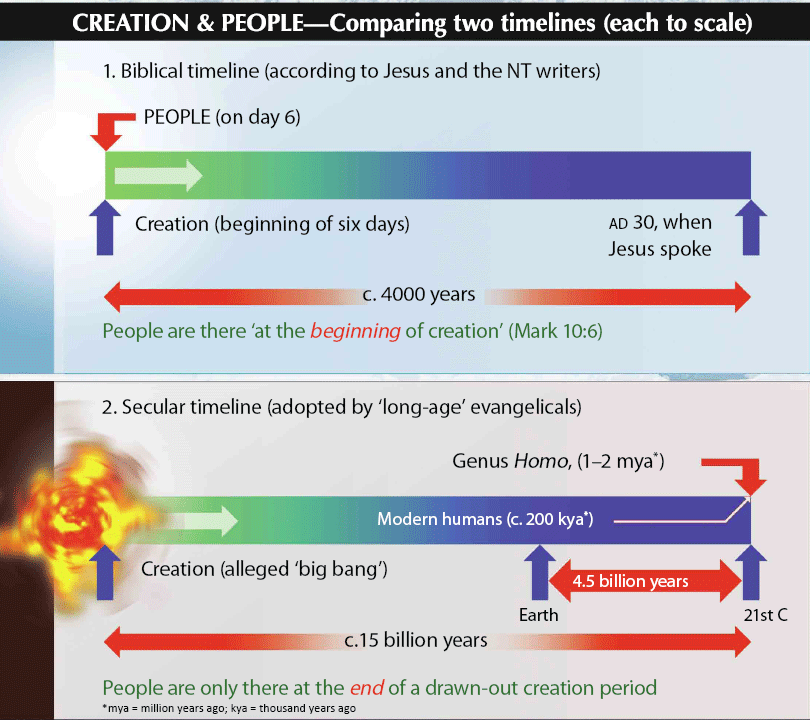
The standard secular timeline, from an alleged ‘big bang’ some 15 billion years ago to now, is accepted by most people in the evangelical Christian world, even though many would deny evolution. Some would even say that to dispute billions of years is to place an unnecessary stumbling block in the way of any scientifically-minded potential converts.

This is in contrast to the teaching of the Lord Jesus Christ, the Creator made flesh, as several of the biblical  authors, which makes it plain that this is wrong—people were there from the beginning of creation. But in the evolutionary timeline, people have only been around for one or two million years—this puts them toward the end of the timeline. This means that He is most definitely claiming that the world cannot be billions of years old.

For example, dealing with the doctrine of marriage, Jesus says in Mark 10:6 (bold emphases added):

But from the beginning of the creation, God made them male and female.

In Luke 11:50–51, Jesus also says: “That the blood of all the prophets, which was shed from the foundation of the world, may be required of this generation; From the blood of Abel to the blood of Zacharias … ”. And in Romans 1:20, the Apostle Paul says of God: “For his invisible attributes, namely, his eternal power and divine nature, have been clearly perceived, ever since the creation of the world, in the things that have been made. So they are without excuse.”.

Jesus, speaking around 4,000 years after creation, was correct to say that Day 6, when humans were created, was effectively ‘the beginning of creation’ as seen from thousands of years later.
Paul is plainly saying that people have been able to perceive these attributes of God in His creation ever since the creation of the world. Not ever since people were created.

Comparing the appearance of people on the timelines below, which are both to scale, is instructive. Jesus, speaking around 4,000 years after creation, was correct to say that Day 6, when humans were created, was effectively ‘the beginning of creation’ as seen from thousands of years later. By contrast, a creation fifteen billion years ago on the secular timescale would put humans at the end of the time scale. It shows clearly how the acceptance of the secular timeline starkly contrasts with the statements of Jesus.

Today, the vast majority of Christians in not only secular academia, but also theological institutions, Bible colleges, etc. believe—and many teach—that the secular ‘billions of years’ is fact. When one tries to find out how they deal with these repeated references, responses vary. But the ‘explaining away’ that takes place (whenever the problem is not simply ignored) invariably makes it plain that the authority being deferred to is not the Word of God, but rather current secular opinion.

Jesus and the age of the earth

The most striking (and sad) example of this switch in authority source I know of comes from a personal experience. In Melbourne, Australia, many years ago, I had arranged to sit down over a hot drink with a distinguished university professor, a Christian who was well-known for his active opposition to a straightforward view of Genesis. At that time, he was actually the head of a grouping of Christian academics which had been openly set up to provide opposition to the inroads our ministry was making. Over the years, this group has unfortunately been very effective in persuading most Christian training institutions that compromising on biblical creation in favour of secular thinking (evolution, long ages) is the only ‘respectable’ position. This professor himself, in addition to his secular science qualifications, was well regarded in the theological arena as well as being very biblically literate. He had at that time already been a frequent guest lecturer at several leading Australian evangelical training institutions.

During our courteous exchange, I asked him about the above comments by Jesus in relation to the age of the world. I asked, “Isn’t it clear that Jesus taught and believed that the world was young?”

A stunning response

I expected him to do as other Christian evolutionists have done—to try to find ways to torture the text to escape these obvious implications. Instead, he said that he totally agreed that Jesus believed in a recent creation of all things.

Somewhat taken by surprise, I said, “Well, how do you deal with that, then?” (He would of course have assumed, correctly, that I knew of the long-age position of this prominent organisation of theistic evolutionists.) His answer simply stunned me, to put it mildly. He said: “Jesus didn’t know as much science as we do today.”

His words burned themselves indelibly on my memory, while the recollection of my response has faded somewhat. But I recall saying something about Jesus being the Creator, God made flesh; He was there at creation, He does not lie, that sort of thing. To which his reply was once again unforgettable:

“Ah, but that’s where it gets very complex—it has to do with the theology of the Incarnation, where Jesus deliberately laid aside many of the things that had to do with His pre-incarnate divinity.”

Our conversation was nearing the end of its allotted period in any case, but I recall being so stunned by this that it took me till well afterwards to fully process the implications.

What it all means:

Firstly, and very importantly, the professor’s comments were a clear admission that the words of the Lord Jesus Christ Himself, as recorded in the Bible, confirm that He believed that things were recently created.

Remember that this professor was at the time the most prominent of all the professing evangelical academics that were being enthusiastically welcomed into Bible colleges and seminaries—to tell them why it was OK to believe in evolution and long ages. He obviously saw it as hopeless to try to claim other than what the Lord is clearly saying in this Bible text. And this is despite many attempts by others to ‘explain away’ this huge stumbling block for long-agers.

His way of being able to hold onto his theistic evolutionary view was to claim that Jesus was not lying, it was just that He was poorly informed. This was because when He as God the Son became flesh, laying aside aspects of His divinity included divesting Himself of all knowledge about what really happened when He had created all things.

If I had had the presence of mind, an appropriate response might have been to ask something like the following:

“OK, let’s assume for the sake of the argument that firstly, creation was by evolution, over millions of years of death and suffering—and that Jesus did perform some sort of lobotomy on Himself, so that He could no longer recall what really took place. So He just understood Genesis in the most natural straightforward way, not realising what the real truth was. What you’re claiming in that case amounts to this: That God the Father, knowing the real truth, permitted not just the Apostles, but His beloved Son, while on Earth, to believe and teach things that were utter falsehoods. Furthermore, it means that the Father permitted these false teachings to appear—repeatedly—in His revealed Word. With the result that for some 2,000 years, the vast majority of Christians were seriously misled about such things as not just the time and manner of creation, but gospel-crucial matters such as the origin of sin, and of death and suffering.”

[Added by author Nov 2014: The Lord Jesus repeatedly made it clear that His words and actions were on the Father’s authority, in all respects. Some examples are firstly John 8:28: So Jesus said to them, “When you have lifted up the Son of Man, then you will know that I am he, and that I do nothing on my own authority, but speak just as the Father taught me”. And John 12:49–50: “For I have not spoken on my own authority, but the Father who sent me has himself given me a commandment—what to say and what to speak. And I know that his commandment is eternal life. What I say, therefore, I say as the Father has told me.”]

If even Jesus’ words in Scripture can’t be trusted on some issues, how are we supposed to trust anything in the Bible at all?
One thing is very clear from all this. Namely, that the erroneous belief that ‘science’ insists that evolution and long ages are ‘fact’ is the most serious challenge to biblical authority, and thus to the faith in general, that Christendom has ever faced. If even Jesus’ words in Scripture can’t be trusted on some issues, how are we supposed to trust anything in the Bible at all? See also the box about the ‘kenotic heresy’.

Other leading theistic evolutionists have similarly made plain their belief that Jesus was mistaken. For example, on the American theistic evolutionary site BioLogos, led by Francis Collins, there appeared the following:

“If Jesus as a finite human being erred from time to time, there is no reason at all to suppose that Moses, Paul, John wrote Scripture without error. Rather, we are wise to assume that the biblical authors expressed themselves as human beings writing from the perspectives of their own finite, broken horizons.”

This is all the more serious because Jesus and the apostles used the history they taught to back up the theology that they taught. The Resurrection (1 Corinthians 15), marriage (Mark 10:1–12), atonement (Romans 5:12–21), and Heaven (Revelation 21–22:5) are only a few of the areas in which compromising Christians are theologically crippled, because they don’t have the same strong stand on Genesis that Jesus and the apostles did when they taught about these areas.

What a tragedy that so many Christian leaders have been bluffed and intimidated into assuming that secular interpretations of the evidence should dictate their understanding of God’s Word. And right at a point in history when there are more scientific reasons than ever to confirm the utter rationality of trusting the Bible, not evolutionary conclusions.

NEW ARCHAEOLOGY DISCOVERY CONFIRMS BIBLE’S ACCOUNT OF JESUS MINISTRY

Second Temple-era synagogue unearthed in northern Israel

Jesus archaeological discovery

The recently discovered ruins of a first century synagogue in Israel confirm historic accounts of Jesus’ life found in the New Testament.

Located near Mount Tabor in the Nahal Tavor Nature Reserve in the lower Galilee at a site called Tel Rechesh, the synagogue ruins date back to the time of the Second Temple period, which ended in AD 79 when the Romans attacked Jerusalem.

Motti Aviam, a senior researcher at the Kinneret Institute for Galilean Archaeology at the Kinneret College on the Sea of Galilee, explained in a statement the significance of the Tel Rechesh excavation find.

“This is the first synagogue discovered in the rural part of the Galilee and it confirms historical information we have about the New Testament, which says that Jesus preached at synagogues in Galilean villages,” explained Aviam, as reported by JNS.

Haaretz noted that while there have been seven other synagogues from the Second Temple period discovered before, the one at Tel Rechesh is the first to be found in a rural instead of urban setting.

“Inscriptions and historical sources show that the synagogues of the period were used for meetings, Torah readings and study, rather than worship. They had neither Torah ark nor regular prayer services,” reported Haaretz.

“One source mentioning synagogues is the New Testament, which states that Jesus ‘went through all the towns and villages, teaching in their synagogues.'”

In an interview with YNet News, Aviam explained why the findings at the Tel Rechesh site “makes the place very important for Christians.”

“During the same period Jesus was still a Jew who observed Jewish rituals and requirements and like many rabbis, he delivered sermons in synagogues. Christianity which developed after his (sic) placed an emphasis on his sermons at synagogues in the Galilee.”

Aviam added that he hoped “that when the work is completed the place will constitute a tourist attraction for Jews and Christians alike.”

This is not the first major find in Israel this year connected to the times of Jesus. In March it was reported that several artefacts from the first century Near East were located in an orphanage in Jerusalem.

As Jesus Himself claimed the Bible is inerrant. It is God’s Word to us, it can be trusted from Genesis to Revelation.


IN THE LAST DAYS; FALSE TEACHERS WILL ABOUND

The details of who God is, what He has done in the past, what He will do in the future, His plan of salvation, His character etc. is only revealed in the Bible. So without a trustworthy source of revelation, we can’t know whether we are trusting in the true God, or a figment of our imagination.

Peter Enns’ latest book “The Sin of Certainty” reads like the average atheist attempting to discredit the Bible, all the while assuring you that he’s a Christian trying to illuminate you on how to build your faith. It’s basically a re-hash of similar concepts we’ve seen before in his previous writings and reiterates that while the Bible doesn’t contain the truth, you can still believe and trust in God (whoever that might be) which of course is nonsense.

the-sin-of-certainty

The subtitle of Enns’ book is ‘Why God desires our trust more than our ‘correct’ beliefs’. He opines throughout on what he believes is the church’s (and the majority of Christians’) unhealthy emphasis on having correct beliefs and champions ‘deep trust’ in God instead.

Unfortunately almost the entire book highlights all of the contradictions, errors and wrong thinking that Enns says the Bible contains which caused him and many others to doubt its validity as real history!

  1. The theory of evolution (which proved the creation account was wrong).3
  2. Archaeology (showing the Bible’s creation story was co-opted from other ancient writings).4
  3. Textual criticism (showing Moses didn’t write the Pentateuch [the JEPD hypothesis]).5
  4. Bible contradictions (such as the Bible’s support/criticism of slavery).6

All of his arguments are rather simplistic and have been answered numerous times by various Christian apologists. A search on Creation.com for example reveals plenty of articles soundly dealing with each of them and it is surprising to find someone who declares himself a believer buying into such weak arguments against his professed faith.

For example in the chapter ‘Slavery: Whose side is God on?’ he accuses the Bible of teaching contrary doctrines (an all too common attack by naive atheists) where he says;

“On the one hand, slavery in the Bible was a given, and slaves were the property of the owner, just as in every other ancient society.”7

“On the other hand, some saw the exodus story as proof that God is in the business of liberating slaves.”8

Unfortunately almost the entire book highlights all of the contradictions, errors and wrong thinking that Enns says the Bible contains which caused him and many others to doubt its validity as real history!

But of course the story of the exodus isn’t the reason we know the Bible doesn’t condone slavery, it is because God’s word strictly forbids it!

“Whoever steals a man and sells him, and anyone found in possession of him, shall be put to death.” (Exodus 21:16)

Man-stealing, man-selling and man-holding is slavery. These are all acts done to people against their will. But there is a big difference between this and indentured servitude (which is what Enns describes as slavery) defined in the Bible.

Indentured servitude in the Old Testament was a wilful arrangement (by both parties) where someone could enter into a binding work contract with someone else to survive in a situation where they probably wouldn’t have in a far less civilised era before government welfare programs existed.

However, Enns quotes Exodus 21:20-21 and equates it to slavery such as the African American slave trade (where Africans rounded up Africans and sold them to American slave owners) when he says;

“I wonder whether African slaves ever felt like God had painted a number on their backs.”

But this is completely out of context. How could a seminary educated individual and Bible teacher like Enns not know this?

Creation

In his chapter on evolution Enns admits what Genesis plainly says.

“The problem for biblically centred Christians is that the Bible, right in the very beginning, tells us clearly that God created all life forms with a simple “Let there be … ” No common descent, natural selection, or billions of years required. So if Darwin was right, the Bible was wrong.”2

Now Enns is a committed theistic evolutionist and hence this isn’t a ‘problem’ for him. Which reveals he isn’t a ‘biblically centred Christian’. And he believes Darwin was right, which means he believes the Bible is wrong!

This would mean that God knowingly put contradictions in His word (or else the Bible isn’t actually inspired although Enns doesn’t comment on this directly). But proclaiming known contradictions amounts to lying (which is likely why Enns has a chapter blasphemously titled ‘God is a liar’9).

Perhaps Enns forgot Numbers 23:19 where Scripture makes something clear- “God is not a man, that He should lie, or a son of man, that He should change His mind.”

(But of course that could just be one of those parts of the Bible you don’t have to take as plainly written in Enns’ way of thinking.)

For Enns the truth of the Bible isn’t what’s important, it’s ‘trust’ in God. Of course the word ‘trust’ is defined as; ‘firm belief in the reliability, truth, ability, or strength of someone or something’. So Enns shoots himself in the foot in his basic premise. How are Christians supposed to trust in God if His revelation to His people is un-trustworthy?

Fuzzy logic

Enns’ approach is much like the ‘fuzzy’ emergent church musings of Rob Bell and Brian McLaren (both of whom also believe in evolution as fact). Because of their ‘non-absolutist’ writing style careful analysis is required to prevent being drawn into their nonsensical way of thinking. For example Enns says;

“This book is about thinking differently about faith, a faith that is not so much defined as by what we believe but in whom we trust. In fact, in this book I argue that we have misunderstood faith as a what word rather than a who word—as primarily beliefs about rather than primarily as trust in.” (Page 22)

“Trust works regardless of where our thinking happens to be at the moment. But when correct thinking is central to faith, we transmit onto God our own distorted mental image of God, with all its baggage, hang-ups and deep fears.” (Page 23)

This may sound rather deep and enlightening until you break it down. According to Enns, faith is a ‘who’ word. OK, so who am I to trust? Well, God. But who God is can only be determined by special revelation.

General revelation is sufficient for anyone to know that God exists (because of the creation as per Romans 1:20), but the details of who God is, what He has done in the past, what He will do in the future, His plan of salvation, His character etc. is only revealed in the Bible. So without a trustworthy source of revelation I could not know whether I was trusting in the true God or a figment of my imagination (see below).

Incredibly, Enns spends an inordinate amount of time quoting Scripture authoritatively and telling you what he thinks it means to convince you that you can’t take it as plainly written (authoritatively) which is self-defeating.

So Enns is wrong in saying focusing on ‘correct thinking’ leads to creating God into our own ‘distorted mental image’, it is rather focusing on wrong thinking (by definition) that does so!

What kind of God does Enns believe in?

Enns says he used to be orthodox in his thinking. What caused him to view God differently? A Disney movie on a plane trip!

Enns says he used to be orthodox in his thinking. What caused him to view God differently? A Disney movie on a plane trip!

“A fifty-two second exchange in a movie … And the next thing I know, my view of God flies away as if sucked out the window due to a loss of cabin pressure.”10

Recounting watching Disney’s Bridge to Terabithia he describes an exchange between two young girls discussing the Bible. Leslie (a non-Christian) announces “I seriously do not think God goes around damning people to hell. He’s too busy running all this … ”

Enns describes how this dialogue caused him to be “ … nostril deep in a faith crisis … ”

“How was I to know that the company that gave us Mickey Mouse, Goofy, and Son of Flubber would venture deep into a religious debate? I was just minding my own business at thirty thousand feet over the Midwest and was caught off guard. Me—a professional Christian, a seminary professor paid to think right thoughts about God and to tell others about them. But after a long trip, my orthodoxy shield was resting at my side. I was unarmed, and Leslie’s words hit their mark. In a flash and without words, I thought quietly to myself, I think Leslie’s right.

The idea that the Creator of heaven and Earth, with all their beauty, wonder, and mystery, was at the same time a supersized Bible thumping preacher, obsessed with whether our thoughts were all in place and ready to condemn us to eternity to hell if they weren’t, made no sense—even though that was my operating (though unexamined) assumption as long as I could remember.”

Now the idea that a seminary trained Christian Professor’s belief in God was devastated by a fictional children’s character making such a simplistic ‘objection’ is bad enough. But the fact that the view he had of God was of a ‘supersized Bible thumping preacher’ should set alarm bells ringing for believers as to whether Enns has ever known who God is.

In fact Enns reveals that he believes in a god that he wants to believe in (rather than the God revealed in Scripture):

“ … Leslie’s God was the one I, deep down, wanted to believe in.”11

And ultimately he admits he’s thought this way for a long time;

“ … judging by an old journal I stumbled on from my early twenties, these themes have been my home base for over thirty years.”12

Certain that certainty is sin

“All this to say that a faith in a living God that is preoccupied with certainty is sin, for it compromises the gospel—personally, locally, and globally.”13

But how does Enns know this (he seems preoccupied with repeating it throughout his book and sounds quite certain about it)? He cannot point to a specific Scripture to back it up, and even if he tried to use words from the Bible to verify his claim he has already stated that the words in the Bible are not ultimately trustworthy. So Enns is just relying on his own mind to determine truth. He has become the god he follows.

Enns is excellent at posing questions that supposedly ‘expose’ contradictions in the text in order to dismiss the plain reading of Scripture as valid. But like most modern theological de-constructionists, he never then gives you a replacement interpretive methodology that should be applied except for his opinion.

Half way through the book one feels like Mowgli from the Jungle book, all wrapped up in the ever tightening coils of the serpent Kaa mesmerised by the hypnotising drone of “Trust in me, just in meeeee!”

This is likely to leave any reader that adopts his ideas to logically conclude that there is no universal way to understand Scripture and that whatever you decide to think or feel about the text is OK.

A wolf in sheep’s clothing

2 Peter 2:1 says “ … there will be false teachers among you, who will secretly bring in destructive heresies, even denying the Master who bought them, bringing upon themselves swift destruction.”

It’s hard not to think of Enns in this way. If I were (still) an atheist and I wanted a resource to try and steer someone away from the Christian faith in a ‘friendly’ way I don’t think I could find a better means to do so than give them a copy of his book.

Remember Peter Enn’s is the Professor of Biblical Studies at Eastern University Philadelphia which is ranked in the top tier of USA North Regional Universities in 2015. Sadly many of them are facing an eternity in hell from this man’s false teaching.

Book review by Calvin Smith of Creation Ministries

EVIL IS A SPIRITUAL BATTLE

Evil is a spiritual battle, well before it is a physical one.

FRANCE-ATTACK-NICE

An unidentified gunman barrelled the truck two kilometres through a crowd that had been enjoying a fireworks display for France’s national day before being shot dead by police.

The physical cannot even test, let alone defeat the spiritual. The natural is toothless when faced by the supernatural. This earth, this visible universe is not all there is. Reality is not measured by the five senses. Reality lives eternally beyond any mere man’s perceptions. Human imagination can not account for all it is unable to see, try as it might. History is heading somewhere. God is in control and He has revealed in His Word, the end-time scenario.

Mankind’s skills are as impotent to prevent evil as legislation is incompetent.

The Fight against Evil (Ephesians 6:10 CEV)

Finally, let the mighty strength of the Lord make you strong. 11 Put on all the armour that God gives, so you can defend yourself against the devil’s tricks. 12 We are not fighting against humans. We are fighting against forces and authorities and against rulers of darkness and powers in the spiritual world. 13 So put on all the armour that God gives. Then when that evil day[a] comes, you will be able to defend yourself. And when the battle is over, you will still be standing firm.

Be ready! Let the truth be like a belt around your waist, and let God’s justice protect you like armour. 15 Your desire to tell the good news about peace should be like shoes on your feet. 16 Let your faith be like a shield, and you will be able to stop all the flaming arrows of the evil one. 17 Let God’s saving power be like a helmet, and for a sword use God’s message that comes from the Spirit.

Never stop praying, especially for others. Always pray by the power of the Spirit. Stay alert and keep praying for God’s people.

Article from Soul Snacks

2500 year old Judah soldiers handwriting discovery confirms Gods word is true

Israeli archaeologist Prof. Ehud Netzer displays the shard from a 2,000-year-old amphora bearing the name of “Herod the Great, King of Judea” July 9. The unique ceramic shard, found during a recent archaeological dig on the ancient desert fortress of Masada, came from a large amphora used for shipping Italian wine to the king who ruled the holy land at the time of Jesus’ birth.

2500 years old pottery
The discovery in question refers to findings posted in April by Israel’s Tel Aviv University, in the Proceedings of the National Academy of Sciences, which demonstrates that it was not only the elites who could read.

“We’re dealing with really low-level soldiers in a remote place who can write,” said Israel Finkelstein, an archaeologist and biblical scholar at Tel Aviv University. “So there must have been some sort of educational system in Judah at that time.”

Finkelstein suggested that what this discovery means is that people in the kingdom had the capacity to write and put together parts of the Old Testament even earlier than it was believed.

“There’s a heated discussion regarding the timing of the composition of a critical mass of biblical texts, but to answer this, one must ask a broader question: What were the literacy rates in Judah at the end of the First Temple period? And what were the literacy rates later on?” the researcher elaborated.

The Bible states in Genesis 5:1, that Adam, the first man in the Bible, had the ability to speak and write.

The Israelites were commanded to write the commands of the Lord on their door posts and bind them on their hands and foreheads (Deuteronomy 6:4–9, 11:18–20), if they could not read or write, what would be the point of these commands?

Most conservative biblical scholars who start with God’s Word believe the Old Testament record that the books were written by the persons associated with them or those who claim to have written them. They also accept that these books were written during the time period they claim to have been written in (e.g., the prophet Isaiah during the reigns of the pre-exilic kings Uzziah, Jotham, Ahaz, and Hezekiah). If these books were not written until decades or even centuries after the events happened, the historicity, accuracy, and infallibility of the texts are called into question since they claim to have been written much earlier.

The pottery shards discovery in Judah, supports the accuracy of God’s Word, because it shows that Israelites were more literate than many scholars believe.

“If history has taught anything, it’s that eventually research and science will confirm Scripture. We have an imperfect and incomplete understanding of history and science, but God’s Word was ultimately written by the God who was there and who never lies (Titus 1:2),” the article added.