PROOF BIBLE AUTHORS INSPIRED BY GOD

Just look at what God revealed to Isaiah about Jesus. Isaiah the Prophet wrote a stunningly accurate portrait of Jesus’ all-encompassing work before, at, and after the cross.

BEFORE THE CROSS

In Isaiah 53, he states “Who has believed what he has heard from us? And to whom has the arm of the Lord been revealed” (Isaiah 53:1). This is an accurate prediction: not many continued to follow Jesus after some of His hard teachings (John 6:66). Not many believed it in the end. At the Cross, they all fled. The crowds liked the fish and loaves of bread, but they were not willing to follow Him.

Jesus was a carpenter (Mark 6:3), and he probably looked just like any other Jew of the day. What does Isaiah tell us about Jesus’ physical appearance?  

“He had no form or majesty that we should look at him, and no beauty that we should desire him” (Isaiah 53:2).

The religious crowd despised Jesus for claiming to be Who He really was. Did Isaiah predict this happening?

He was despised and rejected by men, a man of sorrows, and acquainted with grief; and as one from whom men hide their faces he was despised, and we esteemed him not.Isaiah 53:3

AT THE CROSS BEFORE AND DURING HIS CRUCIFIXION

When taken before the Roman Governor, Pontius Pilot we know that Jesus did not try to defend himself. Could Isaiah have been shown this simple fact?

He was oppressed, and he was afflicted, yet he opened not his mouth; like a lamb that is led to the slaughter, and like a sheep that before its shearers is silent, so he opened not his mouth.Isaiah 53:7

Jesus took upon Himself the sins of the world, motivated by the love of God (John 3:16). Could Isaiah have been shown this 700 years before Jesus came to earth and in such detail?

Surely he has borne our griefs and carried our sorrows; yet we esteemed him stricken, smitten by God, and afflicted. But he was pierced for our transgressions; he was crushed for our iniquities; upon him was the chastisement that brought us peace, and with his wounds, we are healed. All we like sheep have gone astray; we have turned every one to his own way, and the Lord has laid on him the iniquity of us all.Isaiah 53:4-6

Yet it was the will of the Lord to crush him; He has put him to grief; when His soul makes an offering for guilt, He shall see his offspring; He shall prolong his days; the will of the Lord shall prosper in His hand. Out of the anguish of His soul He shall see and be satisfied; by His knowledge shall the righteous one, my servant, make many to be accounted righteous, and He shall bear their iniquities.Isaiah 53:10-11

AFTER THE CROSS

Could Isaiah have been shown details of Jesus’ death and burial? Once again in astonishing detail. We know that Joseph of Arimathea was the rich man who gave Jesus his own grave (Matthew 27:60).

By oppression and judgment he was taken away; and as for his generation, who considered that he was cut off out of the land of the living, stricken for the transgression of my people? And they made his grave with the wicked and with a rich man in his death, although he had done no violence, and there was no deceit in his mouth.Isaiah 53:8-9

Does God reveal anything about the ultimate destiny of the nation, Israel, which He established for His purposes?

For a brief moment I deserted you, but with great compassion, I will gather you. In overflowing anger, for a moment I hid my face from you, but with everlasting love, I will have compassion on you,” says the Lord, your Redeemer. “This is like the days of Noah to me: as I swore that the waters of Noah should no more go over the earth, so I have sworn that I will not be (forever) angry with you, and will not rebuke you. For the mountains may depart and the hills be removed, but my steadfast love shall not depart from you, and my covenant of peace shall not be removed,” says the Lord, who has compassion on you.Isaiah 54:7-10

Israel has a glorious future ahead with Jesus ruling and reigning with the Saints during His Millennial reign on this earth. Will you be there? Start living eternal now ready for Jesus’ return.

They (Saints) came to life and reigned with Christ for a thousand years. The rest of the dead did not come to life until the thousand years were ended. This is the first resurrection. Blessed and holy is the one who shares in the first resurrection! Over such the second death has no power, but they will be priests of God and of Christ, and they will reign with him for a thousand years.” Revelation 20:4-6

ARCHAEOLOGY CONFIRMS THE BIBLICAL DATE OF THE EXODUS

SUBMERGED RUINS OF 3,400-YEAR-OLD MITANNI CITY REVEALED BY DROUGHT

One reason this location is of great interest is that Mitanni is mentioned in the Bible’s book of Judges. In standard dating, the Mitanni kingdom ruled the northern Tigris-Euphrates region from before 1600 BC until about 1350 BC when it was overtaken by the Assyrian Empire. It became a weakened province of Assyria for about a century before fading from the historical record.

Mitanni’s history makes a strong argument against a late Exodus date (also known as the Rameses Exodus date) in the 1200s BC since there is good evidence that Othniel, one of Israel’s first judges, was fighting against a Mitanni invasion in Judges 3. A Rameses Exodus date would put the judge Othniel in the 1100s BC and about two centuries after Mitanni ceased to be a strong kingdom, thus showing that the Exodus must have been much earlier.

The following video produced by Creation Ministries is helpful in understanding the Bible and the archaeological discoveries that support Biblical events and dates. Can I suggest you go to http://www.creation.com and search “Bible and archaeology” where you will find that many archaeologists have found the Bible to be an accurate historical document.

Were the Bible’s stories made up long after the fact, or do the accounts preserve eyewitness testimony? See how archaeology supports the Bible.

IMPORTANT NEW EVIDENCE FOR LANDING SITE OF NOAH’S ARK

Background on the two authors of this article: Ken Griffith is currently researching the Neolithic Era and its implications for biblical chronology. Darrell K. White has extensively researched the ancient chroniclers and found consistency with biblical chronology. He and Ken are now converting that research into a book called The Chronological Framework of Ancient History.

Article “Candidate site for Noah’s Ark, altar, and tomb” in the latest edition of the Journal of Creation, Volume 35, issue 3, 2021.

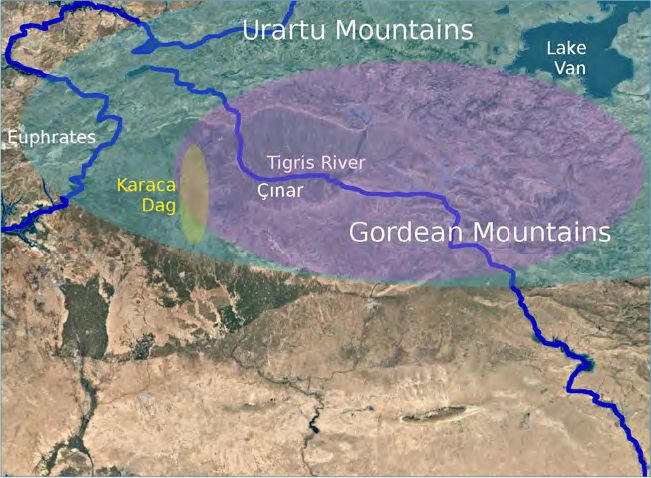
a figure estimated locations of urartu
Karaca Dag lies very near the centre of the Prepottery Neolithic A (PPNA) culture sites and the wild ranges of the eight Neolithic founder crops. To this, we can add the first viticulture and the first domestication of dogs and pigs. The evidence that virtually every aspect of farming began on or near Karaca Dag strongly suggests this is the most likely Ark landing site.

While researching a Babel candidate site near Diyarbakir, Turkey, on 3 October 2019, they found a complex of sites on the mountain Karaca Dag that, upon further examination, seem to match the description of the landing site of Noah’s Ark, along with a tomb, possible altar, and much more. The tomb is a 60-m-square, rough stone mastaba, oriented to the winter solstice sunrise, with two extensions that make it into roughly a 160-m-long boat shape. The site is marked by six or more geoglyphs, situated along an arc 5 km distant on the northwest side of the mountain. The possible remains of the Ark appear to have had a modern school built on them, now collapsed.

We would expect to find the landing site of the Ark near the centre of the oldest post-diluvial distribution of humans and domesticated plants. The site presented in this paper lies upon a mountain between the Tigris and Euphrates Rivers at the centre of the Pre‑Pottery Neolithic A (PPNA) Culture.

This mountain, Karaca Dag, is where the genetic ancestor of all domesticated Einkorn wheat was found by the Max Planck Institute. The other seven founder crops of the Neolithic Revolution all have this mountain near the centre of their wild range. This was so exciting that even the LA Times remarked how unusual it is that all of the early agriculture crops appear to have been domesticated in the same location:

“The researchers reported that the wheat was first cultivated near the Karacadag Mountains in southeastern Turkey, where chickpeas and bitter vetch also originated. Bread wheat—the most valuable single crop in the modern world—grapes and olives were domesticated nearby, as were sheep, pigs, goats and cattle.”

If this site is what we suspect it to be, then the Ark itself has long ago rotted away, leaving nothing but a long patch of gravel ballast and perhaps some broken pottery. Coordinates: 37°42’45.76″N 39°49’57.68″E Upon the gravel patch a school for shepherd children was built in 1928, now collapsed.

The adjacent stone tomb appears unscathed. Further away on the slopes of the mountain several geoglyphs mark the site. Two of them appear to contain writing in an unknown script.

In addition to the geoglyphs, there is evidence of ancient human habitation, farming, roads, and terraces on both ends of the mountain, 10 km north and south of the tomb and Ark site.

We will also review evidence that the site was desecrated in ancient times, making us less surprised to see recent desecrations.

Criteria

Ark searchers have claimed to find petrified wood or a frozen, intact wooden structure above the permanent snowline. Unless it landed at an elevation above 3,000 m, we expect any wood to have rotted away long ago.

Low-value imperishable materials might survive. Considering that the Ark carried a large cargo of relatively low-density foodstuff such as hay, it seems likely that it would have required ballast to ride low enough in the water. Any ballast is likely to still be there in the footprint of the vessel. We would expect to find a foreign patch of gravel, sand, or stones.

Food stores in the Ark must have been placed in rodent-resistant vessels. Therefore, we should expect to find fragments of broken vessels.

Noah built an altar nearby. Earth and stone are the only known materials for an altar for animal sacrifice (Exodus 20:24–25). The altar should have survived in some form unless it was destroyed by religious vandalism.

Extrabiblical sources inform us that Noah was buried on top of the mountain near the Ark. St Ephraim lived in both Amida (Diyarbakir) and Edessa (Sanliurfa), adjacent to Karaca Dag. He said that Noah’s tomb was near the Ark site. Hippolytus recorded the tradition that Noah brought the bones of the pre-Flood patriarchs in the Ark and reburied them after the Flood.

Other probable criteria:

  • Region of ‘RRT’ (Urartu, Ararat, Aratta)
  • Mashu or Masis (names of Ararat in Sumer and Armenia)
  • Villages on the mountain top
  • East-west axis to the site of the Tower of Babel (Genesis 11)
  • Nearby tombs of Noah and/or Pre-Flood Patriarchs

Finding the right mountain

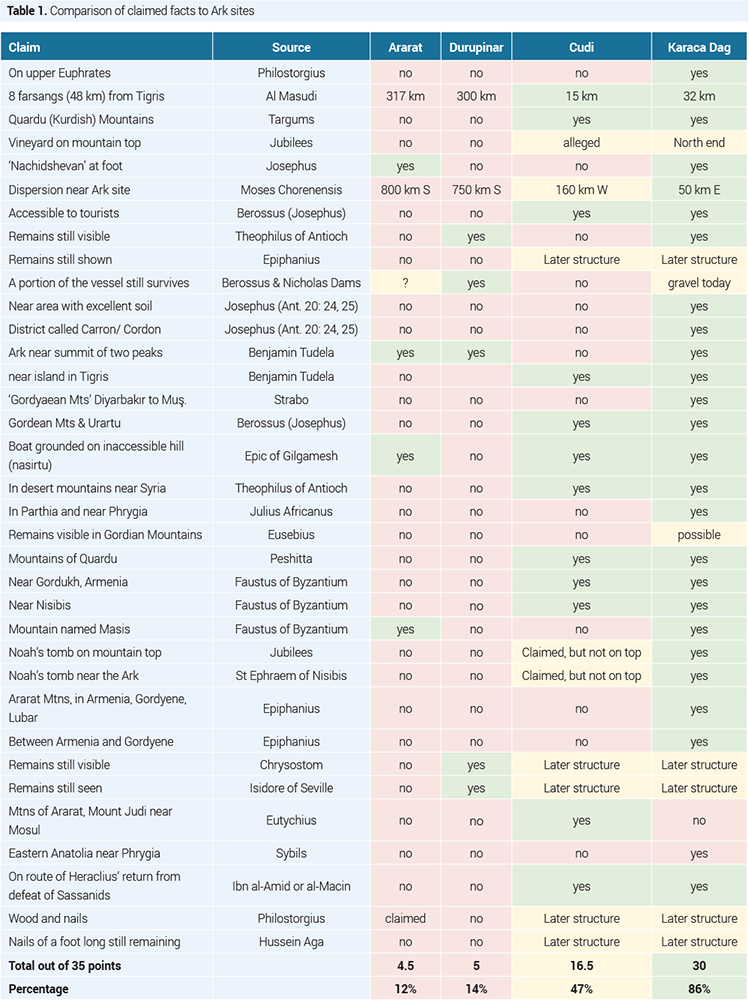
We analyzed the traditions of the church fathers, Midrash, Book of Jubilees, and other historical sources for the Ark, with gratitude to Bill Crouse who did an excellent job compiling those sources in order to justify Mt Judi as the Ark site. For this comparison, we used the following pairings of Ark and Babel sites: Ararat-Babylon, Durupinar-Babylon, Judi-Tel Brak, Karacadag-Çinar. Table 1 compares proposed Ark sites using these criteria. For each of 35 claimed facts, one point was awarded for a strong positive, one-half point for a weak positive, and zero points for a negative.

a table comparison of claimed facts
This image has an empty alt attribute; its file name is d737d3c3d80d0e0015636589fce4b6d2.jpg