MIKE JOHNSON GOT IT RIGHT – JOE BIDEN WAS GOD’S APPOINTMENT FOR PRESIDENT

The House Speaker, Republican Mike Johnson, was asked by an unidentified member of the media at the weekly press conference for GOP leadership on Jan. 17 whether he thinks President Joe Biden’s victory in the bitterly contested and politically heated campaign was, in fact, “God’s will.”

Johnson, a 51-year-old Evangelical who was elected speaker last fall after receiving the backing of former President Donald Trump, told reporters he believes Biden’s victory “must have been God’s will” because of his personal faith in the Scriptures.

“I said in my speech before I took the gavel that, look, I’m a Bible-believing Christian, right? A Bible-believing Christian believes what the Bible says, right?” Johnson replied. “The Bible says that God is the one who raises up people in authority.”

He explained that not only does he believe God is “sovereign,” but that America’s Founding Fathers held a similar view. Johnson pointed to the Declaration of Independence, a document he said shows the Founding Fathers “acknowledge[d] that our rights don’t come from government, they come from God, and we’re made in His image. “Everybody’s made the same,” added Johnson. “We all are given equal rights and value and that’s something that we defend.”

Based on those beliefs, he said, “then you believe that God is the one that allows people to be raised in authority.” “Biden’s election must have been God’s will then. That’s my belief,” said Johnson.

At times, God ensures we get the government we deserve so that we live with the consequences. Fortunately, God has shown us what will unfold in the future as the world turns its back on God and lives as if he does not exist.

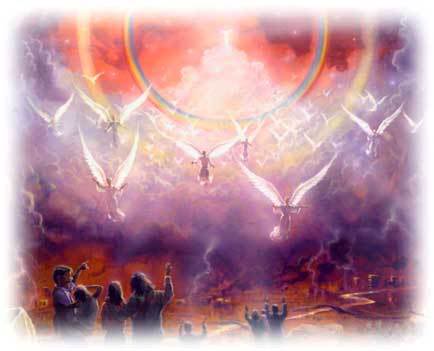
In the Olivet Discourse (Matthew 24:36-39, Luke 17:26-27) Jesus told us that in the last days before He returns to Earth to enforce righteousness the world will be like it was in the days of Noah, evil and lawlessness will abound. We are even told that Satan and His demons are cast out of heaven and Satan knowing his time is short takes over the body of the Antichrist and declares himself to be God. During the reign of the Antichrist, for Christians, it will be like the time of the early church, it will be a time of great persecution. It will also be a time for the church, empowered by the Holy Spirit, to shine, knowing their redemption is close.

For the powers of the heavens will be shaken. And then they will see the Son of Man coming in a cloud with power and great glory. Now when these things begin to take place, straighten up and raise your heads because your redemption is drawing near.” Luke 21:26-28

WHAT DOES GOD LOOK LIKE?

As Christians, we have a fair understanding of God’s characteristics, such as love. But what does He look like? Scriptures clearly tell us that He has fire from His waist up and from His waist down, and it’s mingled with electricity. The word in Hebrew is Ashman, which means “electricity.” In Greek, it’s electros, again “electricity.” We see in other places that it’s lightning. So you have this fiery, lightning, kind of God that cannot have sin or corruption in His presence, not because He doesn’t like us, but just because we’re incompatible. Daniel says His throne was a fiery flame, its wheels a burning fire; a fiery stream issued and came forth from before Him. Imagine being in the presence of God and all of His blazing fire. Now imagine going up to God and giving Him a hug. How would that feel? That would really be the end of your day, wouldn’t it? Because you cannot do that, I cannot do that, in our present bodies we are incompatible with God. 

So God put a veil between heaven and earth, until that time in the future when the veil will be lifted. Actually, God is the one who left the Garden and He cursed the Cosmos and allowed mankind to live on planet Earth for a limited life span. But on occasion, that veil was opened so that people could see through. Stephen, when he was being stoned, gazed into heaven and saw the glory of God. He said, Look! I see the heavens opened and the Son of Man standing at the right hand of God! Acts 7:56 This is just one occasion when God allowed people to see beyond that veil. John says in Revelation, “Now I saw heaven opened”. Rev. 19:11 

There were so many places where the heavens were opened and people were able to see just through a little bit. When Elisha and his servant were surrounded by the Syrians, Elisha prayed that God would open his eyes and then he saw horses and chariots of fire (2 Kings 6:17). It was like Elisha’s servant put on his decoder glasses, and could then see beyond into that other realm and he could see what was behind the veil. God’s desire has always been to dwell with men openly, without any kind of a veil, with nothing between us, and completely exposed, one to another. This is His great desire.

The day is coming; and it will happen after Jesus’ Millennial reign on this Earth, the second resurrection of the dead, and the White Throne Judgement that the righteous will dwell with God on the new Earth.

And he who sits on the throne will dwell among them.” Revelation 7:15

The tabernacle of God is with men, and He will dwell with them, and they shall be His people. God Himself will be with them and be their God. Revelation 21:3


WHOM DO YOU WORSHIP?

Everyone worships something . . . that is just how God made us. But in a world that is corrupted by sin and in constant rebellion to its Creator, that worship gets distorted and twisted in ways that dishonor God. We can understand how that would happen in a jungle tribe where there is no direct access to what God has revealed about the right way to offer worship, but what about in America today? There is access to the Bible on everyone’s phone or laptop, and the instructions are clear.

But That’s the Problem

Many people claim that the problem is just that—the God of the Bible is much too demanding. He expects people to only worship him, follow a list of rules, act a certain way, hang out with certain people, and avoid certain people. So many expectations and such harsh judgment! They would prefer a loving god who accepts them for who they are and validates their choices. If they could find that god, they would probably worship him . . . or her.

A recent commercial from Apple has a ‘Mother Nature’ Figure and the Divine Feminine. It presents several illogical aspects, as we would expect from any worldview that doesn’t begin with God’s Word as its foundation. The key point comes in replacing God with a goddess and attributing his attributes to her. This goddess claims the weather was “however I wanted it to be”, then why doesn’t she just fix climate change? People accuse God of being a capricious, malevolent bully who could exercise his omnipotence to end suffering if he wanted (an oversimplified view that divides God’s character rather than acknowledging his whole being), but this seems to be overlooked in this Mother Earth character. She is claiming to have all-powerful control over the weather, the same ability as the true God. If she can make the weather however she wants it, then why doesn’t she do something about famines and wildlife population devastation through habitat loss (from wildfires, flooding, etc.)? It sounds like she really doesn’t care about these things. And it sounds like she is capricious and malevolent. Yet these technocratic overlords are willing to worship this goddess and demand everyone do the same while telling Christians that our God is evil for not preventing hurricanes, droughts, and melting ice caps. It seems there is a double standard at play.

Dr. Owen Strachan addresses many of these aspects in his Grace & Truth podcast episode “Apple’s ‘Mother Nature’ Figure and the Divine Feminine.” As Dr. Strachan notes, it is not a rejection of any divine being, but the embrace of a divine image that condemns people for their actions and requires sacrifices for those sins. She doesn’t offer up herself, but her gospel is a message of work harder and do more to prove you are worthy of my affection—that is a capricious and malevolent god. The gospel of our technocrat overlords, as Dr. Strachan calls them, is not a gospel of grace, but a gospel of works, which demands acts of sacrifice before love is extended.

NATURAL LAWS EXIST BECAUSE THE UNIVERSE HAS A CREATOR

Democracy without the Ten Commandments, without God’s morality, is destined to fail. Whilst Americans were Bible-based, democracy was great but without it, America is becoming lawless. The professors at prestige universities that were started by Bible-believing Christians are now morally bankrupt including those teaching Theology. The Bible is no longer considered to be God’s Word and therefore inerrant. Evolution and the Big Bang are considered adequate to explain the origins of the Cosmos and yet the evidence of complex design, irreducible complexity, and the universe obeys certain rules—laws to which all things must adhere, prove they are totally inadequate. These laws are precise, and many of them are mathematical in nature. The law of biogenesis states that life always comes from life. Both observational science and Genesis 1 tell us that organisms reproduce after their own kind.

Natural laws are hierarchical in nature; secondary laws of nature are based on primary laws of nature, which have to be just right in order for our universe to be possible. But, where did these laws come from, and why do they exist? If the universe were merely the accidental by-product of a big bang, then why should it obey orderly principles—or any principles at all for that matter? Such laws are consistent with Biblical creation. Natural laws exist because the universe has a Creator God who is logical and who has imposed order on His universe.

Despite billions of dead things buried in rocks all over the world and the abundance of fossil fuels the worldwide flood of Noah’s day is considered a myth. Also, stories about a worldwide flood are found in historical records all over the world? According to Dr. Duane Gish in his popular book Dinosaurs by Design, there are more than 270 such stories, most of which share a common theme and similar characters. So many flood stories with such similarities surely prove they come from the Flood of Noah’s day.

It is important to remember why God destroyed all of mankind with a worldwide flood.

Now the earth was corrupt in God’s sight, and the earth was filled with violence. And God saw the earth, and behold, it was corrupt, for all flesh had corrupted their way on the earth. And God said to Noah, “I have determined to make an end of all flesh, for the earth is filled with violence through them. Behold, I will destroy them with the earth” Genesis 6:11-13

It is also important to remember that the Bible tells us that in the last days before Jesus returns, scoffers will deliberately overlook the fact that God destroyed mankind except for eight people by the flood of Noah’s day. Moreover, He tells us how the story ends.

Knowing this, first of all, that scoffers will come in the last days with scoffing, following their own sinful desires. They will say, “Where is the promise of his coming? For ever since the fathers fell asleep, all things are continuing as they were from the beginning of creation.” For they deliberately overlook this fact… the world that then existed was deluged with water and perished. But by the same word, the heavens and earth that now exist are stored up for fire, being kept until the day of judgment and destruction of the ungodly.2 Peter 3:3-5

BEING OUT OF TOUCH WITH ETERNAL REALITIES

What Makes Someone a Fool?

In Christ’s story of the rich fool, a man decides to hoard his fortune and then “take life easy; eat, drink and be merry” (see Luke 12:13-21). The word translated “fool” literally means “unthinking one.” Mindless. Senseless. The rich fool was out of touch with eternal realities. Despite death’s inevitability, he failed to prepare for it—and failed to remember that he would give an account to God.

For we will all stand before the judgment seat of God; for it is written, “As I live, says the Lord, every knee shall bow to me, and every tongue shall confess to God.” So then each of us will give an account of himself to God.Romans 14:10-12

The rich fool stored up treasures for himself on Earth as if he were the center of the universe and as if this world was where he’d live forever. The man was a fool to imagine his silver, gold, crops, land, and barns were actually his. He was a fool to ignore God’s claims on him and his possessions:

A wise person will regularly ask, “Lord, what do you want me to do with all you have put in my hands?” God’s Word tells us exactly how to prepare now for the afterlife. Though our culture and even some of our Christian friends may encourage us to do so, we don’t have to live like fools!

In the world’s eyes, the rich fool was a great success. Today he would be admired, and he might even be placed on a church or ministry board. But in the end, all his success counted for nothing.

Had the rich fool acknowledged God as his Creator and Redeemer, and as the ultimate owner of everything he possessed, he would have been rich toward God and stored up treasures in Heaven. Instead, he stored up for himself treasures on Earth and was suddenly and eternally parted from them at death.

The most troubling aspect of this parable is that if we met this man, most of us would commend him for his foresight. Notice he isn’t called the rich sinner, but the rich fool.

If you have been raised to believe in the Big Bang and evolution then death is then end of life period. There is no life after death.

Materialists Are Self-Destructive Keepers

Christian Smith and Hilary Davidson observed this about those who fail to live generous lives:

By holding onto what we possess, we diminish its long-term value to us. In protecting only ourselves against future uncertainties and misfortunes, we become more anxious about uncertainties and vulnerable to future misfortunes. In short, by failing to care well for others, we actually do not properly take care of ourselves.

Christ-followers are self-enriching givers. Why? Because giving inevitably enlarges our hearts, lives, and capacity for joy.

Don’t misunderstand. The true good life doesn’t say no to wealth or pleasures. Rather, it says yes to greater and lasting wealth and pleasures that are found when we cheerfully part with God’s money and possessions for others’ good and God’s glory.

God graciously gives us money and possessions to meet real needs, both our own needs and the needs of others. He wants us to enjoy life, but He doesn’t entrust excess to us so we can indulge excessive wants. Money and possessions are not life-giving. They are utterly incapable of imparting to us the identity, purpose, significance, and security we crave.

I recently heard someone talk about the rampant unhappiness, disease, and disillusionment he and his friends experienced while, he said, they were “living the good life.” Though I put that phrase in quotation marks, this person didn’t use air quotes or note the irony that what he called the “good life” was in fact devastatingly bad. In his case, the “good life” included drugs and sexual immorality, which led to the loss of his wife and children, and ultimately left him utterly empty.

Even when this so-called good life brought times of enjoyment, it was only “the fleeting pleasures of sin” (Hebrews 11:25). Such pleasures don’t even last in this world, and they certainly won’t outlive this life. The rich man in Christ’s story learned the hard way that his prosperity was short-lived. It came to a dramatic and eternal end at his death, when God proclaimed, “You fool!”

Our Source of Life

To understand what constitutes the good life, we need to understand what life really is, where it comes from, and where it’s going.

God is the eternal source of life. He gave human beings “the breath of life” (Genesis 2:7), and He designed the first people to experience communion with Himself, the living God. In the presence of Eden’s tree of life (Genesis 2:9), He walked with Adam and Eve as they enjoyed a life-giving and delightful relationship (Genesis 3:8). God warned them, though, that if they ate of the fruit of one particular tree, this beautiful life would tragically end in death (Genesis 2:17).

They disobeyed, and as promised, sin brought death. While Adam and Eve’s physical death came gradually, the end of their life-giving spiritual relationship with God was immediate. The Holy Spirit departed their spirit.

Ever since, people have lived in a state of spiritual death, with dying bodies, decaying relationships, and failed dreams. Death is the new normal. But that’s not the end of the story. The good news of the gospel is that Jesus’ sacrifice conquers sin and death on our behalf.

John’s Gospel tells us that God created the world through Jesus, bringing life and light to His creation (John 1:1-5). He raised Lazarus from the dead to display His power to make dead people alive again (John 11:42-44). Then He, too, rose from the grave, ensuring the ultimate death of sin and the defeat of death itself. His resurrection gives us life (Romans 4:25). His coming back to life is the basis of God’s moving us from death to life (1 Corinthians 15:17).

Jesus calls Himself life in these four passages: the bread of life (John 6:48), the light of life (John 8:12), the resurrection and the life (John 11:25), the way, and the truth, and the life (John 14:6)

There’s no way to overestimate the importance of life in John’s Gospel. John tells readers his Gospel was written: “that you may believe that Jesus is the Messiah, the Son of God and that by believing you may have life in his name” (John 20:31, NIV).

Jesus is not just a signpost or a compass to life; He is life. He’s not merely a map leading to water or an X that marks the spot where treasure is buried. Rather, He is the wellspring. He is the treasure.

The living God says, “I have set before you life and death, blessing and curse. Therefore choose life, that you and your offspring may live” (Deuteronomy 30:19). He offers us true life and, with it, blessing. But He warns us against sin and the curse that always comes with it. Just as He did in the Garden, God offers us the quality of life that comes from obeying Him. God says, “Let your heart hold fast my words; keep my commandments, and live(Proverbs 4:4).

The Good Life Is Available to Everyone Who Knows Jesus

After establishing a restaurant chain, two banks, a ranch, a farm, and real estate ventures, Jerry Caven says the real fun started when his career was coming to an end:

At age 59 I was headed into retirement, looking for a nice lake home. Then God changed our plans and led Muriel and me to put our money and time overseas. It’s been exciting. Before, we gave token amounts, now we put substantial money into missions. Our hearts are in another country now. We visit and minister there often.

The Cavens say, “After seeing the way poor Christians in other countries trust him, we’ve asked God if he wants us to give away all of ‘our’ money. He hasn’t led us to do that yet. But we’ve meant it when we asked.”

When we live the good life, people quickly notice. The Cavens added this story: “A non-Christian couple saw us giving, and saw how much it excited and changed us. Then they started giving too, even before knowing Christ. They saw the joy and they wanted in on it!”

The simplest statement made in Scripture about the life that Jesus brings His people is perhaps also the most profound: “I came that they may have life and have it abundantly” (John 10:10).

The giving life is not about obligation or guilt or drudgery or merely surviving. It’s about life in abundance.

Adapted from Randy Alcorn’s book Giving Is the Good Life.

BUILDING A RIGHT WORLDVIEW

How can we build the right worldview? There is only one way and that is to start with the origins of this complex universe with its multitude of living things that require many scientific laws to make it function correctly. Those inter-related laws could not have constructed themselves. Science has discovered that DNA (complex information) controls all of the machinery in living cells instructing them what to do. Both the information and the machinery have to be complete and functional at the beginning. They cannot evolve. Moreover, information only comes from intelligence, not matter or energy, hence proof there is an Intelligent Designer. Even better still the Intelligent Designer has revealed Himself to us both by Word, and the person of Jesus Christ, God incarnate.

Down through the ages God has spoken to and worked with individuals so we know He created us in His image to be in a relationship with Him. As a result, we have His Word (Bible) most of which is now fulfilled prophecies so that we know it is God’s Word and that the many end times prophecies will also be fulfilled.

Why is church attendance decreasing SO drastically? In this presentation, Ken Ham discusses the mass exodus that churches are experiencing in Western society and what Christians can do about it.

Ken Ham’s talk is based on his book, Divided Nation: Cultures in Chaos and a Conflicted Church. The good news is that there is a link to download Ken’s slides (in four different formats) so you can use them to help get this message of biblical authority out to more believers! He also includes notes with each slide. You can find that resource on the Answers in Genesis online bookstore.

WHO CREATED GOD?

‘Who created God?’ is an age-old question. Children sometimes ask it because they’re curious. But atheists more commonly ask it because they think it is a ‘gotcha’ question for Christians. So, is it really a ‘gotcha’ question? Does God—like everything else in the universe—need a cause? Or have atheists made an error in logic in assuming this? As Dr. Don Batten explains, ‘Who created God?’ has a simple, logical answer—so Christians have no need to be intimidated! On the other hand, atheists have some explaining of their own to do when it comes to first causes!

The cause of the universe cannot be material. It had to be an eternal cause and the Bible tells us that God is a spiritual, eternal being and that He made us in His image to be in relationship with Him. In fact, the Bible tells us that we are Spirit, Soul, and Body and that our Spirit is the lamp of the Lord and it needs to contain oil (Holy Spirit) to function as God intended. When Adam and Eve disobeyed God (SIN) the Holy Spirit departed their spirits and they died spiritually immediately and died bodily 900+ years later.

The spirit of man is the lamp of the Lord, searching all his innermost parts.” Proverbs 20:27

This is a great video. One that you can use in evangelism.

WHY PEOPLE REJECT GOD

The reason a young former pastor renounced his Christian faith and rejected God was because: “How could a loving God reject people who were sincere in whatever faith they held? Would He truly condemn them because they understood Him differently than those professing faith in Jesus Christ as their Savior and Lord?”

This young man’s issue was not the historical credibility of the resurrection of Jesus or the reliability of the Genesis narrative regarding the Fall of Man. Instead, he was offended by the idea that a God of mercy would not welcome into eternal life everyone who seemed to be earnest in whatever faith they have. Put simply, this former pastor decided to create a new god, one in his own image.

Former evangelical pastor Rob Bell turned from biblical faith several years ago by denying the reality of Hell. He like so many leaders of denominational churches believe the Bible teaches non-believers will be tormented for all eternity in the Lake of Fire and yet the Bible clearly teaches that after the White Throne judgement, there is a second death in the Lake of Fire.

For the wages of sin is death, but the free gift of God is eternal life in Christ Jesus our Lord.” Romans 6:23

Bell was right in believing eternity in Hell is hardly just, and is inconsistent with the nature of the God – Who is love. This belief cost him eternal life with his Creator.

My book on the Lake of Fire is available as an ebook on Amazon.

But as for the cowardly, the faithless, the detestable, as for murderers, the sexually immoral, sorcerers, idolaters, and all liars, their portion will be in the lake that burns with fire and sulfur, which is the second death.” Revelation 21:8 (also see Revelation 2:11, 20:6, and 20:14)

In reading various “de-conversion” stories, accounts by and about people who have left their Christian faith, there is a persistent theme. It’s not about the reasonableness of Christianity, its intellectual coherence, or the credibility of its propositional claims. Rather, they come to a point where their dislike of certain doctrines or practices leads them to abandon their walk with Christ. They jettison their faith because it does not comport with their preferences. Or, put another way, the God of Scripture is not Who they want Him to be.

I often wonder if these people were been born again by the Holy Spirit. Jesus made it possible for God the Father to send the Holy Spirit to indwell our Spirit to be our Counsellor, our Teacher, and our Comforter. Jesus said He will bring us into all truth if we let Him.

We need to know God is not like us. He cannot denigrate the purity of His character by acting as though our transgressions really aren’t a big deal. And that’s the sticking point: the eternal Triune God is not concerned with conforming to our expectations. His character is not malleable, and He is not accountable to us for what He does.

Consider the story of Job. God allows Job’s entire family to be murdered, his vast wealth stolen, and his health broken. Job calls out to God, demanding to know why He has permitted these things given that he, Job, has been so faithful to Him. God is uncompelled to justify Himself to Job. Instead, He says, “Will the faultfinder (Job) contend with the Almighty? Let him who reproves God answer it” (Job 40:1).

Similarly, when Paul debates with an imaginary rhetorical opponent about God’s sovereignty and human free will, the apostle does not try to dissect something beyond man’s grasp. Instead, he affirms that “there is no injustice with God” and asks, “Who are you, o man, to answer back to God?” (Romans 9:14, 20).

But this same God is infinitely loving and desires no one to perish but all to come to repentance and faith in His Son (2 Peter 3:9). This is why He invites us into a relationship with Himself. In His great, undeserved kindness, God has revealed Himself to us. “His invisible attributes, namely, His eternal power and divine nature, have been clearly perceived, ever since the creation of the world, in the things that have been made,” Paul asserts (Romans 1:20). His power, intelligence, and love are displayed in a world that is complex, ordered, and abundant. The heavens, “the work of His fingers,” declare His glory (Psalms 8:4, 19:1).

He has revealed Himself in our very natures, with the weight of moral duty “written on our hearts” (Romans 2:15) and eternity placed within them (Ecclesiastes 3:11). He has revealed His character and desires, His demands, and His offer of everlasting life, in the pages of text composed by numerous men over the course of many centuries. The Bible is His written revelation.

Most profoundly, He has revealed Himself in the person of Jesus of Nazareth, the Son of Man and Son of God, sinless and righteous, Who took the penalty for sin we deserve as He died on the cross, and whose resurrection heralded His victory over sin, death, and the devil. Trusting in Him and Him alone for forgiveness, we receive life, eternal life, that He alone can give. Moreover, Jesus made it possible for us to receive the third person of the Trinity, the Holy Spirit into our Spirit to enable us to live the Christian life.

This is news so grand that it invites adoration of the One offering it. It should create in us a longing to know and follow Him, not turn our backs on Him because He does not seek to appease our finite indignation about things we can’t grasp. Would you really want to serve a God so eager to be liked He debases His Majesty to plead for our approval?

“A man can no more diminish God’s glory by refusing to worship Him,” wrote C.S. Lewis, “than a lunatic can put out the sun by scribbling the word ‘darkness’ on the walls of his cell.” He is Who He is and invites us to know Him — and that’s the best news of all.

GOD IS THREE PERSONS: GOD THE FATHER, GOD THE SON, AND GOD THE HOLY SPIRIT

The Rise of Christological Heresy by Simon Turpin on September 9, 2023

The most important question ever is who is Jesus Christ? Is he the eternal Son of God or just a created being like us? Well, a 2022 survey showed that professing Christians’ understanding of the Lord Jesus is slipping, as more than half held heretical views about him. According to the survey, only 54 percent agreed that “There is one true God in three persons: God the Father, God the Son, and God the Holy Spirit.” An astonishing 73 percent agreed with the statement that “Jesus is the first and greatest being created by God.” Given this belief, it is not surprising that 43 percent affirmed that “Jesus was a great teacher, but he was not God.” False beliefs regarding the identity of Jesus are not new but have been condemned throughout church history as heresies, such as Sabellianism, Subordinationism, and Socinianism. Each of these heretical positions continues to this day but just under different names.

To understand the deity of Jesus, it is important to define what Christians believe about the doctrine of God, as many objectors to the deity of Jesus misunderstand what Christians believe about the triune nature of God. The biblical teaching on the nature of God (YHWH, יהוה) is that there is one true being of God (Deuteronomy 6:4Isaiah 45:5) who exists eternally as three coequal and coeternal distinct persons: the Father (Isaiah 63:8Philippians 1:2), the Son (Isaiah 63:9John 1:118), and the Holy Spirit (Isaiah 65:1014Acts 5:3–4).3 This biblical truth is what Christians call the doctrine of the Trinity. All Christological heresies deny the doctrine of the Trinity.

The Apostle John opens his Gospel with the words, “In the beginning was the Word, and the Word was with God, and the Word was God” (John 1:1).

John 1:1 teaches three things: (1) the Word is eternal; (2) the Word has had an eternal relationship with the Father; and (3) the Word, as to his nature, is deity. First, the Word has eternally existed (cf. John 1:158:5817:5). The Word (logoswas (ēn) already there in the beginning, but not as something that came into being. This not only indicates the eternality of the Word but there is a pointed contrast between the Word (that precedes everything) and everything else that comes into existence. The Word was (John 1:1), but everything else became (ginomai) (John 1:3; cf. 1:6). In John 1:1–3, the Word’s preexistence and continuous being is contrasted against the “becoming” of all created things. Second, the Word has an eternal relationship with God (the Father, John 1:18). John describes the Word as being with (pros) God, which is a relational term showing that the person of the Word was with the person of God the Father (cf. John 6:461 John 1:2). Third, the Word, as his nature, is deity. The Word is not only distinct from God (the Word was with God), but the Word is God (theos). John 1:1 clearly shows that the Word (Jesus) is personally distinct from another who is called God; he is not a different God but possesses the same nature as the one whom he is with—the Father (cf. John 5:18).

By describing Jesus as the “firstborn over all creation” (Colossians 1:15), Paul is saying that he is the absolute ruler over all creation. In fact, in Colossians 1:16, Paul absolutely rules out the idea that Jesus is a created being because he presents Jesus as the Creator of the entire universe which exists by his creative power: “For by him all things were created, in heaven and on earth, visible and invisible, whether thrones or dominions or rulers or authorities—all things were created through him and for him.” The reason Jesus can create all things is because “in him the whole fullness of deity dwells bodily” (Colossians 2:9). The Greek word for “deity,” theotēs, refers to “the state of being God.”12 The verb “dwells” (katoikeō) is in the present tense and suggests that the indwelling of the Son in bodily form is permanent (cf. John 1:14).

A passage Unitarians always quote to try to prove their point is John 17:3, “And this is eternal life, that they know you, the only true God, and Jesus Christ whom you have sent.” Unitarians believe this shows that only the Father is God. However, Jesus does not say that only the Father is the true God, as he has already identified himself as divine (John 5:188:58). Moreover, according to Jesus, to have eternal life is to know two persons: both the Father and Jesus (see John 14:6–716:3). Knowledge of God cannot be separated from knowledge of Jesus, as knowing Jesus is the only way to know God (John 14:7). Jewish monotheism (unlike Unitarianism) could contain the idea that the Messiah was divine (Psalm 45:6110:15Isaiah 9:6Jeremiah 23:6) and that together with the Creator, he could give life (see John 5:25–26). But when Unitarians bring up John 17:3, they often neglect to mention that two verses later Jesus says, “And now, Father, glorify me in your own presence with the glory that I had with you before the world existed” (John 17:5). Jesus is speaking of the glory he shared with the Father before the world existed. The words “before the world existed” show that Jesus’ sonship did not begin at his baptism or resurrection (as many Unitarians believe) but is an eternal sonship (John 1:18:58). John 17:3–5 is an example of a divine (John 1:1), yet incarnate (John 1:14) person—the Son—communicating with a divine, but non-incarnate person—the Father in heaven.

The name Jesus (YHWH is salvation) is theophoric (a name that bears God’s name). Unitarians often point out that there are many people in Scripture who have theophoric names, such as Isaiah (YHWH will save), Daniel (God is my judge), Joel (YHWH is God), and Nathanael (gift of God), but it doesn’t mean these individuals are God. This is true, but it is evident that Jesus’ name (YHWH is salvation) identifies him as God, “for he will save his people from their sins” (Matthew 1:21). Matthew is telling us that Jesus is YHWH who saves. No one else in Scripture who has a theophoric name can save people from their sins—only Jesus can (cf. Matthew 8:25). Jesus is the only one who can save his people because as God-incarnate, he gave his perfect life as a ransom for sinners on the cross (Matthew 20:28). Matthew also identifies Jesus as “God with us” (Matthew 1:23; cf. Isaiah 7:14). New Testament scholar Craig Keener notes, “In view of Matthew 18:20 and 28:20, Matthew clearly understands ‘God with us’ in Isaiah 7:14 to mean that Jesus is truly God.”

The only way for churches to avoid these heresies is by emphasizing sound doctrine (such as the deity of Christ) in their teaching and preaching.

For an overseer, as God’s steward, must be above reproach. He must not be arrogant or quick-tempered or a drunkard or violent or greedy for gain, but hospitable, a lover of good, self-controlled, upright, holy, and disciplined. He must hold firm to the trustworthy word as taught, so that he may be able to give instruction in sound doctrine and also to rebuke those who contradict it.Titus 1:7-9

But as for you, teach what accords with sound doctrine.Titus 2:1

For the grace of God has appeared, bringing salvation for all people, training us to renounce ungodliness and worldly passions, and to live self-controlled, upright, and godly lives in the present age, waiting for our blessed hope, the appearing of the glory of our great God and Savior Jesus Christ.Titus 2:11-13