REPLACEMENT THEOLOGY AND ANTISEMITISM

Throughout history, theology has not only shaped Church doctrines but has also deeply influenced social and political ideas, national policies, and public opinion. Among the theological systems that have had far-reaching consequences, replacement theology stands out for its historical and ongoing influence on the development of antisemitism.

Augustine of Hippo (354–430 AD) remains one of the most influential voices in Western Christianity. He spiritualised the promises made to Israel, arguing that the Church was the “New Israel.” Augustine’s City of God posited that the Jews were a witness people – preserved only to confirm the truth of Scripture, but without any divine favour or future.

This “doctrinal de-Judaising” of Christianity, spearheaded by Augustine and cemented by the medieval Church, fed into the bloodstream of Western Christian thought for over a millennium.

If Augustine sowed the seeds, Martin Luther (1483–1546) watered them with toxic rhetoric. Early in his career, Luther advocated kindness toward Jews in the hope of converting them. But when Jews rejected his overtures, Luther’s tone shifted drastically. In his infamous tract “On the Jews and Their Lies” (1543), Luther wrote:

What shall we Christians do with this rejected and condemned people, the Jews?… I advise that their synagogues be set on fire…

Luther’s writings went beyond theological speculation. They were political and social prescriptions. His ideas formed the theological backdrop for centuries of German antisemitism. The Third Reich found in Luther a useful ideological ally, quoting him in Nazi propaganda to justify their genocidal policies.

Dispensationalism: A Biblical Defence of Israel

By the mid-19th century, a corrective theological movement arose that affirmed that God has distinct plans for Israel and the Church. This system – sometimes called dispensationalism – insists on a literal interpretation of Scripture, particularly Old Testament prophecy.

This doctrine, broadly understood, is not new. It has had high-profile supporters all throughout Church history, including Irenaeus and Tertullian.

Dispensationalists argue that the promises made to Abraham (Genesis 12, 15, 17), David (2 Samuel 7), and the prophets (Isaiah, Jeremiah, Ezekiel) concerning the land, the throne, and a restored Israel are irrevocable and non-redefinable. These promises have not been fulfilled spiritually in the Church, but await literal fulfilment.

The rebirth of the modern state of Israel in 1948 is seen not as a political accident but as a prophetic milestone. Dispensationalists point to passages like Ezekiel 36–37Isaiah 66:8, and Zechariah 12–14 to argue that Israel’s return to the land is a foretaste and beginning of the final chapter in God’s redemptive history.

By affirming Israel’s ongoing covenantal role, dispensationalism combats antisemitism at its root. If the Jewish people are central to God’s plan, then persecuting them is an affront to God Himself.

Theological Consequences and Moral Responsibility

Ideas have consequences. When churches teach that the Jewish people are irrelevant to God’s plan, it inevitably influences the moral compass of their followers. This theology has real-world consequences, including:

  • The legitimisation of antisemitic ideologies.
  • Apathy toward Jewish suffering.
  • Opposition to the modern state of Israel.
  • The loss of biblical literacy regarding prophecy.

Dispensationalism, despite being mocked by so-called theological elites, offers a necessary corrective. It upholds a high view of Scripture, recognises God’s sovereign plan for Israel and fosters a theological posture that defends, rather than demonises, the Jewish people. As a result, it insists on the necessity and priority of proclaiming the gospel to them (Romans 1:16).

Reclaiming a Biblical Theology of Israel

Christians must return to a biblical theology that respects the literal promises of God. Romans 11 offers a rebuke to replacement theology:

“Has God cast away His people? Certainly not!… For the gifts and the calling of God are irrevocable.” (Romans 11:129)

Paul anticipates and rejects the idea that Israel has been permanently rejected. The olive tree metaphor reveals that Gentile believers are grafted in—but the natural branches (Israel) will be grafted in again. Replacement theology too often skips this chapter, or spiritualises it beyond recognition.

The Church must repent of its arrogance and recognise that Israel remains central to God’s redemptive plan. This plan is not based on their righteousness, but because of God’s unchanging covenantal promises. The prophet Ezekiel, who wrote much about Israel’s unrighteousness, affirmed:

This is what the Lord God says: It is not for your sake that I will act, house of Israel, but for my holy name, which you profaned among the nations where you went.” (Ezekiel 36:22)

Conclusion

The history of antisemitism is not merely a story of cultural prejudice – it is also a story of bad theology. Replacement theology, shaped by Augustine and exacerbated by Luther, laid the ideological groundwork for centuries of Jewish persecution. Its failure to recognise the ongoing role of Israel in God’s plan has had catastrophic consequences, including complicity in the Holocaust and ongoing antisemitic rhetoric today.

In contrast, dispensationalism stands as a prophetic voice, reminding the Church that God’s promises are irrevocable and that Israel’s modern restoration is not an accident but a divine appointment.

If antisemitism is indeed a “doctrine of devils,” then it has often been dressed in the robes of religious respectability. The Church must repent, realign its theology with Scripture, and embrace the whole counsel of God – including His plans for Israel. Anything less is not only theologically deficient but morally reprehensible.

This post is taken from thr article: Doctrines of Devils: Replacement Theology, Antisemitism, and the Prophetic Destiny of Israel by Peter Bain, 1 August 2025, The Daily Declaration.

DEMONIC DELUSION OF ANTISEMITISM: FOUR CRITICAL TESTS FOR EVERY CHRISTIAN

Calling every pastor and every follower of Jesus worldwide to ‘Be Like Bonhoeffer!’

Dietrich Bonhoeffer was a German pastor and theologian who possessed not only the moral clarity to distinguish good from evil but also the historical and doctrinal clarity that Jesus was a Jew.

Bonhoeffer understood that it was impossible to separate the person and work of Jesus — who he believed was the Messiah of Israel, and therefore the Savior and King of the world — from the descendants of Abraham, Isaac, and Jacob!

But his understanding was not merely intellectual; it was a deep, unwavering conviction that fueled extraordinary courage.

He boldly stood against Hitler and called the church to awaken to the evil of antisemitism, urging those who followed Jesus to stand with and protect the Jews, who were being systematically isolated and persecuted.

In 1938, Bonhoeffer wrote, “Only he who cries [out] for the Jews may sing Gregorian chant.”

In April 1943, Bonhoeffer was arrested by the Gestapo after attempting to save 14 Jews by helping them escape to Switzerland.

Following his arrest, it was revealed that Bonhoeffer had been involved in a plot to assassinate Hitler.

Yet Eberhard Bethge, Bonhoeffer’s close friend and biographer wrote, “There is no doubt that Bonhoeffer’s primary motivation for entering active political conspiracy was the treatment of the Jews by the Third Reich.”

On April 9, 1945, just days before the American liberation of the POW camp, Dietrich Bonhoeffer was hanged at Flossenbürg where it is believed 10,000 Jews lost their lives.

The last words of this brilliant, godly, and courageous man — who stood up to Hitler, gave his life to rescue Jews, and once said, “When Christ calls a man, he bids him come and die” — were: “This is the end — for me, the beginning of life.”

A ‘Bonhoeffer Moment’

Today, we stand at a turning point in history. We are facing a “Bonhoeffer Moment” — why? Because we are witnessing the rise of antisemitism and anti-Zionism at levels not seen since the Holocaust.

As Christians, we cannot, NOT see what we are seeing. We must not make the same mistakes that so many made in the German church during Bonhoeffer’s time.

What is essential at this crucial moment is that every Christian pass four critical tests:

1. The moral test

Hitler believed in a superior race, while today the Iranian Islamic leadership believes in a superior faith and seeks to establish a new Islamic world order, with Israel standing on the front lines of this battle. Today, the “Free Palestine” campaign has become nothing less than the rallying cry of “Islamic Nazis” — those who seek to destroy Israel and spearhead an Islamic New World Order. Those who chant this slogan are deluded by evil; those who promote it are its puppets.

2. The historic test

The land of Israel is the ancestral home of the Jewish people! Zionism is the belief that Jews have the right to a national home in Israel. A Christian is a Bible believer who stands on the biblical promise that God gave the land of Israel to the Jewish people and in fulfillment of prophetic Scriptures, God is behind Israel’s regathering in the land after nearly 2,000 years of dispersion.

Anti-Zionism stands in opposition to the very purposes of God. Anti-Zionism is the promotion of the idea that the land of Israel is not the historic and ancestral home of the Jewish people. This lie is the fertilizer of the false narrative that Israel is “the oppressor” in “occupied Arab land,” feeding the delusion that murder and rape against Jews is a justified response.

3. The theological test

Christians are grafted into God’s unfolding plan through Israel and the Messiah of Israel. “… you, being a wild olive tree, were grafted in among them, and with them became a partaker of the root and fatness of the olive tree, do not boast against the branches. But if you do boast, remember that you do not support the root, but the root supports you” (Romans 11:17-18).

4. The faith test

Our faith should not only inform us of the truth but also transform us. As Scripture reminds us, “faith without works is dead.”

If Christians don’t pass these tests, how can we expect the world to?

To be like Bonhoeffer is to pray for and protect all Jews, to fight against the insanity and demonic delusion of antisemitism, anti-Zionism, radical Islamism, replacement theology, and other attacks on Israel and the Jewish people.

May there be an awakening throughout the Christian world — one where the darkness of antisemitism and anti-Zionism is confronted first by Christians, ensuring that our Jewish friends and the nation of Israel know more than ever that they are not alone. Now is the time!

Article by Greg Denham, Op-ed contributor, Christian Post, Saturday, November 23, 2024. Greg Denham is the Senior Pastor of Rise Church in San Marcos, CA. He is the founder of “The Context Movement” and spearheads yearly “Friends of Israel Weekends” to fight anti-Semitism and champion friendships between Christians and Jews.

THE GOSPEL BRINGS LIFE TO SOME AND HOSTILITY FROM OTHERS

The Gospel brings life to those who receive it. But it often leads to hostility from those who do not. Thus, the desire to comprise the Word is ever-present as compromise may lessen or even eliminate one’s suffering. For Paul, the presence of the Holy Spirit is the key. Timothy can guard the treasure “through the Holy Spirit who dwells in us”.

For God gave us a spirit not of fear but of power and love and self-control.2 Timothy 1:7

By the Holy Spirit who dwells within us, guard the good deposit entrusted to you.2 Timothy 1:14

Sadly, many people in our institutional churches including leaders have never been born again by the Holy Spirit. He indwells all true believers and provides the power and love, and self-control to live the Christian life. He will produce the fruit of the spirit (Galatians 5:22, all 9) and provide the ministry gifts (all 9).

Fight the good fight of the faith. Take hold of the eternal life to which you were called and about which you made the good confession in the presence of many witnesses. I charge you in the presence of God, who gives life to all things, and of Christ Jesus, who in his testimony before Pontius Pilate made the good confession, to keep the commandment unstained and free from reproach until the appearing of our Lord Jesus Christ, which He will display at the proper time—He who is the blessed and only Sovereign, the King of kings and Lord of lords, who alone has immortality, who dwells in unapproachable light, whom no one has ever seen or can see. To him be honor and eternal dominion. Amen.1 Timothy 6:12-16

NOTE: “Until the appearing of our Lord Jesus Christ which He will display at the proper time.”

As I have mentioned many times previously there are many more prophesied signs of Jesus’ second coming (2,000) than there were of His first coming (300). The religious leaders of the day, the Pharisees and Sadducees totally misread the signs of His first coming and sadly most of the institutional/denominational church is miss reading the many signs preceding Jesus’ second coming.

Supersessionism or Replacement Theology is one of the main reasons. The source of Replacement Theology came about in the first century.

The following article is largely taken from the lead page of Jewish Voice (www.jewishvoice.org).

The Messianic/Christian debt to Hebrew Scripture, Jewish exegesis, and divine revelation was evident to all followers of The Way. In fact, Jewish-Christian relations, in spite of second and third-century Christian elitist assaults upon all things Jewish, continued with good rhythm and solid relationship until the mid-fourth century with the advent of the First Council of Nicaea. At the Council of Nicaea, under Constantine’s oversight, the Church formally disconnected from the Jewish roots of Christian theology and practice, by separating the celebration of Easter from the Celebration of Passover.

But the sentiments of the Bishops at Nicaea have their foundations in debates that began in the second century. Justin Martyr crafted his Dialogue with Trypho the Jew on the heels of the Bar Kochba uprising in the Land of Israel, then under Roman rule, and first called “Palestine,”, in 135 C.E. The Dialogue was finally published in 150 C.E. some 15 years before Justin’s martyrdom. Here Justin made his strong case for a “New Israel,” a “True Israel,” in replacement of biblical Israel―hence, the term “Replacement Theology” or “Supersessionism” (that the Church Supersedes Israel).

Although we find warnings against Replacement Theology (Supersessionism) in the Book of Romans, Paul attacks it at its roots and reminds Gentile followers of Yeshua that “the root (that is, Israel) supports you (Romans 11:18b). However, what begins with Justin’s Dialogue, an increasingly hostile disposition towards the Jewish people, the God of the Hebrew Bible (sometimes referred to as the “demiurge”), the Torah and any expression of faith that was linked to these began to flourish in the newly forming institutional Church.

For historical reasons too complex to explain here, the Church fathers sought to create a new “wall of partition” between Jewish and Christian people. This would not only result in thousands of assaults upon Jewish people over the next 1,500 years but also cripple Christian self-understanding as a “daughter” of the Faith of Israel. God intended for Israel and the apostolic fruit of Jewish efforts at winning non-Jews to Yeshua to labor for the Kingdom in total partnership under Yeshua. The Christian negation of all things Jewish helped to foster Jewish resistance to the Gospel message.

This Christian elitist antipathy toward Jews and Judaism became woven into the fabric of Christian theology and thereby into Western civilization. Martin Luther and the other reformers inherited this anti-Jewish theological posture and cultural prejudice. Luther, heralded as the Father of the Reformation and an avid student of Paul is credited for his justification by faith emphasis as newly discovered in Romans. But in the processing of his new insights, he took severe liberties to castigate the Jewish people, even Jewish Believers in Yeshua. This led Luther to craft during the final decade of his life horrific written sermonic siege upon the Jewish world. That collection informed much of the Western expressions of anti-Semitism over the centuries that followed and was quoted oftentimes by the Nazi Regime in the days of Hitler.

However, the re-establishment of the Land of Israel in 1948 and the recapture of the City of Jerusalem in 1967 have forced the Church to reconsider long-held attitudes towards the Jewish people. In a time when Israel did not inhabit the Land promised to them by the God of Abraham, Isaac, and Israel, it was a bit easier to believe that He may have abandoned His Covenant promises to Israel. With the nation re-born in a day (Isaiah 66:7-8) and the City now under Israeli sovereignty (Luke 21:24), Christians of many denominations are seriously reconsidering many long-held theological positions concerning Israel and the Jewish people. May the Lord eradicate the fallacy of Replacement Theology from His Bride, the Church, in our lifetime and in our days. Jesus in the Oliver Discourse makes it clear that the miraculous re-establishment of Israel as a nation back in 1948 was the prime sign of His soon-coming return. Please make sure you get a copy of the Free book 10 Signs the Last Days Have Begun from http://www.lastdaysovercomer.org. where you will find this sign (Israel reborn) plus nine other related signs.

RESURGENCE OF REPLACEMENT THEOLOGY

During the Passover observance in 2019, 19-year-old John Earnest allegedly walked into a synagogue in Poway, California and opened fire, killing one worshipper and wounding three others. It was later revealed that Earnest was an active member of an Orthodox Presbyterian Church congregation and specifically believed that he was doing God’s will by killing Jews.

The revelation that the lone suspect in the mass shooting was a devout Christian stirred reactions from many, including author and columnist Michael Brown, a proponent of Messianic Judaism and host of the nationally syndicated radio show, “The Line of Fire.”

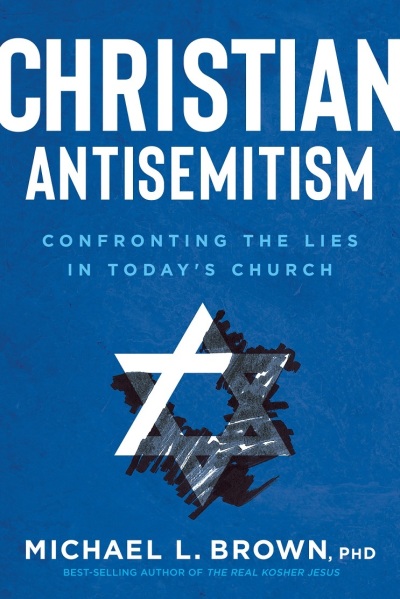
In his latest book, scheduled to be released Tuesday, Christian Antisemitism: Confronting the Lies in Today’s Church, Brown documents a new resurgence of anti-Semitism within American churches.

Brown wrote about what he saw on social media from self-identified Christians and rhetoric espoused by modern Christian ministries and some theologians. “This is a book I wish I didn’t have to write,” Brown told the Christian Post in an interview.

“Sadly, there is a real rise in anti-Semitism in the church, even in America.”

“I felt I had to write the book to demonstrate what was happening,” he added. “The rising tide of anti-Semitism in the church today.” This includes the rise of the heresy Replacement Theology, the notion that the Church has replaced Israel as the new chosen people, with God no longer having any plans for modern Jews.

Below are excerpts from a conversation Christian Post (CP) had with Brown about Christian anti-Semitism and its apparent growing strength.

CP: You have written about anti-Semitism in the Church before; notably the 1992 book Our Hands Are Stained With Blood. How does this book differ from your earlier works?

Brown: This book focuses on what’s happening now. The earlier book, Our Hands Are Stained With Blood: The Tragic Story of the “Church” and the Jewish People,came out in 1992, remained in print continuously until 2019 when we put out a new updated edition of the book.

And in doing so, that was very jarring because I was confronted with what had grown in recent years and how some of the dangerous trends of the past were back today. So Christian Antisemitism, the new book, picks up where Our Hands Are Stained With Blood left off. It gets much more in-depth into the wrong theology behind it. It traces some of the current conspiracy theories in the Church today about the Jewish people. It gets much deeper into the contemporary issues that the first book touched on.

CP: You devoted a fair amount of attention to refuting replacement theology. How pervasive a problem do you believe replacement theology is in the American church? Do you see it as more prevalent in some denominations than others?

Brown: Yes, it’s very prominent. It is certainly growing. It is very dangerous. It is more to be found in what would be called the mainstream denominations — so Presbyterian, Episcopalian, Methodist, etc. It is less found in Charismatic circles or in some aspects of evangelism. But the fact is it’s there. It’s certainly there in Catholic theology.

Those that hold to it don’t like to be put in the category of holding to replacement theology. They would rather say they believe in “fulfillment theology” or put another name on it. But the end result is the same: the promises that God once gave to the Jewish people as a people no longer apply to them, but rather apply to the Church.

This website livingeternal.net is about preparing the church for the end times tribulation and the coming Millennial reign of Christ from a restructured Jerusalem. Jesus will rule the world on this earth with the resurrected saints. A literal, grammatical and historical view of the Bible makes this truth crystal clear. Israel will finally have fulfilled all of the O.T and N.T. prophecies of its Messiah ruling the nations from Jerusalem. The book by Michael Brown is obviously an important contribution to this cause.

MESSIANIC JUDAISM EXPLAINED

Ron Cantor does a great job of explaining Messianic Judaism in this five minute video. It reveals how Satan deceived the early church with Replacement Theology and how anti-biblical it is. Can I suggest you distribute this video to your network. Blessings, Ron