A SUPERSONIC AI TSUNAMI IS COMING

Elon Musk describes what’s coming as a Supersonic Tsunami of converging exponentials. AI isn’t improving linearly anymore. We’re watching three exponential curves hit their inflection points simultaneously: compute scaling, model capabilities, and infrastructure deployment. When exponentials converge, you don’t get incremental progress. You get phase shifts.

Let me give you the raw numbers that demonstrate just how fast this is moving. What’s happening with AI revenue right now is unprecedented in the history of business. Anthropic hit $14 billion in annualized revenue in February 2026, growing from $1 billion just 14 months earlier. That figure has since surpassed $19 billion, more than doubling from $9 billion at the end of 2025. There is simply no precedent for this in B2B software.

And yet most people do not know who Anthropic is and what they do. Also, to understand what that means: Anthropic’s monthly revenue run rate is now roughly $1.6 billion per month, and it keeps accelerating. Anthropic projects as much as $70 billion in revenue by 2028.

OpenAI reached $25 billion in annualized revenue at the end of February 2026, up from $21.4 billion at year-end 2025, with full-year 2025 revenue coming in at $13.1 billion. Both companies are now valued in the hundreds of billions, Anthropic at $380 billion following its $30 billion Series G. OpenAI’s most recent private round in February 2026 valued it at approximately $730 billion, with an IPO potentially targeting a $1 trillion valuation.

Nvidia’s, Jensen Huang recently finalized a $30 billion investment in OpenAI and a $10 billion investment in Anthropic, and told investors these will likely be Nvidia’s last private investments in either company, because both are heading toward public markets. Think about that: the CEO of Nvidia, who has better visibility into AI infrastructure demand than anyone on Earth, made $40 billion in bets on these two companies as his final pre-IPO move.

What’s driving this revenue? It’s not IT budgets anymore. The models — Claude from Anthropic, GPT-5 from OpenAI — have crossed a threshold. They’re now competing with labour budgets.

Companies aren’t buying AI to replace servers. They’re buying AI to augment and ultimately displace human labour.

What’s the breakthrough use case? Coding. Claude Code (Anthropic’s agentic coding tool) now has run-rate revenue above $2.5 billion, having more than doubled since the beginning of 2026. Business subscriptions have quadrupled since the start of the year, and enterprise use has grown to represent over half of all Claude Code revenue.

Now you can buy intelligence on a metered basis. Pay per token. No recruiting, no vetting, no retention, no equity. Just intelligence as a utility. Consumers pay $20/month. Enterprise power users pay $200/month. And companies are spending millions per year because the ROI is there.

The Infrastructure Equation

Here’s the infrastructure reality that almost nobody is talking about loudly enough.

The five largest US hyperscalers — Microsoft, Alphabet, Amazon, Meta, and Oracle — have collectively committed to spending ~$690 billion on capital expenditure in 2026 alone, nearly doubling 2025 levels. The vast majority is directed at AI compute, data centers, and networking.

Total global AI spending is forecast to hit $2.5 trillion in 2026, a 44% increase over 2025, according to Gartner. Data centers, GPUs, power generation, chip fabrication. This is the largest infrastructure buildout in the history of technology, by a wide margin.

The rule of thumb in this industry: roughly $50 billion per gigawatt of infrastructure, and approximately $10 billion of annual revenue per gigawatt. Energy equals intelligence.

On a recent earnings call, Jensen Huang estimated that between $3 trillion and $4 trillion will be spent on AI infrastructure by the end of the decade. TechCrunch

This isn’t hype. This is capital deployment at a scale that rewrites the rules of what’s possible. When you’re spending $50 billion on a single data center and generating $10 billion a year in revenue from it, you’re not building a product… you’re building a new economic substrate. You’re building the electricity grid of the 21st century.

The tsunami is here. The question is whether you’re building on the wave or getting buried by it.

AI: The Capability Jump

Those revenue numbers I just showed you are driven by real capability breakthroughs happening right now.

Start here: neuromorphic chips just solved complex physics simulations at 1,000x better energy efficiency than supercomputers. That’s not 10% better. That’s three orders of magnitude. When compute gets that cheap, you don’t just do the same things faster. You do entirely new things that were economically impossible before.

Drug discovery moves from weeks on supercomputer clusters to hours on desktop chips. Climate modeling that required national labs runs on university hardware. Real-time protein folding for personalized cancer treatment becomes viable. This is Dematerialization, demonetization, and democratization followed by disruption (four of the Six D’s) in action.

Meanwhile, China’s DeepSeek launches V4 next-gen models through Huawei and Cambricon instead of U.S. chips. The AI race is officially multi-polar. OpenAI is preparing for the largest AI IPO in history.

And NVIDIA releases Alpamayo — the “ChatGPT moment for the physical world” — bringing reasoning to autonomous vehicles.

What it means: AI just moved from virtual to physical, from U.S.-dominated to globally distributed, and from expensive to radically cheap. All in the same week. And the revenue is proving it’s not experimental anymore: companies like Palantir, the U.S. military, and NVIDIA are running this in production for existential wartime operations.

Energy: Solving the Bottleneck

The elephant in the room: AI requires massive power. Those $50 billion data centers being built need gigawatts of electricity – and the grid was never designed for this.

Global electricity demand from data centers is set to more than double by 2030, reaching around 945 terawatt-hours: roughly equivalent to Japan’s entire annual electricity consumption. In the United States alone, data centers will account for nearly half of all electricity demand growth between now and 2030. AI will drive most of this increase, with electricity demand from AI-optimized data centers expected to more than quadruple by 2030.

Lawrence Berkeley National Laboratory projects U.S. data center electricity demand will grow from 176 TWh in 2023 to between 325 and 580 TWh by 2028 — representing up to 12% of total U.S. electricity consumption.

The grid was simply not built for this. Interconnection queues are backed up two to three years, transmission permitting takes a decade, and the power plants needed don’t yet exist. In just northern Virginia, a 2024 voltage fluctuation triggered the simultaneous disconnection of 60 data centers, a preview of what grid strain at scale actually looks like.

But look at what’s happening to solve it.

Nuclear Fusion is converging – fastChina’s “Artificial Sun” EAST reactor recently breached a major fusion plasma density barrier that researchers had long considered impossible to cross. In 2025, France’s WEST tokamak sustained plasma for over twenty minutes, while EAST maintained high-confinement plasma for nearly eighteen minutes — demonstrating the levels of stability required for commercial operation.

On the private side, the race has never moved faster. Commonwealth Fusion Systems has raised nearly $3 billion, including investments from Nvidia and Google, with the ultimate goal of a 400-megawatt power plant — enough to power around 280,000 average U.S. homes. CFS’s SPARC demonstration machine is expected to produce its first plasma in 2026 and achieve net fusion energy shortly after — the first commercially relevant design to produce more power than it consumes. That paves the way for ARC, their grid-connected power plant, targeted for the early 2030s.

Helion Energy has also begun construction of its first commercial fusion plant, designed to supply power directly to Microsoft’s data centers starting from 2028.

Private fusion investment has mushroomed, growing to $10.6 billion between 2021 and 2025, with the number of private fusion companies more than doubling from 23 to 53 in the same period.

The timeline is compressing. “Fusion in 30 years away” is becoming “Fusion this decade.” Fusion timelines are collapsing in real time — and AI is actually helping accelerate the plasma physics research itself. The irony: the technology that creates the power problem may also be helping solve it.

The wild card: Tesla Terafab: On March 14, 2026, Elon Musk announced on X that the “Terafab Project launches in 7 days” (March 21st).

So, what is Terafab? Musk first outlined the concept at Tesla’s 2025 shareholder meeting, describing a chip fabrication facility comparable in scale to TSMC’s largest plants. During Tesla’s January 2026 earnings call, he confirmed the company would “have to build a Tesla TeraFab: a very big fab that includes logic, memory and packaging, domestically” to avoid hitting a hard ceiling on chip supply in three to four years.

The facility is designed to produce between 100 and 200 billion custom AI and memory chips per year, with an initial target of 100,000 wafer starts per month and an ambition to scale toward one million, roughly 70% of TSMC’s total output, concentrated in a single U.S. facility. The project carries an estimated cost of approximately $25 billion. Tesla’s fifth-generation AI chip, AI5, is expected to be among the first products fabricated at Terafab, with small-batch production in 2026 and volume production projected for 2027.

To be precise: March 21st almost certainly marks the formal kickoff: a groundbreaking or announcement event, not a fully operational fab. Semiconductor fabs of this scale take years to build and commission. But the signal matters enormously. Tesla is joining Apple, Google, Amazon, and Microsoft in a new category of tech company: one that controls its own silicon. When the largest AI compute consumers own their own chip supply chains, the semiconductor industry is permanently restructured.

What It All Means: The energy bottleneck that threatened to constrain AI is being attacked from every direction simultaneously: fusion physics breakthroughs, private capital pouring into next-generation reactors, nuclear power plant revivals, and vertical integration of the chip supply chain. This is abundance thinking in action. When problems get big enough, fast enough, the solutions scale to match.

The constraint isn’t permanent. It never was.

The Supersonic Tsunami: How It All Connects

Here’s what Elon understood: these are not separate trends. They’re one interlocking system.

Neuromorphic chips make AI 1,000x more efficient → inference becomes cheap enough to deploy everywhere → agentic systems run locally in robots and cars. Fusion energy solves the power bottleneck → enables massive AI training clusters → next-gen frontier models get deployed in humanoids → robots work in any environment and can be launched to orbit on Starship for space manufacturing.

And the capital is already flowing. $1 trillion in infrastructure. $50 billion data centers generating $10 billion annually. Companies going from $1 billion to $14 billion in 14 months. This is not speculation…. it’s deployment at a scale that’s rewriting the rules.

The companies being built right now aren’t competing with 2024 business models.

Today’s companies are competing in an “Abundance Economy” where everything becomes possible, where intelligence is free, energy is abundant, labour is robotic, and orbital access is cheap.

As well, the professions are capitulating faster than the machines can replace them. An AMA survey found 81 percent of physicians now use AI, more than double the 2023 rate. New US Senate guidelines permit aides to use Gemini, ChatGPT, and Copilot for official work.
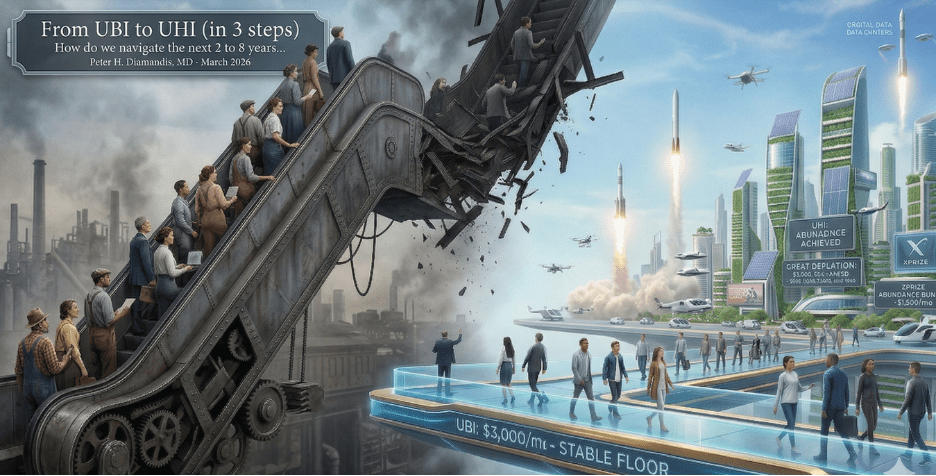
 Large language models, multimodal reasoning systems, and humanoid robots are not displacing one type of work — they are displacing all types of work, and the economic value of human time itself, across every sector, simultaneously.

There is no adjacent labor category to retrain into. The escalator that carried workers from disrupted industries to new ones for two centuries has no destination… it is crumbling.

That future isn’t ten years away. It’s arriving now and deploying over the next 12-24 months.

This will cause chaos particularly for Gen Z. How do they prepare for work in the AI era? Biblical prophecy reveals that in this world that no longer believes that God is in control. and that a spiritual war is intensifying as Satan the prince of this world does his utmost to retain rulership of the world, people worldwide will embrace Satan’s Antichrist ruler that has supernatural powers and promises peace and prosperity. Watch as Biblical end times prophecies unfold in our time.


CRAZY GOVERNMENTS PRIORITIES

The world is in a state of chaos. Government debt is spiraling out of control in the U.S.A. and most Western countries. War in Gaza has been raging for months. War in Ukraine has been raging for years. And Russia has even threatened to use nuclear weapons. Terrorist groups brazenly attack American shipping vessels. Iran keeps stirring the pot by shipping weapons and cash (most of which has been provided by the US) to belligerents around the world. China continues to insist that it will “reunify” with Taiwan by force if necessary, and demonstrates its resolve for war by bombing mock-ups of US ships.

Now, the world has been in far worse shape in the past. World War 2 is a prime example. History shows that it is possible to pull back from the brink of almost certain conflict— the Cuban Missile Crisis is a great example. But putting out all these fires requires serious, experienced professionals who can be laser-focused on achieving their nation’s diplomatic priorities from a position of strength. Yet the US State Department has a far higher calling than achieving peace through strength: gender neutrality.

US Secretary of State Antony Blinken recently sent a memo to State Department employees entitled,“Modeling DEIA [Diversity, Equity, Inclusion, and Accessibility]: Gender Identity Best Practices.”

The memo informs State Department employees that they should use “gender-neutral language whenever possible” because gendered terms such as “manpower”, “you guys”, “ladies and gentlemen”, “mother/father”, “son/daughter”, and “husband/wife” can be offensive.

Offensive to whom, exactly? Does the US Secretary of State honestly believe that the word “father” is in any way offensive to the people with whom they have to negotiate?

Are Hamas terrorists triggered by the term “husband”? Will Ukrainian soldiers be outraged for praising “the brave men and women” who are fighting on the front lines? Obviously not.

Terms like “father” and “mother” are only offensive to a tiny, tiny group of silly extremists in the US who have nothing better to do than wake up every morning and find an excuse to live in a state of perpetual victimhood. But apparently, the State Department is teeming with these whiny perpetual victims… which is pretty terrifying given the state of the world today.

Rather than focus on promoting strength, peace, and stability, there are ostensibly American diplomats who are more concerned about not being triggered by gender-specific words that have existed in the English language for more than 15 centuries.

Now, bear in mind that the entire purpose of the State Department is to interact with officials in other nations, who obviously tend to speak different languages. Yet many of these gender-neutral terms don’t even translate.

In Spanish, for example, mother is la madre and father is el padre. And if you’re referring to both parents, or you’re not sure which one, native speakers say padre, i.e. father. There is no genderless word for parent in Spanish. It simply doesn’t translate. So what exactly is the point of using this new genderless woke newspeak when it cannot even be communicated to foreign diplomats?

A good example of the stupidity of gender-neutral language is the story of Fran Itkoff who worked as a volunteer with the National Multiple Sclerosis Society. The organization recently implemented a new Diversity and Inclusion policy in which staffers must include their pronouns, i.e. she/her, at the end of an email. Fran didn’t understand the policy and asked why putting ‘she/her’ was inclusive? It’s certainly a reasonable question.

But “why” is the most triggering word of all to Diversity & Inclusion fanatics. They have no answers, they have no logic. So they respond with rage. 90-year-old Fran Itkoff was fired— as a volunteer— for asking why.

Her story started making the rounds online, so the National Multiple Sclerosis Society subsequently issued a bizarre apology, which stated that, even though “Fran has been a committed champion of [the Multiple Sclerosis] cause” for six decades, they fired her “with the best intentions”.

The Multiple Sclerosis Society cares more about pronouns than they do about eradicating Multiple Sclerosis! How does this organization expect anyone to take them seriously?

But the same question applies to the State Department. By publishing this memo, the Secretary of State has made it very clear what his Department’s priorities are. How does he expect Iran, Hamas, Saudi Arabia, Russia, China, etc. to take him seriously?

Remember, we’re not talking about a mid-sized non-profit or some random Congressman. This woke newspeak is now official guidance at the US Department of State.

The United States faces a mountain of extraordinary challenges, from geopolitical threats to the southern border crisis to the looming national debt catastrophe. These problems are not unsolvable. Unfortunately, the Inspired Idiots in charge keep making things worse. And this is a perfect example: by publishing this memo, the Secretary of State weakened America’s position in front of its adversaries. He made things worse, not better. Obviously, they don’t believe they’re making anything worse. They think their crusade for justice makes the world a better place. But they’re clearly out of touch with reality.

The State Department’s Newspeak memo states that you should not “pressure someone to state their pronouns” because it is “problematic” and sends a “harmful, exclusionary message”. Wait, so which is it? Are we supposed to demand people state their pronouns or aren’t we? It’s all so confusing… pronouns cannot be simultaneously “inclusive” and “exclusionary” at the same time, can they? And that’s part of this 1984-style newspeak. Nothing has any fixed meaning. Everything is arbitrary and open to interpretation. There is no structure, there is no order. It’s all fluid and ever-changing… just like their definition of gender.

The world has discarded God and His commandments/laws as Jesus said they would before His return to restore righteousness. In God’s Word, we are given incredibly detailed prophecies about the state of the world before His return so we can prepare.

Tell us, when will these things be, and what will be the sign of your coming and of the end of the age?” And Jesus answered themAnd you will hear of wars and rumors of wars. See that you are not alarmed, for this must take place, but the end is not yet. For nation will rise against nation, and kingdom against kingdom, and there will be famines and earthquakes in various places. All these are but the beginning of the birth pains... “Then they will deliver you up to tribulation and put you to death, and you will be hated by all nations for my name’s sake. And then many will fall away and betray one another and hate one another. And many false prophets will arise and lead many astray. And because lawlessness will be increased, the love of many will grow cold. But the one who endures to the end will be saved.” Matthew 24:3,6-13

There are many ministries God has raised up to prepare Christians for the approaching end times events. One I can recommend is http://www.lastdaysovercomers.org with Nelson Walters, Marquis Laughlin, and Jake McCandless. It is imperative Christian prepare for the coming tribulation.

A WORLD GONE MAD – NOTHING IS THE NEW SOMETHING

THE ART WORLD

Just when we thought it couldn’t get crazier… The most egregious example of speculative excess in the art world… $18,000 for ‘air and spirit’… Signing up to get nothing in the financial realm… Ignorance is not a valid excuse… We’re living in the ‘Age of the Emperor’.

For the past year and a half, collectors have been paying outrageous prices for some truly weird works… first, a banana duct-taped to a wall sold for $120,000 in Miami back in December 2019. Then, this past March, an artist known as “Beeple” sold a non-fungible token (“NFT”) of his work – a digital-only collage of 5,000 images – for $69 million at auction. The latest example occurred last month in Milan, Italy… Auction house Art-Rite sold a piece of work by Italian artist Salvatore Garau titled Io sono (Italian for “I am“) for $18,000. With Beeple’s NFT going for $69 million, how does a mere $18,000 sale qualify as egregious excess? The answer is simple… because Io sono doesn’t actually exist. It’s “invisible art.” It’s not there. The buyer got a whole lot of nothing for his $18,000. Instead, Garau issued a certificate of authenticity to the buyer (like the banana-and-duct-tape piece). The artist – and his piece of paper “verifying” it – said Io sono is a sculpture that consists of a 25-square-foot space and that light and climate control are optional.

You can’t sell a certificate of authenticity for something that doesn’t exist without concocting a fantastic story… Garau put together a great one. As he told one Spanish news outlet… You don’t see it, but it exists. It is made of air and spirit.

THE FINANCIAL WORLD – Information from Stansberry Research Digest – Largest USA independent financial research organisation.

Art is the flag of culture. And its excesses are frequently preceded by those in the financial realm, given as it is to stoke the fires of greed.

‘Nothing’ has been on sale in the financial markets for much of the past decade…

The most obvious example is negative-yielding sovereign debt. According to Bloomberg, $13.3 trillion of this debt is circulating around the world these days. Roughly $10 trillion of the total is the sovereign debt of countries like Japan, Germany, Switzerland, and France. (Nearly all the rest is corporate debt.) This is supposed to be the second-safest debt in the world, behind only the debt of the U.S. government. When you buy a bond trading at a negative yield, it means you’re guaranteed to get less in principal and interest at maturity than you paid for it in the first place. In other words, you’re guaranteed to lose money. You’re signing up to get nothing.

Bonds are supposed to be the “smart money”… It’s where savvy investors go to get a much safer return than the stock market. And for a $13 trillion swath of the bond market, that supposedly safer return is a little less than zero today… NothingNadaZip.

The Securities Industry and Financial Markets Association’s 2020 Fact Book puts the value of the global bond market at $105.9 trillion. So negative-yielding debt – a guarantee to receive a little less than nothing for putting capital at risk – accounts for 12.5% of a massive global market.

And it’s not just bonds, either. The rational expectation for stocks is a negative average return over the next 10 to 12 years. That’s according to the work of often quoted economist John Hussman, Hussman’s return model suggests the S&P 500 is currently priced to return a 7% loss per year, on average, for the next decade. However, reality is that the market doesn’t simply tick down 7% each year for a decade. It falls 50% or more in a great washout that generally lasts somewhere between six months and two years.

Moreover, many would suggest that a great washout is about to occur or put another way the financial bubble is about to burst. In a Bloomberg interview, GMO’s Jeremy Grantham talked about his asset-management firm’s study of 330 bubbles across all asset classes. As Grantham succinctly put it… the last 12 months have been a classic finale to an 11-year bull market. And he cited plenty of data to make his point during the interview, ultimately concluding… The great bubbles by scale and significance… all accelerated late in the game and had psychological measures that could not be missed by ordinary investors. (Economists are a different matter.)

The data, like today, is always clear, just uncommercial and inconvenient for the investment industry and often psychologically impossible to see for many individuals. In other words, all of us “ordinary investors” ought to be like the child in “The Emperor’s New Clothes” who innocently blurts out that the emperor is naked. That emboldened others to say so… eventually making it impossible for the emperor himself to avoid admitting the truth.

We can all see the truth. Our only remaining task is to acknowledge it and act accordingly. But the great herd of investors just can’t do it. The herd is like the courtiers and other sycophantic hangers-on around the emperor. They’re all scared of his ire and eager to gain his favour , prompting them to proclaim the surpassing beauty of his non-existent clothes.

They’re too vested in continuing the charade to notice that doing so is an unsustainable state of affairs.

The greatest charade perhaps of all is in the cryptocurrency called Dogecoin. Dogecoin was created as a joke to make fun of cryptocurrencies being worthless, and not only has it taken off, but it’s such a success that second-level joke cryptocurrencies making fun of Dogecoin have gone to multibillion-dollar valuations. An unabashed ode to the culture of nothingness has wound up with a massive valuation… Dogecoin’s market cap peaked on May 7 at $88 billion and still sits above $32 billion today. Its value has crashed over the past six weeks. But even so, that’s still a whole lotta nothin’.

There’s no fraud going on in these instances at all. Folks are saying, “Hey, sign me up. I want nothing and I’ll pay real money for it!” Nothing is the new something.

Any sane person can see that this cannot end well. In fact, it will get so crazy that the world will be crying out for a Saviour, the scene is set for the entry of the Antichrist on to the world scene. His appearance is the most significant prophesied “end times” sign. As I have said many times before there are far more prophecies about Jesus second coming than there were of His first coming. Are you aware of these prophecies? Are you prepared for what is ahead? For Christians it is a time of intense persecution. We are already seeing the “end times” prophesied falling away in the church from the truth of God’s Word and His moral values. Wake up church, God is purifying His church. Sadly, much of the church is like the church at Laodicea which will be left behind to face God’s wrath.

I know your works: you are neither cold nor hot. Would that you were either cold or hot! So, because you are lukewarm, and neither hot nor cold, I will spit you out of my mouth. For you say, I am rich, I have prospered, and I need nothing, not realizing that you are wretched, pitiable, poor, blind, and naked.Revelation 3:15-17

It is the Church at Philadelphia that represents the church that is raptured prior to God’s wrath being poured out with the Trumpet and Bowl Judgements.

Because you have kept my word about patient endurance, I will keep you from the hour of trial that is coming on the whole world, to try those who dwell on the earth. I am coming soon. Hold fast what you have, so that no one may seize your crown.Revelation 3:10-11

The Rapture of the Saints prior to God’s wrath being poured out on an unrepentant world with the Trumpet and Bowl Judgements

IS THE STAGE IS BEING SET FOR THE ANTICHRIST?

Are we headed towards high noon for democracy?

This article by Henry Ergas AO, suggests to me that the stage is being set for the prophesied Satanically empowered leader to emerge on the world stage. Ergas is an economist who spent many years at the OECD in Paris before returning to Australia. He has taught at a number of universities, including Harvard

Image result for picture of Hitler at the height of his power

“In 1923, as the Weimar Republic struggled with chaos, the German polymath Carl Schmitt wrote a short but enormously influential book, The Crisis of Parliamentary Democracy.

With the US government plunged into a shutdown that only a presidential declaration of a state of emergency is likely to end, and Britain in a crisis that seems ­irresolvable, Schmitt’s warnings cannot simply be ­dismissed.

The notion of “liberal democracy”, he ­argued, was fundamentally ill-conceived. Liberalism and democracy had certainly been allies in the battle to rein in the power of monarchs. But that accomplished, the tensions between them had burst to the surface and would inevitably worsen as societies ­developed.

Liberal institutions — parliamentarianism, the rule of law, the separation of powers — existed to temper the democratic impulse, channelling it into an “endless conversation” that readily led to dead-ends. However, whenever they gathered explosive force, the pressures of democracy — the brute, often inchoate, expression of the popular will — were not so easily corralled.

As liberalism collided with the popular will, one had to overwhelm the other, hurtling the system towards “the state of exception” — that is, the suspension of business-as-usual. And, as Schmitt put it in another famous work, Political Theology, when the chips are down, “sovereign is he who decides on the exception”.

In other words, the ultimate ruler in any political system is the actor who, once consensus has worn so thin as to make the system unworkable, can impose an outcome by invoking emergency powers.

With the conflict between liberalism and democracy growing ever starker, Schmitt ­argued, we would enter an age of states of emergency, eroding liberalism’s foundations.

As Clinton Rossiter, the foremost American scholar of the emergency powers, concluded many decades ago, emergency powers are “an inevitable and dangerous thing” that have never been invoked to address domestic discord “without permanent alteration in the governmental scheme, always in the direction of an aggrandisement of the power of the state”.

Yet for all those limitations, it is clear that declaring an emergency offers Trump a way out. There is, however, a fundamental ­question as to whether Theresa May has any such options.

Schmitt thought May’s predicament would become increasingly common. And the only outcome that could follow, he ­argued, was for the state of emergency to ­become the norm: one way or the other, the exception had to become the rule, permitting government to continue functioning. With liberal constitutionalism’s twin ancestral homes both in dire straits, Schmitt’s time may finally have arrived.