YOUNG EARTH AND DISTANT STARLIGHT (PART 2)

Part 1 explains that the cause of the universe is supernatural and cannot be explained by natural events. The word of God brought the universe into existence from something that is not visible, something, unlike ordinary visible/tangible matter and energy. This is consistent with the scientific conclusion that the matter and energy that comprise the universe cannot be eternal. Thus, the cause of the universe must be supernatural.

2. There are potential explanations anyway.

Christian astrophysicists have proposed various explanations as to how God might have created things in such a way that even Adam and Eve would have been able to see distant starlight. This section is a bit technical, but we have tried to make it as easy as possible to understand. The ideas are mind-stretching because they seem to conflict with our everyday experience of the world.

Time dilation models

Einstein is famous for discovering that time is not constant but is affected by movement (speed) and gravitational forces. This is known as Special Relativity and General Relativity, respectively. When an object moves very fast, time for that object slows down, or even stops at the speed of light. Also, when an object is in the presence of a massive object, which provides a strong gravitational attraction, time slows down. These effects are measurable and thus have been verified by experiment. They are so real that GPS satellites, which depend on precision clocks for global positioning calculations, must have their on-board clocks adjusted for the lesser gravity (being up in the sky) and for the speed of movement of the satellite.

Now we can try to imagine God creating the universe, “stretching out the heavens” (Psalm 104:2) on Day 4 of Creation Week. This would entail massive gravitational forces and enormous differences in speeds, both of which would change the time ‘out there’ compared to planet Earth. Thus, in one Earth day (Day 4) an enormous amount of time could transpire ‘out there’ allowing ample time for the light to travel to Earth. Various models have been proposed based on these ideas

New Model

Well, this is not so new; it goes back to Einstein’s era. Einstein’s findings of time changing with motion means that the speed of light (c) cannot be measured in one direction. It can only be measured for the round trip (two-way speed). This gives the average speed, but we cannot know if the speed is the same in both directions.

Einstein assumed that the speed of light in all directions was the same (called the synchrony convention) but he realized that it was an assumption without proof.

7535-Genesis1
God calls us to humbly submit to Him and His Word.

Physicists have been wracking their brains ever since Einstein to try to figure out how to measure the speed of light in one direction. For example, we might want to fire a laser beam at the moon and measure how long it takes to get there. However, we need to place a clock on the moon that is telling the same time as a clock on Earth. That is a problem because as we fly the clock to the moon, the time changes on the clock! Putting it another way, the only way the observer on the moon can know when the light beam is sent from Earth is to be sent a message, which then travels at the speed of light. It all becomes totally circular!

There has been quite some discussion about this in recent times, including from secularists—that the speed of light might not be the same in all directions.

So, what if the speed of light towards us was infinite and the speed away from us was c/2? That would give an average speed of c, which we measure. There is no way that we can know that this is not so. And that would mean that light from distant stars would reach Earth the instant that they were created. No problem!

Go to http://www.creation.com for the entire article.

YOUNG EARTH AND DISTANT STARLIGHT (PART 1)

Creation Week entailed a series of miracles.

Throughout the account in Genesis 1, the Bible says that God spoke things into existence—eight times, “And God said … ”. And after He spoke, it is often concluded with, “and it was so”. The New Testament tells us,

“By faith we understand that the universe was created by the word of God, so that what is seen was not made out of things that are visible.” (Hebrews 11:3)

The word of God brought the universe into existence from something that is not visible, something, unlike ordinary visible/tangible matter and energy. This is consistent with the scientific conclusion that the matter and energy that comprise the universe cannot be eternal. Thus, the cause of the universe must be supernatural.

And so the Bible describes the Word of God as powerful:

“So shall my word be that goes out from my mouth; it shall not return to me empty, but it shall accomplish that which I purpose, and shall succeed in the thing for which I sent it.” (Isaiah 55:11)

The New Testament tells us that this agency of God, the Word by which He created everything, was none other than the Lord Jesus Christ:

In the beginning was the Word, and the Word was with God, and the Word was God. He was in the beginning with God. All things were made through him, and without him was not anything made that was made. (John 1:1–3)

Genesis 2 tells us that God made the first man and woman. He took dust and made the man, Adam (Genesis 2:7), and took his rib and fashioned the woman, Eve, the mother of all.

I have never had anyone demand that I explain to them how God made a man from dust. And yet there is this demand that we explain how God could have created the stars such that we can see the light from distant stars.

Distant star cluster

The Genesis account makes it clear that the creation of the heavenly bodies was just as miraculous as the creation of the first people:

And God said, “Let there be lights … And God made the two great lights—the greater light to rule the day and the lesser light to rule the night—and the stars.” (Genesis 1:14–16).

Was this any less a miracle than the creation of the man from dust? And yet there is a demand for a naturalistic explanation for how God did this! This seems to me to be quite inconsistent and unreasonable to demand such a thing as a condition of believing the Bible’s account, especially the timeframe.

It’s also interesting that the timeframe of six days with the seventh day of rest—the basis of our 7-day week (Exodus 20:11)—underlines the miraculous nature of God’s actions. And that is part of the problem for those who don’t or won’t believe the timeframe, such as theistic evolutionists and long-age creationists. When they refuse to believe the timeframe, they then tend to think of ‘creation’ in a naturalistic way, over billions of years. And then secular ideas of how things came to be take precedence over the Bible’s clear account. Thus the miraculous nature of Creation Week takes a back seat and so we have this demand for a naturalistic explanation for how we can see distant starlight.

The bottom line: Creation Week involved a series of miracles, one after the other. Thus, these are things for which we can provide no natural explanation. We do not know how God could speak the stars into existence, and thus we cannot know how He created things in such a way that we can see the light from celestial objects millions and billions of light-years distant.

In other words, the question tacitly denies the supernatural nature of the Creation Week events. In doing so it robs God of His omnipotence and limits Him to work only in ways that we can understand. This results in a very diminished view of God. In effect, those who do this are constructing a god compatible with their own limited understanding, which is a form of idolatry.

Go to http://www.creation.com for the entire article.

DINOSAURS REFUTE MILLIONS OF YEARS

What’s the big deal with “dinosaur soft tissue”?

It is not just dinosaur soft tissue, either, but the presence of detectable proteins such as collagen, hemoglobin, osteocalcin, actin, and tubulin that they must account for. These are complex molecules that continually tend to break down to simpler ones. If the world is billions of years old these cannot be there.

Not only that but in many cases, there are fine details of the bone matrix, with microscopically intact-looking bone cells (osteocytes) showing incredible detail. Palaeontologist, Dr. Mary Schweitzer has even recovered fragments of the even more fragile and complex molecule, DNA. This has been extracted from the bone cells with markers indicating its source such that it is extremely likely to be dinosaur DNA.

Others have reported the fast-decaying carbon-14 from dino bones—not a single atom should be left after 1 million years.

Go to http://www.creation.com for more evidence of a young earth from Ph.D. scientists.

DISTANT STARLIGHT AND A YOUNG EARTH

Astronomer Danny Faulkner describes his solution to the light travel-time problem, then discusses many of the issues with Big Bang cosmology. Dr Danny Faulkner received his PhD in astronomy from Indiana University. He is distinguished Professor Emeritus at the University of South Carolina-Lancaster, where he taught astronomy and physics for over 26 years. Since January, 2013, he has been the staff astronomer at Answers in Genesis in northern Kentucky. For more information on Dr. Faulkner, please go to https://bit.ly/3kGkcFV

This 20 minute video segment is from “Beyond Is Genesis History? Vol 3 : Bible & Stars,” where they explore the universe, the Tower of Babel, the Hebrew text, and the history of interpretation of Genesis, and much more! Check it out on their website: https://bit.ly/BIGH-3

Thus says God, the Lord, who created the heavens and stretched them out?” Isaiah 42:5

BIBLICAL VIEW OF THE ROCKS

THE GEOLOGY TRANSFORMATION TOOL – A new way of looking at your world by Tas Walker

Like the recent article Compelling Evidence for a Young Earth this article by Tas Walker is taken from the latest Creation Magazine http://www.creation.com.

Perhaps you have seen a report in the media about a rock outcrop ‘800 million years old’ and wondered how that fits with the history of the Bible. One confronts the same puzzle when reading about a fossil dinosaur that lived in ‘Jurassic’ times. Or we may visit a tourist site with a sign that speaks about a volcano forming ‘25 million years ago’.

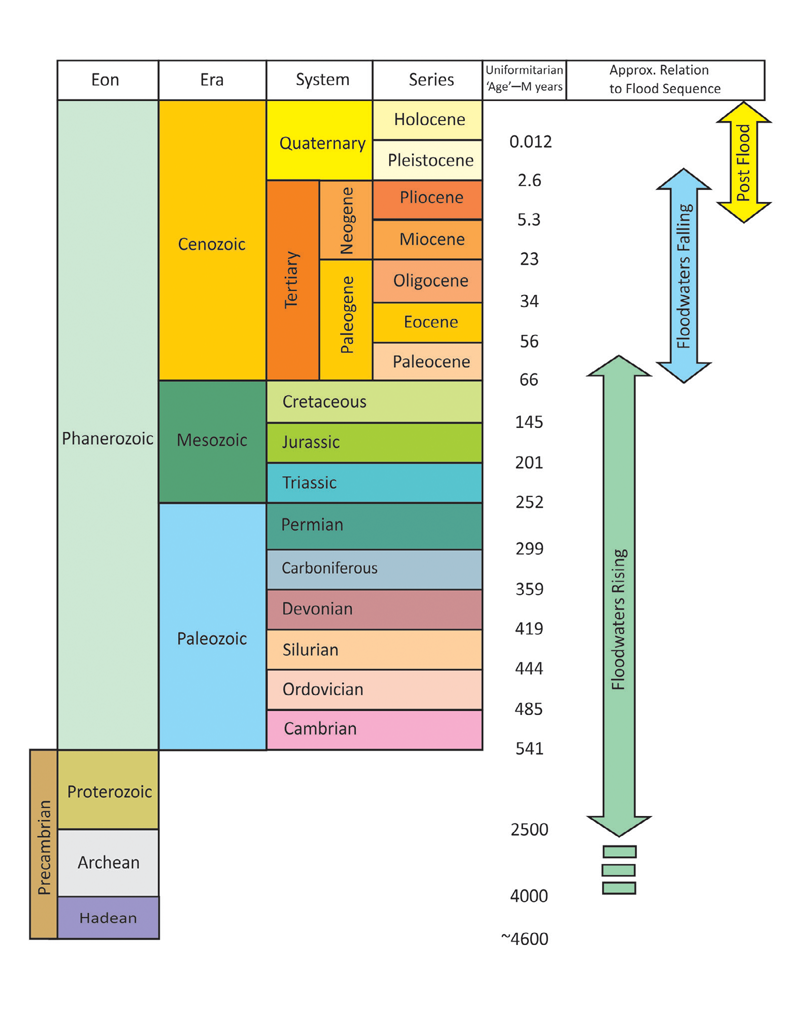
If you would like to see your world from a biblical perspective, the simple diagram in figure 1 is what you are looking for. It allows you to work out a first, ballpark understanding of how each situation you encounter relates to the true history of the universe, that is, to the history presented in the Bible.

A Chart of Geological transformation tool
Diagram 1: Geologic Column adapted to show Noah’s Flood sequence

The right side of the diagram has three vertical arrows, which show how these rocks relate to biblical history. The first arrow (green) indicates which rocks formed in the first 150 days of Noah’s Flood as the floodwaters were rising. The second arrow (blue) indicates which rocks formed in the last 220 days of Noah’s Flood as the waters were falling and the continents were rising. The third arrow (yellow) indicates which rocks have formed in the 4,500 years since the Flood ended.

You will notice at the top of the diagram that the biblical arrows overlap, and that at the bottom the green arrow is shown dotted. This is to indicate that there is uncertainty in these areas. The main reason for the uncertainty is that there is not a one-to-one relationship between the rocks on the geological column and biblical history. That is because uniformitarian geologists place the rocks into the geological column using criteria that assume Noah’s Flood never happened. However, the rocks must be understood using criteria based on biblical history, which includes the Creation and Flood events.

When we do examine the geology using biblical criteria, we discover that the geological column provides a general Flood order. However, there are many exceptions and the relationship is highly non-linear. As illustrated in figure 1, most rocks (the Precambrian, Paleozoic, and Mesozoic) formed as the floodwaters were rising on the earth. These are generally of very large scale, both in thickness and geographical extent. The second part of the Flood, when the waters were receding as the continents uplifted, mainly involved huge erosion on the continents. The receding floodwaters deposited the eroded material at the continental margins. Local deposits did occur on the continents but very late in that period, after most of the water had gone.

Easy to use

The figure is easy to use. All that is required is to locate on figure 1 the ‘date’ in millions of years for your example. Then you simply check where it sits on the arrows of biblical history. Let’s look at the examples mentioned above.

For the rock outcrop 800 million years old we see on figure 1 that it fits between the numbers 541 and 2500. To the left, on the column this corresponds to the ‘Proterozoic’ as well as the ‘Precambrian’. To the right, on the biblical interpretation, this corresponds to the period when the waters of Noah’s Flood were rising, and quite early in this period. Given that the waters of Noah’s Flood were rising for 150 days, 800 million years would correspond to the first month or two of the Flood, which occurred some 4,500 years ago.

For the fossil dinosaur that lived in the ‘Jurassic’, we see that this fits between 145 and 201 million years ago. It is part of the groupings called the ‘Mesozoic’ and the ‘Phanerozoic’. On the biblical interpretation to the right we can see that this also corresponds to the time when the waters of Noah’s Flood were rising, but later than the rock described in the previous example. Its position on the arrow indicates that this would have been as the waters were approaching their peak, perhaps a month before that, which would be about four months after the Flood began, 4,500 years ago.

For the volcano ‘25 million years’ ago, we see that it corresponds to the ‘Oligocene’, which is part of the ‘Paleogene’, the ‘Tertiary’, the ‘Cenozoic’, and the ‘Phanerozoic’. On the biblical interpretation to the right we can see that this corresponds to the 220-day (approx. 7-month) period when the waters of Noah’s Flood were falling. This was as the continents were being uplifted, causing the floodwaters to flow off the land into the expanding oceans. This would have been a few months into that period after the waters peaked, which would put this some 8 months or more after Noah’s Flood began, 4,500 years ago.

COMPELLING EVIDENCE FOR A YOUNG EARTH

CURVY ROCK LAYERS UNDERMINE MILLIONS OF YEARS”, article by Gavin Cox in the latest issue of Creation Magazine. Go to http://www.creation.com to sign up for this must have creation resource.

The Bible indicates that the Flood, which lasted just over a year, was a global tectonic event, with much vertical and horizontal earth movement. This provided the forces required to mould sediments and fold rocks. Genesis 7:11 tells us how the Flood started, when “all the fountains of the great deep burst forth.” Genesis 8:1–3 tells us how the Flood ended: “And God made a wind blow over the earth, and the waters subsided. The fountains of the deep … were closed … and the waters receded from the earth continually.” These verses are also describing vast global geological activity. Furthermore, Psalm 104:6–9 clearly describes Noah’s Flood: “The waters stood above the mountains. At your rebuke they fled … The mountains rose, the valleys sank down to the place that you appointed for them … so that they might not again cover the earth.” Evidently, huge earth-moving forces were involved that transported vast amounts of freshly deposited, wet sediments. The Flood provides all the factors necessary to fold strata quickly.

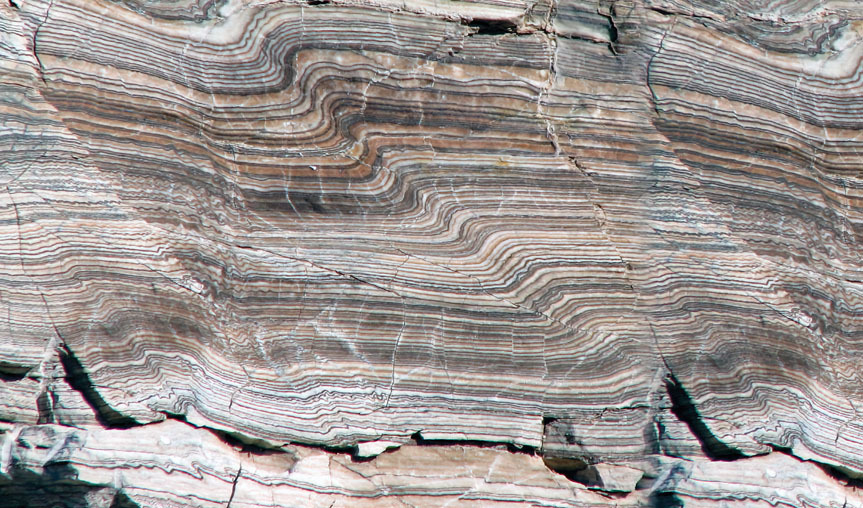
In the Grand Canyon, the rock appears as though it has deformed like wet clay. It becomes thinner where the fold has been in tension (not showing tensional fractures), and thicker where it has been in compression (but not showing signs of being crushed). This is powerful evidence that the sediment was still wet and plastic, like clay, and not solid rock, when it was bent.

Long-agers can accept that an individual rock layer could have been wet and plastic when folded. But not when there are multiple layers clearly bent together, with the top and bottom layers supposedly separated by millions of years. This is because they know it would be unreasonable to think that rock layers would stay soft for millions of years. So, at least the bottom layer of any such folded sequence would have had to be solid when bent.

Image of folded rocks

In the Grand Canyon, where the folded strata are part of a larger formation called the Kaibab Upwarp (figure 3), the deepest layer (the Tapeats Sandstone) is supposed to be 550 million years old. The topmost of the folded layers (the Kaibab Limestone) was allegedly deposited 300 million years later. (The bottom layer is supposedly millions of years older than any of the intervening layers.) So, since they were all folded together in plastic fashion, the straightforward understanding of the evidence is that they were all still wet and pliable when folded.

Long-agers must therefore find some way around this. To preserve long ages, rocks must be seen as able to bend without breaking—in the unobservable past, over huge time periods.

Conclusion

The supposed millions of years to bend rock strata into folds is an illusion. Folded strata do not constitute evidence for vast amounts of time in the rocks. Furthermore, no one has waited for eons to watch if it really takes that long to form folds in strata. ‘Deep time’ is a philosophical idea (derived from uniformitarianism), not a scientific observation.

MORE EVIDENCE FOR A YOUNG EARTH

Dinosaur-bone-cellsBone cells discovered by Schweitzer, showing classic appearances including nuclei and connecting fibrils—from a Brachylophosaurus allegedly 80 million years old!

Following the most rigorous tests and checking of data, many evolutionists now admit the existence of such dinosaur soft tissue and organic material in not just one or two specimens, but well over thirty. They now have to explain how extremely delicate structures could have been preserved over incredibly vast time periods.

E.g, In 2009, researchers reported that they had found the fossilised remains of a fish brain—dated at 300 million years by evolutionary standards. John Maisey, the lead author, found it remarkable that brain tissue was preserved by fossilisation, since it consisted mainly of water.
Then, in 2016, researchers studying the remains of an Iguanadon-like creature reported not just fossilised brains, but unfossilised brain tissue. Dated by evolutionists at 133 million years, this fossil from Bexhill, England, was discovered more than a decade ago but only recently analysed. It was found to contain unfossilised protein fragments—brain tissue, fine capillaries, collagen structures, and the membrane that surrounds the brain. The authors attributed the brain tissue preservation to the highly acidic, low-oxygen environment in which it was found. However, such an acidic environment should have sped up rather than slowed the breaking down of brain tissue and protein.
How long can brain tissue last?

The existence of soft issue in fossils is hugely problematic to the idea that these fossils are millions of years old.

Believing proteins could last for tens of millions of years takes enormous faith. According to a report in the science journal The Biochemist, even if collagen were stored at 0°C, it would not be expected to last even three million years.8 But such is the power of the evolutionary paradigm that many choose to believe the seemingly impossible rather than accept the obvious implication, that the samples are not as old as they say.

8 Roach, J., Oldest fossil brain found in “bizarre” prehistoric fish, news.nationalgeographic.com, March 2009.
Brasier, M.D. et al., Remarkable preservation of brain tissue in an Early Cretaceous iguanodontian
dinosaur, Geol. Soc. London Spec. Publ. SP448.3, October 2016 | doi: 10.1144/SP448.3

WHY CREATION IN SIX DAYS? DOES IT HAVE SIGNIFICANCE FOR TODAY?

The immediate significance of a six days creation was as a pattern for man, six days you will work and the seventh day is the Sabbath of the Lord your God. The finger of God wrote this fourth commandment, one of ten, on a stone tablet for Moses. We still have a seven day week but do we uphold God’s Sabbath?

Equally important, and of more significance in our day, is the prophetic significance of the six days of creation. Six thousand years of man’s reign on earth and the seventh, the Millennial reign of Jesus Christ.

The Bible’s history is clear on a young earth with genealogies in both the OT and NT giving us a six thousand year history. Sadly, the world does not acknowledge that God judged mankind with a worldwide chaotic flood, which reshaped the geography of the entire planet, laying down the fossil layers and creating the fossil fuels. The flood lasted one year and created what the world believes took billions of years.

It is enlightening to see what the early church fathers had to say on the subject.

St Justin Martyr had this to say “But I and others, who are right-minded Christians on all points, are assured that there will be a resurrection of the dead, and a thousand years in Jerusalem, which will then be built, adorned, and enlarged, [as] the prophets Ezekiel and Isaiah and others declare. And further, there was a certain man with us, whose name was John, one of the apostles of Christ, who prophesied, by a revelation that was made to him, that those who believed in our Christ would dwell a thousand years in Jerusalem.”

Iraneus was another early Church Father who taught that the Church will face Antichrist during the Great Tribulation and after that Christ will return and usher in his Millennial Kingdom: “But when this Antichrist shall have devastated all things in this world, he will reign for three years and six months, and sit in the temple at Jerusalem; and then the Lord will come from heaven in the clouds, in the glory of the Father, sending this man and those who follow him into the lake of fire; but bringing in for the righteous the times of the kingdom, that is, the rest, the hallowed seventh day; and restoring to Abraham the promised inheritance, in which kingdom the Lord declared, that “many coming from the east and from the west should sit down with Abraham, Isaac, and Jacob.”

The Seventh Day: Iraneus mentioned the Seventh Day, but the Church has forgotten this critical teaching, which in and of itself proves the Millennial Kingdom. It is very well explained by the Epistle of Barnabas  cited by Clemens, Alexandrinus, Eusebius, Jerome, and many ancient Fathers (even Origen.)

“And in the beginning of the creation he makes mention of the Sabbath. And God made in six days the works of his hands; and he finished them on the seventh day, and rested the seventh say, and sanctified it.

Consider, my children, what that signifies, he finished them in six days. The meaning of it is this; that in six thousand years the Lord God will bring all things to an end.

For with him one day is as a thousand years; as himself testifies, saying, Behold this day shall be as a thousand years. Therefore children, in six days, that is, in six thousand years, that all things shall be accomplished.

And what is it that he says, And he rested the seventh day: he means this; that when His Son shall come, and abolish the season of the Wicked One, and judge the ungodly; and shall change the sun and the moon and the stars; and he shall gloriously rest in that seventh day (a thousand years)”. (Barnabas 13:3-6)

This wonderfully explains the understanding of the Great Creation Prophecy explained by Peter and the Writer of Hebrews which has been forgotten by the Church.

The writer of Hebrews clearly explains this teaching within the canon of scripture: “For we which have believed do enter into rest, as he said, As I have sworn in my wrath, if they shall enter into my rest: although the works were finished from the foundation of the world. For he spake in a certain place of the seventh day on this wise, And God did rest the seventh day from all his works. And in this place again, If they shall enter into my rest. Seeing therefore it remains that some must enter therein, and they to whom it was first preached entered not in because of unbelief:  Again, he limits a certain day, saying in David, To day, after so long a time; as it is said, To day if ye will hear his voice, harden not your hearts. For if Jesus (or Joshua) had given them rest, then would he not afterward have spoken of another day. There remains therefore a rest to the people of God. For he that is entered into his rest, he also hath ceased from his own works, as God did from his. Let us labour therefore to enter into that rest, lest any man fall after the same example of unbelief.” (Heb. 4:3-11)

It is incredibly important to understand this passage which clearly speaks of the Millennial Kingdom, a Seventh Day. Notice the Writer of Hebrews says that  Joshua (it is most likely Joshua, his name and Jesus’s are identical in the Greek) did NOT provide us rest upon entering the promised land and that is why a Seventh Day, a seventh 1000 years, is still coming.

Of even greater interest is what follows this statement. It is obvious that the seventh day (the 1000 years) and the rest of God was still remaining when Hebrews was written! We are told we must labour to enter the 1000 year rest. Our discussion of Amillennialism should end right here, but there is more, much more.

Peter speaks of this same 1000 years and calls those who claim there won’t be a PAROUSIA or Rapture are mockers or scoffers: “Know this first of all, that in the last days mockers will come with their mocking, following after their own lusts, and saying, “Where is the promise of His coming (PAROUSIA or rapture)? For ever since the fathers fell asleep, all continues just as it was from the beginning of creation.” For when they maintain this, it escapes their notice that by the word of God the heavens existed long ago and the earth was formed out of water and by water (the Creation) through which the world at that time was destroyed, being flooded with water. But by His word the present heavens and earth are being reserved for fire, kept for the day of judgement and destruction of ungodly men. But do not let this one fact escape your notice, beloved, that with the Lord one day is like a thousand years, and a thousand years like one day.  The Lord is not slow about His promise, as some count slowness, but is patient toward you, not wishing for any to perish but for all to come to repentance.  But the day of the Lord will come like a thief.” (2 Pet. 3:3-10)

Peter demonstrates that all the ages of the creation prophecy “days” are 1000 years long.  Peter is clear that the mockers don’t know the date of Jesus’s return because they don’t understand the creation account (in which the seventh day is mentioned) and its prophetic meaning. If they did, they would know that Jesus returns 6000 years after creation; and that a 1000 year day of rest remains after that.

John of course, re-enforces this teaching in the Book of Revelation: “I saw thrones on which were seated those who had been given authority to judge. And I saw the souls of those who had been beheaded because of their testimony about Jesus and because of the word of God.They had not worshipped the beast or its image and had not received its mark on their foreheads or their hands. They came to life and reigned with Christ a thousand years. (The rest of the dead did not come to life until the thousand years were ended.) This is the first resurrection. Blessed and holy are those who share in the first resurrection. The second death has no power over them, but they will be priests of God and of Christ and will reign with him for a thousand years.” (Rev. 20:4-6)

John’s testimony is the same as the writer of Hebrews, Peter, and the early Church Fathers. There is a thousand year reign of Jesus in which the resurrected will reign with him.

Summary: So the teaching of the “Seventh Day” is fundamental to our understanding of the Millennial Kingdom of Jesus. The concepts of seven millennia as prophesied by Genesis has been ignored and forgotten by much of the Church, but as we can see, it was an integral understanding of the Apostles and the early Church Fathers and framed their understanding of eschatology.