RUSSELL BRAND SPEAKS ON HIS COMING BAPTISM

Brand says many returning to Christianity as the world crumbles.

Actor and comedian Russell Brand announced Friday that he is going to be baptized this weekend, the culmination of his months-long public wrestling with the tenets of Christianity.

“This Sunday, I’m taking the plunge,” Brand, 48, said in a video he posted to X. “I’m getting baptized.”

Listen to what he has to say. I think you will be pleasantly surprised. I was.

NO GOD LEADS TO NO HOPE: YOUR WORLDVIEW MATTERS

Testimony of Michael (‘Mike’) Dooley, pianist, composer, song and hymn writer, producer, and music teacher, who studied at the Sydney Conservatorium of Music and Canberra Institute of Technology (AdvDipMusA, AMusA).

Pursuing music as a career, Mike’s acceptance into the elite Sydney Conservatorium was exciting. However, his enthusiasm was short-lived. He explained: I became quite disillusioned; the music we were studying was very depressing. There was no sense of hope. It was basically reflecting the very grim state of the world … I was led into a sense of real despair.

Mike continued: Something very significant happened when I went to a concert of J.S. Bach’s St John Passion. I was reading along with the English translation of the associated German text. The music was profoundly beautiful, but also, the story of the Crucifixion deeply touched my heart.

Mike walked into that concert as an atheist but he walked out saying under his breath, “I believe”, without really knowing what or why.

Music and worldview

At the time, he was studying with one of Australia’s most prominent composers. I asked him, “Why did Bach create such beautiful, harmonious, and meaningful music? And why do we today create this very dissonant-sounding avant-garde music?” He looked at me, I think somewhat sadly, and said, “You know, they had God in those days, but we don’t have God anymore.” That was his answer! To me, that was like a bit of a light going on.

This led him to a further realization: Your worldview influences the music. So, someone with a worldview that has no hope—we came from nothing and we’re going nowhere—will write despairing, hopeless music. Someone with a hopeful, positive worldview about a purposeful Creator will create purposeful and hopeful music. And that is what you see in the great Christian composers. There would always be triumph and hope at the end because that’s reflective of their worldview.

Sometime after the Bach episode, Mike said, his best friend from high school told him he had become a Christian. I was rather shocked, because we’d been on this journey to find out the truth together. He shared the Gospel with me, and very quickly, I took the step of to Jesus—a very big change for me.

Mike recalls the incredible, unforgettable joy he felt at that moment. He no longer thought of himself as a random assortment of molecules caused by a series of cosmic accidents. Instead, he realized that he was a loved creation of a purposeful and living Creator:

But then a couple of days later, he said, “So, do you believe in the theory of evolution?” and I said, “Well, yeah.’ He replied, “Well, I’ve got something to read to you”, and he read from one of the very early creation books, before there was the sort of high quality apologetics we have now in creationist ministries. But there was enough good science in there, and enough truth from the Word, that I completely accepted the Genesis creation account as being true. And I completely rejected evolution at that point.

It was an incredible life-changer for me, and at that point I said, “I want to serve this God.”

So, that’s what he did. He spent around thirty years overseas doing humanitarian missions work while performing—a fascinating experience for him:

Music opened doors to travel to various countries that would normally be quite closed to the Gospel. Doing music allowed us to bring a message to people and personally share the Gospel with them in closed and difficult situations.

Believing that music is a gift from God has also presented opportunities to tear down evolutionary, anti- Christian thinking. Mike noted that music is a uniquely human ability and doesn’t really make sense within evolutionary theory:

What would be the survival advantage of being able to play a harmonic and melodic instrument? If you think about how musical ability supposedly evolved, or look up the literature on it, evolutionists are really clutching at straws. They try to explain why and how we would develop such fine acoustic appreciation, and the motor skills to be able to perform music.

Amazingly, researchers are uncovering how the design of our inner ear ‘receiver’ coupled with the brain’s computational ability allows humans to distinguish the pitch and timing of notes in a way that greatly exceeds a theoretical mathematical limit. It is bordering on absurd to think that such advanced technology could come about from the selection of random but somehow advantageous mutations.

Mike said he found the writing of creationsit Professor Stuart Burgess on engineering and design particularly helpful, especially on human design in relation to creativity:

A quarter of our brain’s cortex, the surface where most of the processing is done, is devoted just to the hands, which are such an important part of our creative equipment. But hands would be useless if it wasn’t for the complex software controlling them.
Spreading biblical truth
Composing is something Mike especially loves doing. He spoke of Perpetua, his recent classical choral work about the Christian martyr of that name. He called it one of the favourite things he has done, because of the strong messages he was able to give: It’s about standing up for faith in difficult times and living for heavenly values rather than worldly success or values— and about supporting the persecuted church.
A piece Mike wrote for string quintet and piano was used as the theme for the graduation ceremony of a large Australian university, and is called One Human Family. Mike said:
It was inspired by Creation Ministries International’s (CMI’s) book of the same name. I actually made a melodic line from a section of the human genome and arranged it in the styles of different cultures.
Mike is currently working on a large classical choral work called The Redemption which tells the story of creation, the Fall, Jesus’ redemptive act on the Cross, and the coming restored creation. Well aware of the importance of the creation message in today’s world, since 2013 he has been part of a volunteer CMI ‘Friends Group’—people supporting the ministry’s speakers at events. Mike said:
What it’s really about for me is the authority of Scripture. It’s the fact that when God says what He says, He means it and He is able to communicate that to us. God can create the universe in six days. We humans can wonder how that could be possible, or doubt that God could do it, but He is omnipotent—all-powerful.
We read Genesis Chapter 1, and read the genealogies in Chapter 5, there’s a clear history there. God is a clear communicator: He told us what was true, and when Jesus came, He said to His Father “..your word is truth” (John 17:17b).
If you start eroding either the efficacy of God as a communicator, or the historicity of the Bible, you start losing many Christian convictions. These include the key facts that we are depraved sinners and need the Cross—we need Jesus as our Saviour.
That’s one major thing I love about CMI—that it kindles that reverence for God’s Word, and its authority in our lives.
Asked for a final word to readers, Mike said: To me, humanity’s musical ability is a witness to the genius of the Creator. We should use that music to glorify and thank Him for His gifts, and to spread His message of salvation far and wide.

Extract from the article Music Man Declares His Masterful Maker in Creation Magazine, 2023, volume, 45, issue 4.

QUESTIONS WE ALL ASK

Why were you born? Why do you exist? Is there a reason, a purpose, for human life? These questions have baffled the greatest thinkers and philosophers down through the ages. We ponder the meaning of life. A child naturally wonders, “Where did I come from?” As adults we ask, especially in our twilight years:
“Is this physical life all there is? Does my life have a purpose?”

the vastness of the night sky

Three thousand years ago King David considered the apparent insignificance of human beings when compared to the vastness of the night sky. As a shepherd, he had spent many nights outdoors gazing at the star-studded expanse overhead. Notice the thoughts he recorded in Psalm 8:3-9:

When I look at your heavens, the work of your fingers, the moon and the stars, which you have set in place, what is man that you are mindful of him, and the son of man that you care for him? Yet you have made him a little lower than the heavenly beings and crowned him with glory and honor. You have given him dominion over the works of your hands; you have put all things under his feet, all sheep and oxen, and also the beasts of the field, the birds of the heavens, and the fish of the sea, whatever passes along the paths of the seas. O LORD, our Lord, how majestic is your name in all the earth! Psalms 8:3-9

David was reflecting on the dominion God gave mankind at creation, using basically the same language as Genesis 1:26-27.

Then God said,Let us make man in our image, after our likeness. And let them have dominion over the fish of the sea and over the birds of the heavens and over the livestock and over all the earth and over every creeping thing that creeps on the earth.” So God created man in his own image, in the image of God he created him; male and female he created them.Genesis 1:26-27

The author of Hebrews quotes David when he is talking about us and the author of our salvation, Jesus. How wonderful it is to know that the Creator of the universe is our Saviour and he calls us brothers and sisters. Every human being needs to know this transforming TRUTH about why God made us and our destiny and it is our job to tell them.

What is man, that you are mindful of him, or the son of man, that you care for him? “You made him for a little while lower than the angels; you have crowned him with glory and honor, putting everything in subjection under his feet.” Now in putting everything in subjection to him, he left nothing outside his control. At present, we do not yet see everything in subjection to him. But we see him who for a little while was made lower than the angels, namely Jesus, crowned with glory and honor because of the suffering of death so that by the grace of God he might taste death for everyone. For it was fitting that he, for whom and by whom all things exist, in bringing many sons to glory, should make the founder of their salvation perfect through suffering. For he who sanctifies and those who are sanctified all have one source. That is why he is not ashamed to call them brothers, saying, “I will tell of your name to my brothers; in the midst of the congregation I will sing your praise.” Hebrews 2:6-12

GIVE GLORY TO GOD

The first purpose for which we were created was to give God glory and make His glory known to others. For example, if we get into trouble, we are told to “call upon me in the day of trouble; I will deliver you, and you shall glorify Me (Psalm 50:15). The psalmist knew that it was Not to us, O Lord, not to us, but to your name give glory, for the sake of your steadfast love and your faithfulness” (Psalm 115:1). 

The heavens declare the glory of God, and the sky above proclaims his handiwork”. (Psalm 19:1), so rightfully we should say, O LORD, our Lord, how majestic is your name in all the earth! You have set your glory above the heavens” (Psalm 8:1).

Answered prayer gives God glory, so the Lord our God is to be praised and we should seek to glorify His name.

Jesus is returning to this earth to complete unfinished business with Israel and all of the nations. Jesus will rule the nations from a completely restructured Jerusalem. Israel will be the lead nation exactly as Jesus promised the O.T. prophets.

Therefore God has highly exalted him and bestowed on him the name that is above every name, so that at the name of Jesus every knee should bow, in heaven and on earth and under the earth, and every tongue confess that Jesus Christ is Lord, to the glory of God the Father.” Philippians 2:9-11

All the nations you have made shall come and worship before you, O Lord, and shall glorify your name.” Psalms 86:9.

In the Millennial Kingdom, they [will] sing the song of Moses, the servant of God, and the song of the Lamb” (Rev. 15:3a), asking, “Who will not fear, O Lord, and glorify your name? For you alone are holy. All nations will come and worship you, for your righteous acts have been revealed” (Rev. 15:4).

Give glory to God now, you will have no choice if you survive to live on in the Millennial Kingdom.

Blessed and holy is the one who shares in the first resurrection! Over such the second death has no power, but they will be priests of God and of Christ, and they will reign with him for a thousand years.” Revelation 20:6

REALITY OF MORAL LAW

God is the moral lawgiver and has declared there is a moral order that governs life. It is revealed in His Word to us – the Bible. He created us, so He has the authority to tell us how life should be lived. Moreover, He created us in His image to be in a love relationship with us. Consequently, He gave us free will to choose, to trust Him or reject Him. Sadly, our progenitors disobeyed Him resulting in a world separated from its Creator. Demonstrating the extent of His love for us, our Heavenly Father sent His Son, Jesus, to become one of us so that He could provide a way for us to get back into a right relationship with Him. Jesus made it possible for our Heavenly Father to send the Holy Spirit to indwell all believers so they can follow the road map (Bible) God provided so we don’t get lost.

Adam and Eve expelled from the Garden of Eden

However, it must be remembered, all have a conscience, a moral compass which ultimately keeps us from destroying ourselves.

“No society has ever survived or will ever survive without morality, and no morality has ever survived without a transcendent source.” C.S. Lewis, Six Essays on the Abolition of Man

Dr. George Mavrodes taught philosophy at the University of Michigan for thirty-three years. He said that though the reality of moral obligations might not be proof for the existence of God, it is very strong evidence for it. He said that if anyone believes in absolute moral obligations, this only makes sense in a world where God exists. He makes it clear that this is the only way to account for one of the most significant aspects of human life. He encourages people who might not believe in God to be open to the possibility that the theistic view of life is truer to reality.

“Most of the skeptics I have seen move toward faith later told me that it was around this issue of moral obligation that they first began to wonder whether their views really fit the actual world they lived in.” Dr Tim Keller, Making Sense of God

Friedrich Nietzsche, the philosopher who coined the phrase “God is dead,” clearly recognized the hypocrisy that existed among those who claimed to be atheists. He had great contempt for those who didn’t believe in God and yet still clung to a belief in truth, morality, love, and human dignity. Nietzsche attempted to practice atheism until the day he died. As Jean-Paul Sartre said, such a life is “a cruel and long-range affair,” a life where love, beauty, and meaning could not exist. Nietzsche eventually went insane, suffering from the horrors of syphilis and spending the balance of his rapidly declining life in an asylum.

If you have an atheistic worldview and you logically think through its implications, you cannot help but experience despair when you consider that life is purposeless. We are here by chance, and when we die we go into everlasting nothingness. This generally culminates in a life of emptiness.

Diverting the mind is much easier for us today, because of the breakneck, vastly accelerated speed of daily life. The frenzy of digital life allows so little time for introspection and reflection. We find we are subtly, insidiously encouraged to ignore the significant issues of life, particularly the issue of “meaning.” Without realizing it, we seek to divert our minds with work and pleasure, to keep us from having to think about the emptiness of life, knowing that one day this is all going to end.

Without God, life ultimately is absurd.

WAKE UP CHURCH! LEARN FROM DR JORDAN PETERSON

True Arrow Events Group is an Australian professional events business with a strong focus on mental health and rescuing our culture from the chaos. They have sponsored Dr Jordan Peterson’s speaking tour in Australia. He is speaking to packed out audiences of young men. What is his message that draws such attendance?

A professor of psychology at the University of Toronto, Dr Jordan Peterson shot to global prominence when he objected to a university edict that staff refer to students by their preferred gender pronouns. For Peterson, the issue was one of compelled speech. He will not, he says, be told what he must say, much less by people who are driven by Marxist and postmodernist motives.
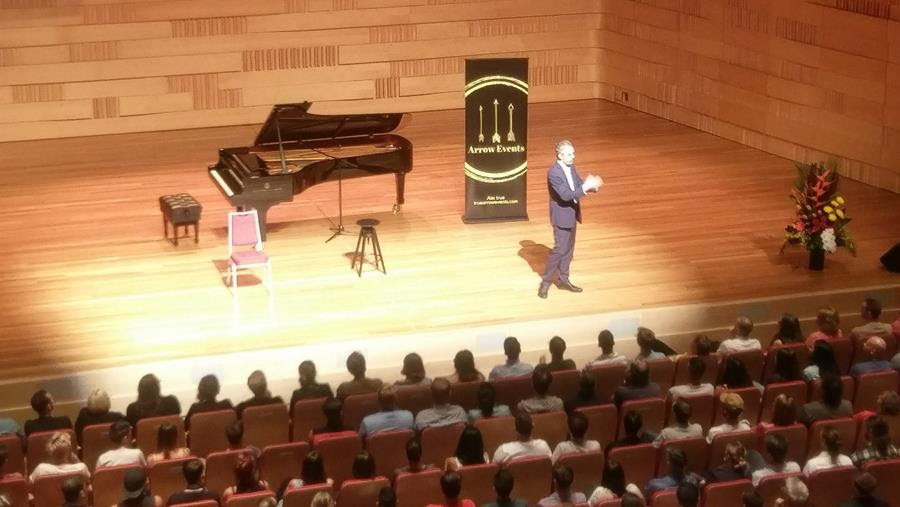
His YouTube channel is now approaching 1 million subscribers.

As Peterson takes the stage of his Sydney lecture, the auditorium erupts into a standing ovation fit for a hero of our times. But there is no showmanship here. As the audience resumes their seats and silence sets in, Peterson begins hesitantly. He is softly spoken, cautious, almost diminutive and yet these people are listening. I mean really listening. Nearly every one of the packed-out audience is leaning forward, totally focused, eagerly hanging on his every word. It remains this way for well over two hours.

“I like to get to the bottom of things,” declares Dr Peterson. “I mean all the way to the bottom, until you hit bedrock you can rely on.”

Peterson’s message is one of truth and meaning. In particular, he tells his audiences how to live in light of these things. It is a message of personal responsibility and self-betterment, but one that understands the vacuous postmodernism in which today’s young people are steeped, successfully tearing it down and building up some meaning in its place.

The fact that his message is literally taking the Western world by storm is testament to how hollowed out and emptied of substance we have become.

The young men in this room have been raised on a diet of video games, porn, and binge-watched television series’. Many of them are fatherless. Their postmodern education has given them nothing firm upon which to stand in order to understand the world. They hear that their masculinity is toxic, their deep desires to protect and provide are wrong or evil, they are rapists-in-waiting, and they need to get out of the way of the women in their lives.

They have been left with no idea how to deal with themselves on almost every level.

Now here is a man – a father figure – who literally tells them to clean their room, stand straight with their shoulders back, “lift heavy rocks” (take responsibility), be brave, change the world, get married, be good fathers and husbands, seek truth…

They’ve never heard anything like it. And they love it.

Read the comments on Peterson’s YouTube videos. Young men in their droves are writing, “Jordan Peterson is literally my dad.” “Dr Peterson – I made my bed this morning.” One YouTube clip shows Peterson choking back tears as he tells of the young men like these who write to him.

Significantly, Christians are flocking to Peterson. Though not a Christian himself, he speaks a language that we are instantly drawn to because it relies so heavily upon Christian principles. He even teaches the Bible in his lectures.

But listening carefully to Peterson, I couldn’t help thinking of the Apostle Paul’s sermon to the Athenians on Mars Hill (Acts 17:22-34). They, too, sought bedrock.

Many of them great Greek philosophers, the men who Paul addressed were engaged in one of the greatest quests for truth and ultimate meeting. The Western cultural heritage bears witness to their work. But they had not gone deep enough. Theirs was a drilling expedition that had stopped too soon.

Paul saw, as he walked through their city, altars and idols to many gods (v23). So many of these represented realities these people had discovered – gods who imparted art and music, fertility, victory in battle. Gods of the sea, of fire, of beauty, and so forth. But surely there is something even greater, that yet lies behind all of this?

Peterson is the same. The foundations upon which he relies are the “archetypes” of psychological theory. These are said to be deep, enduring truths, held in the collective unconscious of societies throughout the ages. They find expression in narratives, religions, social norms, psychological realities, and so forth. They exist because they are true, though often we know not how or why.

In his lectures, the Bible is held up as a text in which we find the paramount expression of some of these archetypes.

Jesus, says Peterson, shows us the deep truth that, if we bear the burden of our own vulnerability to hardship and injustice willingly and without complaint, then we will be able to transcend it.

Zion, the Heavenly City on a hill, tells us that we can struggle under the weighty burdens of our human brokenness in a way that carries us upwards until we reach a place where they will be no more.

The Sermon on the Mount tells us that, no matter the pain and difficulty of our own circumstances; no matter our lack of privilege, moral character is attainable by all.

Again, I say: surely there is something even greater than archetypes?

The realities of our world are not true because they spring from Greek myth, or even from archetypes that may be expressed by those myths and other sources, like the Bible.

As Paul once said, these things are true because of God who is yet unknown to Peterson and so many of his disciples. The true and living God – the “God who made the world and everything in it, being Lord of heaven and earth” (v24). God who made the bedrock truth which lies behind the archetypes. The One “in whom we live and move and have our being” (v28) – by whom we can be transformed to become the people of character that Peterson would have his followers become.

In many ways, I felt like I was sitting in a modern-day Areopagus (v22) on Monday night. The great philosopher stood before us, leading us on our quest for truth and meaning. An audience made hungry by hollowed out, postmodern secularism, hangs on every word. Questions follow.

It would have been fitting had there been an altar to an unknown God (v23) in the corner. The room does not know it, but He is the answer to all their questions – those they have asked, and those they do not even know.

He is the bedrock they seek. The Logos by whom all things have been made, who is the light and life of men (John 1:3-4).

There is a hungry, needy, confused generation growing up in Australia. The Dr Jordan Peterson’s of this world are feeding them something, but I can’t help thinking: why not the church?

If it is a message of truth and meaning we crave, then this increasingly unknown God, revealed in the pages of scripture, is the answer because He is true, and He has given all things their meaning.

Extracted from Martin Ile’s blog – acl.org.au