CHURCHES DESTROYED BY ISLAMIC STATE REOPEN IN IRAQ

Two historic churches in Mosul, Iraq, have officially reopened after years of restoration, nearly a decade after their destruction during the Islamic State’s occupation. The reconsecration ceremonies marked a rare moment of revival for the region’s dwindling Christian population. Hundreds of worshippers gathered for the reopening and consecration ceremonies, attending prayers amid the rebuilt halls.

The Saint Thomas Syriac Orthodox Church dating back to the 7th century, and the Al-Tahira Church of the Chaldeans which was built in the 18th century, were both inaugurated following their reconstruction which came as part of the “Revive the Spirit of Mosul” initiative, launched in 2018, by United Nations Educational, Scientific and Cultural Organization (UNESCO) and the Iraqi authorities. Reconstruction efforts for the churches began in 2023.

Fadi, a 27-year-old Christian from Mosul who trained for three years to help the restoration project, told Vatican News that the reopening’s are “a sign of hope” for displaced Christians. “It shows the Christians living abroad that things are better here now, that they can move back home,” he said. 

Mosul’s Christian population, once 14% of the city, has now shrunk to fewer than 60 families in a city of nearly 2 million, reports the Catholic non-profit media outlet Zenit.

“These churches are not just stones. They are the memory of faith, history, and community,” Archbishop Najeeb Michael Moussa, the Chaldean bishop of Mosul, was quoted as saying after the ceremony.

The restoration, he added, showed that “faith can be wounded but not extinguished,” and that each bell strike “calls not only the faithful, but the future.”

Teams first cleared mines and explosives from the sites before beginning reconstruction. Among the carefully restored features was the 13th-century alabaster door of Saint Thomas, carved from local marble known as farsh and depicting Christ with the twelve apostles.

Church bells cast by the Cornille Havard foundry in Normandy now ring out again over Mosul. The same foundry restored the bells of Notre-Dame de Paris, Zenit notes. 

Inscriptions on the bells include the phrases “The truth will make you free” and “Peace I leave you, my peace I give you.” 

GOD USES PERSECUTION TO GROW THE CHURCH IN UKRAINE

As war continues to devastate Ukraine, a mighty spiritual revival is unfolding amid the ruins, according to Ukrainian evangelist David Karcha, who told a gathering of European church leaders that the Gospel becomes unstoppable in a time of war. Speaking at the European Congress on Evangelism in Berlin, Germany, on May 29, Karcha described how churches across Ukraine have become beacons of hope, drawing thousands to Christ even as the country endures deep physical and emotional suffering. His address came just a day after Franklin Graham met with Ukrainian President Volodymyr Zelenskyy in Berlin to pray for peace, underscoring the Congress’s message of gospel resilience in the face of crisis. “In a time of peace, the Gospel is powerful. But in a time of war, it is unstoppable,” said Karcha in his opening remarks in which he brought greetings from the Evangelical wider Church in Ukraine to the Berlin Congress delegates.

After Russia’s invasion in February 2022, Karcha said Ukrainian Evangelicals faced a critical choice: to fracture and flee, or to remain and share in the suffering of their fellow countrymen. This was “not because we had a plan, not because we felt ready, but because we saw that even the smallest act done in faith becomes a part of something much greater.” “Hope as a reality is something searched for as part of human existence seeking “something greater, something essential,” Karcha pondered. For the Church in Ukraine, this journey of hope, made within the light of the living Lord Jesus, has meant taking small steps as a unified community moving together. By doing so, “it becomes a movement no war can stop.” Karcha wanted to set the record straight about religious persecution, often dominating news about Christian Ukrainians. He pointed out that the main headline story in Ukraine is about masses of people turning to Christ. The church minister said that in 2023 “alone,” Baptist churches witnessed “thousands of people publicly profess their faith through baptism.”

The Church has woken up to the spiritual hunger in the country and stood up to the challenge of serving not just bodies but souls. In the last three years, Karcha testified that “hundreds of thousands of people have walked through the doors of Ukrainian churches and encountered the love and care of God.” “Many of them for the first time in their life,” he added, and told the story he heard from a German pastor at the Congress of a particular woman who knew nothing of church but fled to Germany as a refugee and sought shelter in a church. She experienced food, care and the church showed love, telling her about Jesus. The woman eventually gave her heart to Jesus Christ. Karcha thanked churches across Europe for their loving support for Ukrainians in the past few years of the war. “The body of Christ is not confined to one country or to one border but is alive and active whenever his people are present,” said Karcha, to more applause. “Thank you for being his hands and his heart for those who are in real need.”

“God is teaching us to listen and to see where he is already at work,” he continued. “Ukrainian churches are there on the front lines, ministering as chaplains in the trenches and grounds, at hospitals, bringing prayer and the hope of Christ to the soldiers in the fire of battle and places of hopelessness.” “We are there for the widows of fallen soldiers and for the orphans whose mothers are never coming home, holding their clothes, sharing the grief. We minister to those who have lost everything, homes reduced to rubble, families torn apart, bodies and souls scared by unspeakable fragments and torture brought to us by the Russian army.” All of these ministries start with active listening, Karcha said, “We listen. We pray. We help. And then when we see how we can help and what can be gone, we speak Jesus.” A man called Viktor, in his mid-50s, came to Karcha’s own church as a refugee, “like so many other at that time.” He was a quiet man, according to the church leader, who seemed broken and carried a “lifelong lifetime of burdens.”

One day, Viktor asked Karcha if they could talk. He disclosed that he knew about God since childhood and spent many decades running away from him, causing pain around him. However, he declared a readiness to surrender his life to Christ. “He cried. He wept. And he was born again, right in front of our eyes,” said Karcha, adding that God is still at work and listening, and still redeeming, bringing children home. “Dear brothers and sisters,” Karcha told delegates, “This is a little bit of what God is doing in our country. He’s awakening his church, stirring a desperate search for hope, and teaching us to listen and watch him work.” “He’s stirring suffering into testimony, fear into faith, and small acts of love into seeds for his kingdom. In the world’s eyes, Ukraine is a story of war. But in God’s eyes, it is a story of revival, a story that reminds us all that the Gospel … advances. That even when the rockets are exploding next to us, the foundation of Christ stands firm. That even in the darkest night, the light of his truth still breaks.” “Let history bow down to the cross,” Karcha said, concluding with an encouragement to boldly proclaim Jesus as Lord regardless of circumstance.

Source:   Christian Daily International

WHY DOES GOD ALLOW END TIMES PERSECUTION OF CHRISTIANS?

The Bible says persecution can strengthen the Church

The Bible clearly shows that persecution can advance the Gospel and unify the Church. In Philippians 1:12–13, Paul (writing from a Roman prison) shares how his imprisonment has emboldened others to proclaim Christ without fear. “I want you to know, brothers,” Paul writes, “that what has happened to me has really served to advance the Gospel, so that it has become known throughout the whole imperial guard and to all the rest that my imprisonment is for Christ.

Four Iranian Christians were sentenced to 80 lashes for drinking communion wine.

Throughout history, persecution has purified and strengthened the church, fueling its growth even in the most difficult and dangerous places. Consider the underground church in Iran, the fastest-growing Christian community in the world despite — or perhaps because of — 45 years of oppression by a government doing everything it can to hinder its work.

The church in Eritrea is another remarkable example. Pastors there have found ways to witness to others while in prison. The church thrives when its focus is sharpened, and denominational divisions fall away under the weight of shared suffering and purpose.

The Bible tells Christians how to respond to persecution

The Bible provides clear guidance on how to face persecution. Jesus’ words in Matthew 5:44 are simple and unambiguous: “Love your enemies and pray for those who persecute you.” This radical response reflects God’s love and is a powerful testimony to a watching world.

The Bible also tells us that Christians who aren’t currently facing persecution still have a role to play and shows how to hold our Christian brothers and sisters in our hearts and minds: “Remember those in prison, as if you were there yourself. Remember also those being mistreated, as if you felt their pain in your own bodies” (Hebrews 13:3).

The stories and testimonies of persecuted Christians demonstrate the transformative power of following Christ’s command and example. An imprisoned pastor in Central Asia saw his treatment improve drastically after he began receiving letters of encouragement from believers worldwide. His guards became kinder and his warden more attentive, all because of the unity and love evident among the global body of Christ.

We Christians in free nations must recognize our role in supporting and praying for our persecuted brothers and sisters.

The Bible shows that persecution can be a platform for God’s power

Even amid our trials and weaknesses, God works mightily through his people.

After a house church pastor was arrested in Iran, his wife was terrified that she might be next. She worried that she wouldn’t be able to resist torture and would give up other believers’ names. She prayed that God would hide her from the religious police. But when they arrested and interrogated her, she became empowered by the Holy Spirit, witnessing boldly to her interrogator. “You are an interrogator,” she told him, “but one day you are going to stand before the ultimate interrogator, Jesus Christ, and he is going to examine you. Without him, there is no hope for you.”

After three straight days of her bold, spirit-empowered witness, the interrogator visited her filthy jail cell late one night. She feared that he was there to kill her, but instead he placed his faith in Christ and told her how she could witness for Christ more safely. Then, the interrogator released her and her husband.

This story highlights a profound truth: God often uses human frailty to show us his strength. As Paul reminds us in 2 Corinthians 12:9, God’s power is “made perfect in weakness.

What the Bible does NOT say about persecution

The Bible never tells believers to be afraid.

This is striking, considering the suffering brought by persecution. Yet Scripture repeatedly emphasizes courage and trust in God’s sovereignty. As Richard Wurmbrand, Romanian pastor and founder of The Voice of the Martyrs, observed, the Bible contains 366 admonitions to “fear not” — one for every day of the year, including an extra for leap years. That number was significant to Wurmbrand because he was arrested on Feb. 29, which occurs only in leap years.

Fear is a natural human response, but it does not have to define us. A Filipino pastor once told me, “Until God is finished with you, you are invincible.” His confidence was not rooted in his human strength but in God’s purpose and power.

Persecution may not be part of your reality today, but the call to be involved remains. Whether through prayer, advocacy, or encouragement to believers who are currently facing persecution, every follower of Christ has a role to play.

Let us live boldly, trusting that God’s grace and power are sufficient for every trial we face.

Source: Todd Nettleton is Vice President for Message at The Voice of the Martyrs and host of The Voice of the Martyrs Radio. He is the author of When Faith Is Forbidden: 40 Days on the Frontlines with Persecuted Christians.

HOSTILITY AGAINST CHURCHES IN USA ACCELERATING

Over the past several years, the Family Research Council has been tracking acts of hostility against churches in the United States. Between January 2018 and November 2023, at least 915 acts of hostility occurred. The types of acts include vandalism, arson, gun-related incidents, bomb threats, and more.

In 2023, the Family Research Council identified 436 incidents—more than double the number identified in 2022 and more than eight times the number identified in 2018. These findings suggest that hostility against U.S. churches is not only on the rise but also accelerating.

From January to November 2023, there were at least 315 occurrences of vandalism, 75 arson attacks or attempts, 10 gun-related incidents, 20 bomb threats, and 37 other incidents. Seventeen incidents fell into multiple categories. Criminal acts of vandalism and destruction of church property may be symptomatic of a collapse in societal reverence and respect for houses of worship and religion.

Although the motivations for many of these incidents remain unknown, the rise in crimes against churches is taking place in a context in which American culture appears increasingly hostile to Christianity. Criminal acts of vandalism and destruction of church property may be symptomatic of a collapse in societal reverence and respect for houses of worship and religion—in this case, churches and Christianity. Americans appear increasingly comfortable lashing out against church buildings, pointing to a larger societal problem of marginalizing core Christian beliefs, including those that touch on hot-button political issues related to human dignity and sexuality. Attacks on houses of worship may also signal a discomfort with religion in general.

We should not be surprised because all three Gospels, Matthew, Mark, and Luke record what Jesus told the disciples about the intense persecution of Christians that will take place before Jesus returns, first to rescue His Saints, then pour out His wrath upon the unrepentant, and finally to restore righteousness during His Millennial reign on this Earth.

Then they will deliver you up to tribulation and put you to death, and you will be hated by all nations for my name’s sake. And then many will fall away and betray one another and hate one another. And many false prophets will arise and lead many astray. And because lawlessness will be increased, the love of many will grow cold. But the one who endures to the end will be saved. And this gospel of the kingdom will be proclaimed throughout the whole world as a testimony to all nations, and then the end will come.Matthew 24:9-14

And brother will deliver brother over to death, and the father his child, and children will rise against parents and have them put to death. And you will be hated by all for my name’s sake. But the one who endures to the end will be saved.Mark 13:12-13

You will be delivered up even by parents and brothers and relatives and friends, and some of you they will put to death. You will be hated by all for my name’s sake. But not a hair of your head will perish. By your endurance you will gain your lives.Luke 21:16-19

GROWING CHRISTIANITY IN TIMES OF PERSECUTION

As China’s Christian Persecution Rages, Is Biblical Faith in Decline or Thriving in the Shadows?

David Curry, CEO of Global Christian Relief, an organization that helps Christians under duress around the globe, believes the church in China based on our methodology, is somewhere around 120 million,” Curry said, though definitive numbers are difficult to determine. If true, this would mean some estimates are off by almost 100 million people. One of the challenges, Curry said, is using self-identifying religious data inside a country that openly punishes Christianity and those who choose to publicly align with the faith. “They have self-identifying as one of the factors which make the number incredibly low,” he said. “Historically, the Chinese church has been underground.” While the church came above ground in recent decades, the rise of Chinese President Xi Jinping has created roadblocks and problems, with the Chinese Communist Party (CCP) increasingly cracking down on the faithful. The government looks down upon those who attend church regularly, and children cannot be legally aligned with any faith tradition. “[President Xi has] become more like a dictator,” he said. “It’s gone back underground, because of the increased restrictions. So, to be self-identified as a Christian means to put yourself in the crosshairs of a lot of government surveillance and other things, because Christian behaviour is punished in their social score system, and they have a very sophisticated way of monitoring this.”

In this photo taken Sunday, June 3, 2018, the demolished house church is seen in the city of Zhengzhou in central China’s Henan province. Under President Xi Jinping, China’s most powerful leader since Mao Zedong, believers are seeing their freedoms shrink dramatically even as the country undergoes a religious revival. Experts and activists say that as he consolidates his power, Xi is waging the most severe systematic suppression of Christianity in the country since religious freedom was written into the Chinese constitution in 1982. (AP Photo/Ng Han Guan)

As CBN News has reported, the CCP is reportedly also attempting to rewrite the Bible in its own image, with officials in one area also testing out a new app demanding citizens pre-register before attending religious services. “When you ask people if they’re Christian, they’re not likely to just raise their hand, wave, and jump up and down, and say, ‘Yeah, count me in your survey,’ because they know what it means,” Curry said. Despite these challenges, Curry believes Christianity is, in all reality, increasing in China, with a healthy underground church continuing to grow.  “It’s under pressure … but the church of China is growing,” he said. “I think it’s healthy, despite a lot of the headwinds it’s facing right now.”

Curry said Chinese Christians could help believers in the West who are “in a mode of retreat” amid the cultural changes that have suddenly made those heralding biblical values persona non grata. “We’re in a defensive position,” he said. “And I think we need to look at the Chinese church and the church that’s under persecution in general as perhaps a model of how a church can grow in difficult times.”

We are fast approaching the Biblical prophesied last seven years before Jesus returns to Earth, to rescue the Saints and to pour out His wrath upon an unrepentant world. Persecution/Tribulation of Christians is prophesied to increase during the time the Antichrist will rule the world. Jesus has told us in advance so we will be prepared for the suffering knowing our redemption is close at hand.

Then they will deliver you up to tribulation and put you to death, and you will be hated by all nations for my name’s sake. And then many will fall away and betray one another and hate one another. And many false prophets will arise and lead many astray. And because lawlessness will be increased, the love of many will grow cold. But the one who endures to the end will be saved. And this gospel of the kingdom will be proclaimed throughout the whole world as a testimony to all nations, and then the end will come.” Matthew 24:9-14

Now when these things begin to take place, straighten up and raise your heads because your redemption is drawing near.Luke 21:28

FACE PERSECUTION OR FLEE?

The end times church will be faced with this question (face persecution of flee) more and more as Christians experience the coming prophesied tribulation in the last seven years before Jesus returns first to rapture His church and to pour out His wrath on a lawless, unrepentant world.

In this photo taken Sunday, June 3, 2018, the demolished house church is seen in the city of Zhengzhou in central China’s Henan province. Under President Xi Jinping, China’s most powerful leader since Mao Zedong, believers are seeing their freedoms shrink dramatically even as the country undergoes a religious revival. Experts and activists say that as he consolidates his power, Xi is waging the most severe systematic suppression of Christianity in the country since religious freedom was written into the Chinese constitution in 1982. (AP Photo/Ng Han Guan)

Three years ago, 62 members of China’s Shenzhen Reformed Holy Church, also known as the Mayflower Church, fled to South Korea to escape persecution from the Communist government. They requested political asylum in South Korea but were denied. The church is now in Thailand, where members hope to gain refugee status, and eventually resettle in the United States. Until then, they face many challenges, including possible arrest by Thailand immigration police and being sent back to China.

The Mayflower Church believes that they are like the Israelites in Exodus who God brought out of Egypt. As well, if you study the book of Acts, the Apostle Paul fled persecution. Most Christian churches in the Western world would support the course of action taken by the Mayflower Church, however, many of the Chinese house church Christians have a self-identity of being “patriotic martyrs”. They are willing to suffer and be martyred for their faith. So when a group decides to leave persecution and martyrdom, that creates some tension in what has become a cultural and religious identity of the entire house church Protestant movement in China.

Regardless, it was encouraging to learn what Pastor Pan said in response to this contradictory view, “While church members still face restrictions and potential deportation, we enjoy the freedom we have to worship. I struggle with many uncertainties in my heart like most of my congregation. But we find strength every time we experience how God has been faithfully providing for our daily needs and how He is constantly protecting us from the evil men who want to harm us. “Whether we go live in the US or are taken back to China, we will regard this experience as listening to God’s call and continuing to be a vibrant testimony of His goodness and faithfulness.”

DOING CHURCH RIGHT

If you do church right, some of the unchurched will love you and some will hate you

This article by Michael Brown addresses the traditional church model but it applies to some degree to the House Church model. However, it is unlikely that a hostile pagan will ever want to attend a house church meeting.

Jesus Himself exhorted us, “let your light shine before others, that they may see your good deeds and glorify your Father in Heaven” (Matthew 5:16). Or, in the words of Peter, “Live such good lives among the pagans that, though they accuse you of doing wrong, they may see your good deeds and glorify God on the day he visits us” (1 Peter 2:12).

Let us be known for our good works, for our kindness and compassion, for helping the poor and the needy, for standing for righteousness, and for opposing injustice. By all means, let us live this out for the glory and honor of God and for the good of a hurting world.

But let us not deceive ourselves. The same world that hated Jesus will hate us also. The same humanity that chose darkness over the light in Jesus’ day will gravitate to the darkness today. Do not be deceived.

As Jesus said to His disciples, “Students are not greater than their teacher, and slaves are not greater than their master. Students are to be like their teachers, and slaves are to be like their masters. And since I, the master of the household, have been called the prince of demons, the members of my household will be called even worse names!” (Matthew 10:24–25)

And this: “If the world hates you, keep in mind that it hated me first. If you belonged to the world, it would love you as its own. As it is, you do not belong to the world, but I have chosen you out of the world. That is why the world hates you. Remember what I told you: ‘A servant is not greater than his master.’ If they persecuted me, they will persecute you also. If they obeyed my teaching, they will obey yours also” (John 15:18–20).

That means that some people will love us because they see our lives, because they are drawn to Jesus, and because they too have opened their hearts to Him. Others will hate us, repelled by our godly lives, turned off by our moral standards, and dead set against receiving Jesus as Lord. No matter how gracious we are, they will brand us as bigots and haters and worse.

On a practical level, that means that the young, drug-addicted, non-believing couple living together out of wedlock should feel welcomed and loved when they walk into one of our services. They should encounter people who have joy, who are thrilled to see new faces, and who treat them as if they were family.

At the same time, if the Gospel is being preached and the Holy Spirit is moving, at some point they will become conscious of their sin and will be called to repent and receive mercy and grace through the cross.

If they can continue to come week in and week out, never feeling uncomfortable, never feeling conviction, never encountering both the holiness of God and the love of God, then something is wrong with those meetings.

As Jesus also said, the Holy Spirit has come to “convict the world concerning sin and righteousness and judgment” (John 16:8). The Holy Spirit will make us uneasy in our sin. The Holy Spirit will invade our hiding places. The Holy Spirit will reveal what is wrong so that we can be made right.

Again, on a practical level, that means that a gay couple attending our meetings should be greeted just like a couple living together out of wedlock — with love and grace and with hospitality. But if they continue to attend our gatherings, if we are preaching the Word, giving place to the Spirit in our worship, and living godly lives ourselves, they will recognize that God is not pleased with their union. They will be confronted with grace and truth and will have to decide how they will respond. Will it be with contrition and confession or with disobedience and defiance?

This reminds me of what an ex-gay Christian said when he was asked if you could be gay and Christian (meaning, practicing and/or affirming homosexuality and following Jesus at the same time). He responded, “Not for long!”

In light of this, I have to question what a pastor is teaching when a wealthy strip club owner could be a long time, tithing member of his church without either coming under church discipline or Holy Spirit conviction. Something very fundamental is wrong with this picture. (For the record, this is a real-life example. The church claimed to be a Bible-believing, evangelical congregation.)

So, let us do our best to have churches and communities that the unchurched will love, but not at the expense of speaking the truth, with both clarity and compassion. And let us remember that if we are true to Jesus, true to the Word, and true to the Spirit, some will love us and others will hate us. It is inevitable and unavoidable.

Article “If you do church right, some of the unchurched will love you and some will hate you” by Michael Bronw in Christian Post Wednesday, Feb. 8th, 2023.

CHRISTIAN PERSECUTION IN INDIA

Authorities in the northern Indian state of Uttar Pradesh arrested seven pastors at a prayer meeting under the state’s “anti-conversion” law, which Christians have accused Hindu nationalists of using as a tool to persecute them.

The pastors were arrested during a prayer meeting they were holding in Mau district last Sunday, UCA News reported, adding that the pastors have been charged with “illegal assembly.”

The U.S.-based persecution watchdog International Christian Concern said this past weekend that the Christians remained in jail.

“We will move bail applications and are hopeful that they will be out of jail soon,” the pastors’ lawyer, Ashish Kumar, was quoted as saying.

The police initially also detained 50 worshipers but released them the same day. Two Catholic nuns who were at a bus stop near the prayer house were also held at the police station for several hours until the evening, said UCA News.

“Police wanted to book the sisters along with the pastors but let them go after the pastors and the faithful said they were not part of the prayer group,” Father Anand Mathew, a member of the Indian Missionary Society, was quoted as saying.

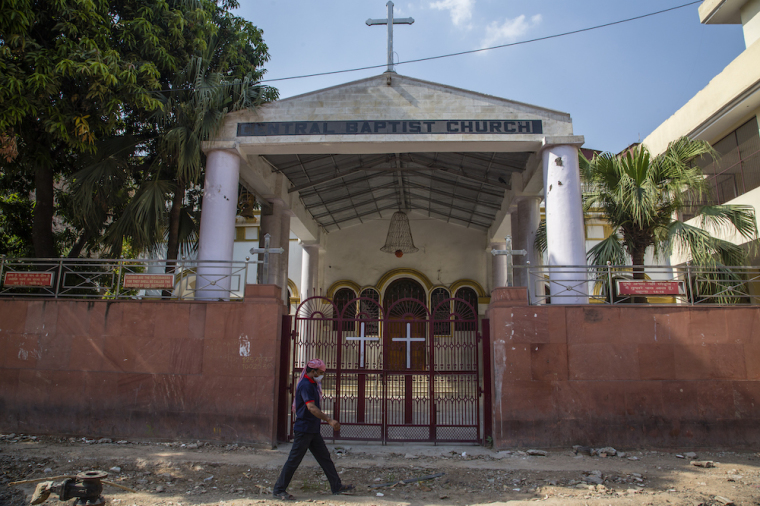
india church, delhi
An Indian man walks outside a deserted Baptist church, as India remains under an unprecedented extended lockdown due to COVID-19 on May 5, 2020, in Delhi, India.

Uttar Pradesh is one of the several Indian states that have “anti-conversion” laws, which presume that Christians “force” or give financial benefits to Hindus to convert them to Christianity.

The law states that no one is allowed to use the “threat” of “divine displeasure,” meaning Christians cannot talk about Heaven or Hell, as that would be seen as “forcing” someone to convert. And if snacks or meals are served to Hindus after an evangelistic meeting, that could be seen as an “inducement.”

The ICC previously noted that India’s population data proves that the conspiracy of mass conversions to Christianity is a false claim. “In 1951, the first census after independence, Christians made up only 2.3% of India’s overall population. According to the 2011 census, the most recent census data available, Christians still only make up 2.3% of the population.” This is a sad state of affairs and Christians need to pray for India and God’s plan to liberate this nations from Satan’s clutches.

India ranks as the 10th worst country globally when it comes to Christian persecution, according to Open Doors USA’s 2021 World Watch List. The U.S. Commission on International Religious Freedom has urged the U.S. State Department to label India as a “country of particular concern” for engaging in or tolerating severe religious freedom violations.

Open Doors USA warns that since the ruling Hindu nationalist Bharatiya Janata Party took power in 2014, persecution against Christians and other religious minorities has increased. The group reports that “Hindu radicals often attack Christians with little to no consequences.”

“Hindu extremists believe that all Indians should be Hindus and that the country should be rid of Christianity and Islam,” an Open Doors fact sheet on India explains. “They use extensive violence to achieve this goal, particularly targeting Christians from a Hindu background. Christians are accused of following a ‘foreign faith’ and blamed for bad luck in their communities.”

This is further evidence we are in the prophesied last days before Jesus returns first to rapture the Saints and then to return with the Saints to set up His Millennium Kingdom. Time is short and the task is daunting but we know God is in control. Each of us just needs to allow the Holy Spirit to direct our steps so we complete the good works He has assigned for each of us.

For we are his workmanship, created in Christ Jesus for good works, which God prepared beforehand, that we should walk in them.Ephesians 2:10

work out your own salvation with fear and trembling, for it is God who works in you, both to will and to work for his good pleasure.Philippians 2:12-13

For the grace of God has appeared, bringing salvation for all people, training us to renounce ungodliness and worldly passions, and to live self-controlled, upright, and godly lives in the present age, waiting for our blessed hope, the appearing of the glory of our great God and Savior Jesus Christ,Titus 2:11-13

This image has an empty alt attribute; its file name is image-1.jpeg

BIBLE BELIEVING COUNTER-CULTURAL CHURCHES THRIVING

The most common religious identity among young adults in the U.S. is “none,” and the majority of Americans don’t believe it’s necessary for a person to believe in God to be moral and have good values, a new survey has found. The survey on American Life investigating contemporary religion in the U.S. found that among young adults (age 18 to 29), the most common religious identity today is none. More than one in three (34%) young adults are religiously unaffiliated.  Nearly nine in 10 (87%) Americans report they believe in God, but just over half (53%) report they believe in God without any doubts at all. Overall, 42% of Americans have a close social connection with someone who is religiously unaffiliated — up from 18% in 2004.
Additionally, most Americans say it’s not necessary for a person to believe in God to be moral and have good values. Close to six in 10 (59%) Americans say a belief in God is not a precondition to being moral and having good values, while 41% of the public say a belief in God is essential. These statistics, the authors say, mark a “remarkable shift in recent years. The study also found that Americans are almost equally divided over whether it is better to discuss religious beliefs and ideas with those who do not share the same perspective, and most Americans have never been invited to church. A majority (54%) of Americans say they have not been asked to participate in a religious service in the past 12 months or have never been asked.

The survey corroborates a 2019 Pew Study survey that documented the decline of Christians and rise of religiously unaffiliated. Pew noted that the religiously unaffiliated group rose to 22.8% share of the population in 2014, eclipsing the number of Catholics in America, who fell to 20.8%. Christians as a whole fell from 78.4 to 70% of the population between 2007 to 2014, with every major group experiencing a decline. Similarly, the 2018 General Social Survey found that the number of religious “nones” in the U.S. are now statistically equal to the number of evangelicals. Ryan Burge, a political science researcher at Eastern Illinois University who analyzed data from the survey, told The Christian Post that the religious “‘none’s’ are not slowing down.”

THE GOOD NEWS

Russell Moore, president of the Ethics & Religious Liberty Commission of the Southern Baptist Convention, previously said the “increasing strangeness” of Christianity is actually “good news” for the church. “Christianity isn’t normal anymore. It never should have been. The increasing strangeness of Christianity might be bad news for America, but it’s good news for the church. The major newspapers are telling us today that Christianity is dying, according to this new study, but what is clear from this study is exactly the opposite: while mainline traditions plummet, evangelical churches are remaining remarkably steady,” Moore said.

He added that statistics indicate there are honest atheists in America today, and that they are rejecting what’s called “almost-Christianity,” or traditions that “jettison the historic teachings of the Church as soon as they become unfashionable.” “The churches that are thriving are the vibrant, counter-cultural congregations that aren’t afraid to not be seen as normal to the surrounding culture. This report actually leaves me hopeful. The Bible Belt may fall. So be it,” he continued. “Christianity emerged from a Roman Empire hostile to the core to the idea of a crucified and resurrected Messiah. We’ve been on the wrong side of history since Rome, and it was enough to turn the world upside down.”

GOD’S WORD IS INERRANT

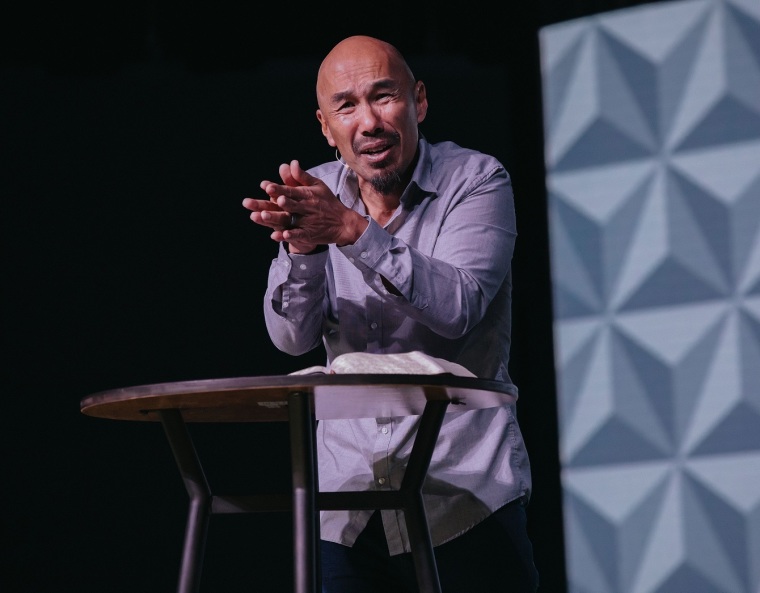
MORE WISDOM FROM FRANCIS CHAN ON THE FUTURE CHURCH

Francis Chan, the Cornerstone Church founder said he believes God has given the Church an opportunity in the pandemic to grow and become “deeply intimate” with Him. Chan said he believes God is using the crisis to wake up Christians.

Chan questioned how effective the Church has been with religious freedom when compared to places like China where the Church is persecuted.

“When you look at the places where there is religious freedom and you compare those places to where there is not religious freedom, what have we done with the freedom? It’s just weakened the Church,” he said.

I’m grateful for the people who fight for religious freedom. I’m grateful to have it. At the same time, I’m not really afraid of losing it because I look at how the church is flourishing and how it actually looks like the Church of Scripture where there is persecution. And again, I’m not saying I’m wanting that or desiring that. But what I am wanting is to see a pure Church where people are devoted, they’re serious and they understand what it means to really follow Jesus. Then we can really be a light to the world,” Chan explained.

“God does not put us in a situation where we can’t be deeply, deeply, intimate with him and growing with one another. Man don’t miss this,” he said, noting that it’s a great opportunity for parents to become more hands one with the spiritual development of their children.