A SUPERSONIC AI TSUNAMI IS COMING

Elon Musk describes what’s coming as a Supersonic Tsunami of converging exponentials. AI isn’t improving linearly anymore. We’re watching three exponential curves hit their inflection points simultaneously: compute scaling, model capabilities, and infrastructure deployment. When exponentials converge, you don’t get incremental progress. You get phase shifts.

Let me give you the raw numbers that demonstrate just how fast this is moving. What’s happening with AI revenue right now is unprecedented in the history of business. Anthropic hit $14 billion in annualized revenue in February 2026, growing from $1 billion just 14 months earlier. That figure has since surpassed $19 billion, more than doubling from $9 billion at the end of 2025. There is simply no precedent for this in B2B software.

And yet most people do not know who Anthropic is and what they do. Also, to understand what that means: Anthropic’s monthly revenue run rate is now roughly $1.6 billion per month, and it keeps accelerating. Anthropic projects as much as $70 billion in revenue by 2028.

OpenAI reached $25 billion in annualized revenue at the end of February 2026, up from $21.4 billion at year-end 2025, with full-year 2025 revenue coming in at $13.1 billion. Both companies are now valued in the hundreds of billions, Anthropic at $380 billion following its $30 billion Series G. OpenAI’s most recent private round in February 2026 valued it at approximately $730 billion, with an IPO potentially targeting a $1 trillion valuation.

Nvidia’s, Jensen Huang recently finalized a $30 billion investment in OpenAI and a $10 billion investment in Anthropic, and told investors these will likely be Nvidia’s last private investments in either company, because both are heading toward public markets. Think about that: the CEO of Nvidia, who has better visibility into AI infrastructure demand than anyone on Earth, made $40 billion in bets on these two companies as his final pre-IPO move.

What’s driving this revenue? It’s not IT budgets anymore. The models — Claude from Anthropic, GPT-5 from OpenAI — have crossed a threshold. They’re now competing with labour budgets.

Companies aren’t buying AI to replace servers. They’re buying AI to augment and ultimately displace human labour.

What’s the breakthrough use case? Coding. Claude Code (Anthropic’s agentic coding tool) now has run-rate revenue above $2.5 billion, having more than doubled since the beginning of 2026. Business subscriptions have quadrupled since the start of the year, and enterprise use has grown to represent over half of all Claude Code revenue.

Now you can buy intelligence on a metered basis. Pay per token. No recruiting, no vetting, no retention, no equity. Just intelligence as a utility. Consumers pay $20/month. Enterprise power users pay $200/month. And companies are spending millions per year because the ROI is there.

The Infrastructure Equation

Here’s the infrastructure reality that almost nobody is talking about loudly enough.

The five largest US hyperscalers — Microsoft, Alphabet, Amazon, Meta, and Oracle — have collectively committed to spending ~$690 billion on capital expenditure in 2026 alone, nearly doubling 2025 levels. The vast majority is directed at AI compute, data centers, and networking.

Total global AI spending is forecast to hit $2.5 trillion in 2026, a 44% increase over 2025, according to Gartner. Data centers, GPUs, power generation, chip fabrication. This is the largest infrastructure buildout in the history of technology, by a wide margin.

The rule of thumb in this industry: roughly $50 billion per gigawatt of infrastructure, and approximately $10 billion of annual revenue per gigawatt. Energy equals intelligence.

On a recent earnings call, Jensen Huang estimated that between $3 trillion and $4 trillion will be spent on AI infrastructure by the end of the decade. TechCrunch

This isn’t hype. This is capital deployment at a scale that rewrites the rules of what’s possible. When you’re spending $50 billion on a single data center and generating $10 billion a year in revenue from it, you’re not building a product… you’re building a new economic substrate. You’re building the electricity grid of the 21st century.

The tsunami is here. The question is whether you’re building on the wave or getting buried by it.

AI: The Capability Jump

Those revenue numbers I just showed you are driven by real capability breakthroughs happening right now.

Start here: neuromorphic chips just solved complex physics simulations at 1,000x better energy efficiency than supercomputers. That’s not 10% better. That’s three orders of magnitude. When compute gets that cheap, you don’t just do the same things faster. You do entirely new things that were economically impossible before.

Drug discovery moves from weeks on supercomputer clusters to hours on desktop chips. Climate modeling that required national labs runs on university hardware. Real-time protein folding for personalized cancer treatment becomes viable. This is Dematerialization, demonetization, and democratization followed by disruption (four of the Six D’s) in action.

Meanwhile, China’s DeepSeek launches V4 next-gen models through Huawei and Cambricon instead of U.S. chips. The AI race is officially multi-polar. OpenAI is preparing for the largest AI IPO in history.

And NVIDIA releases Alpamayo — the “ChatGPT moment for the physical world” — bringing reasoning to autonomous vehicles.

What it means: AI just moved from virtual to physical, from U.S.-dominated to globally distributed, and from expensive to radically cheap. All in the same week. And the revenue is proving it’s not experimental anymore: companies like Palantir, the U.S. military, and NVIDIA are running this in production for existential wartime operations.

Energy: Solving the Bottleneck

The elephant in the room: AI requires massive power. Those $50 billion data centers being built need gigawatts of electricity – and the grid was never designed for this.

Global electricity demand from data centers is set to more than double by 2030, reaching around 945 terawatt-hours: roughly equivalent to Japan’s entire annual electricity consumption. In the United States alone, data centers will account for nearly half of all electricity demand growth between now and 2030. AI will drive most of this increase, with electricity demand from AI-optimized data centers expected to more than quadruple by 2030.

Lawrence Berkeley National Laboratory projects U.S. data center electricity demand will grow from 176 TWh in 2023 to between 325 and 580 TWh by 2028 — representing up to 12% of total U.S. electricity consumption.

The grid was simply not built for this. Interconnection queues are backed up two to three years, transmission permitting takes a decade, and the power plants needed don’t yet exist. In just northern Virginia, a 2024 voltage fluctuation triggered the simultaneous disconnection of 60 data centers, a preview of what grid strain at scale actually looks like.

But look at what’s happening to solve it.

Nuclear Fusion is converging – fastChina’s “Artificial Sun” EAST reactor recently breached a major fusion plasma density barrier that researchers had long considered impossible to cross. In 2025, France’s WEST tokamak sustained plasma for over twenty minutes, while EAST maintained high-confinement plasma for nearly eighteen minutes — demonstrating the levels of stability required for commercial operation.

On the private side, the race has never moved faster. Commonwealth Fusion Systems has raised nearly $3 billion, including investments from Nvidia and Google, with the ultimate goal of a 400-megawatt power plant — enough to power around 280,000 average U.S. homes. CFS’s SPARC demonstration machine is expected to produce its first plasma in 2026 and achieve net fusion energy shortly after — the first commercially relevant design to produce more power than it consumes. That paves the way for ARC, their grid-connected power plant, targeted for the early 2030s.

Helion Energy has also begun construction of its first commercial fusion plant, designed to supply power directly to Microsoft’s data centers starting from 2028.

Private fusion investment has mushroomed, growing to $10.6 billion between 2021 and 2025, with the number of private fusion companies more than doubling from 23 to 53 in the same period.

The timeline is compressing. “Fusion in 30 years away” is becoming “Fusion this decade.” Fusion timelines are collapsing in real time — and AI is actually helping accelerate the plasma physics research itself. The irony: the technology that creates the power problem may also be helping solve it.

The wild card: Tesla Terafab: On March 14, 2026, Elon Musk announced on X that the “Terafab Project launches in 7 days” (March 21st).

So, what is Terafab? Musk first outlined the concept at Tesla’s 2025 shareholder meeting, describing a chip fabrication facility comparable in scale to TSMC’s largest plants. During Tesla’s January 2026 earnings call, he confirmed the company would “have to build a Tesla TeraFab: a very big fab that includes logic, memory and packaging, domestically” to avoid hitting a hard ceiling on chip supply in three to four years.

The facility is designed to produce between 100 and 200 billion custom AI and memory chips per year, with an initial target of 100,000 wafer starts per month and an ambition to scale toward one million, roughly 70% of TSMC’s total output, concentrated in a single U.S. facility. The project carries an estimated cost of approximately $25 billion. Tesla’s fifth-generation AI chip, AI5, is expected to be among the first products fabricated at Terafab, with small-batch production in 2026 and volume production projected for 2027.

To be precise: March 21st almost certainly marks the formal kickoff: a groundbreaking or announcement event, not a fully operational fab. Semiconductor fabs of this scale take years to build and commission. But the signal matters enormously. Tesla is joining Apple, Google, Amazon, and Microsoft in a new category of tech company: one that controls its own silicon. When the largest AI compute consumers own their own chip supply chains, the semiconductor industry is permanently restructured.

What It All Means: The energy bottleneck that threatened to constrain AI is being attacked from every direction simultaneously: fusion physics breakthroughs, private capital pouring into next-generation reactors, nuclear power plant revivals, and vertical integration of the chip supply chain. This is abundance thinking in action. When problems get big enough, fast enough, the solutions scale to match.

The constraint isn’t permanent. It never was.

The Supersonic Tsunami: How It All Connects

Here’s what Elon understood: these are not separate trends. They’re one interlocking system.

Neuromorphic chips make AI 1,000x more efficient → inference becomes cheap enough to deploy everywhere → agentic systems run locally in robots and cars. Fusion energy solves the power bottleneck → enables massive AI training clusters → next-gen frontier models get deployed in humanoids → robots work in any environment and can be launched to orbit on Starship for space manufacturing.

And the capital is already flowing. $1 trillion in infrastructure. $50 billion data centers generating $10 billion annually. Companies going from $1 billion to $14 billion in 14 months. This is not speculation…. it’s deployment at a scale that’s rewriting the rules.

The companies being built right now aren’t competing with 2024 business models.

Today’s companies are competing in an “Abundance Economy” where everything becomes possible, where intelligence is free, energy is abundant, labour is robotic, and orbital access is cheap.

As well, the professions are capitulating faster than the machines can replace them. An AMA survey found 81 percent of physicians now use AI, more than double the 2023 rate. New US Senate guidelines permit aides to use Gemini, ChatGPT, and Copilot for official work.
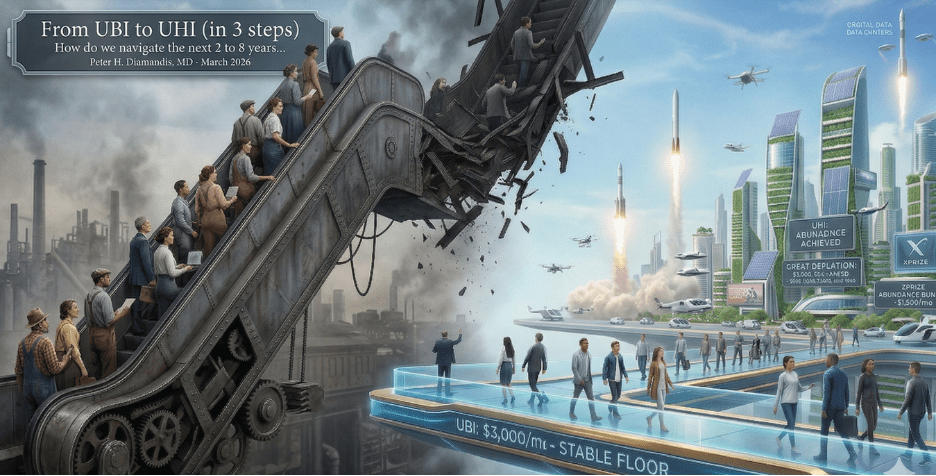
 Large language models, multimodal reasoning systems, and humanoid robots are not displacing one type of work — they are displacing all types of work, and the economic value of human time itself, across every sector, simultaneously.

There is no adjacent labor category to retrain into. The escalator that carried workers from disrupted industries to new ones for two centuries has no destination… it is crumbling.

That future isn’t ten years away. It’s arriving now and deploying over the next 12-24 months.

This will cause chaos particularly for Gen Z. How do they prepare for work in the AI era? Biblical prophecy reveals that in this world that no longer believes that God is in control. and that a spiritual war is intensifying as Satan the prince of this world does his utmost to retain rulership of the world, people worldwide will embrace Satan’s Antichrist ruler that has supernatural powers and promises peace and prosperity. Watch as Biblical end times prophecies unfold in our time.

$12 BILLION JOB MASSACRE: AMAZON’S ROBOT ARMY WILL REPLACE 600,000 WORKERS

A silent revolution is unfolding inside Amazon—and it’s far more than a warehouse upgrade. Leaked internal documents reveal that the company plans to automate up to 75% of its operations by 2033, using robots like Cardinal, Blue Jay, Sparrow, and Robin to replace what would have been over 600,000 human jobs. The implications stretch across every sector of the American economy. In this video, you’ll uncover how Amazon’s robotic workforce is reshaping the meaning of employment, why businesses are prioritizing efficiency over labour, and what kinds of skills—and investments—will actually survive the coming automation wave. From AI-driven logistics to the rise of collaborative robotics, this isn’t science fiction; it’s the new economic reality unfolding in real time. You’ll also learn how artificial intelligence has accelerated Amazon’s transformation, why other corporations are preparing to follow, and what steps individuals can take to protect their financial and professional futures. The question isn’t if automation will replace jobs—it’s how fast it will happen, and who will be prepared when it does.

This is not only happening at Amazon, UPS has disclosed about 48,000 job cuts this year.

Governments that have rejected God have already descended into chaos on all fronts so this move by companies to shed jobs will only further heighten the mayhem. There is only one answer to the problem and that has been revealed to us in God’s Word. Jesus returns as king first to rescue His Saints and then to pour out His wrath upon an unrepentant world with the Trumpet and Bowl judgements of Revelation 8 & 16. The battle of Armageddon follows and then Jesus sets up His Millennial Kingdom. To prepare for Jesus coming Millennial Kingdom go to http://www.millennialkingdom.net

EVERYTHING THAT MOVES WILL BE ROBOTICS AND EVERYTHING THAT MOVES WILL BE AI DRIVEN

This is what is ahead says Jensen Hwang and Elon Musk and they are not wrong. Are we ready for this?

Elon Musk and Jensen Huang have officially joined forces in shaping the next era of AI dominance. NVIDIA’s new Blackwell chip isn’t just an upgrade—it’s a revolution, redefining what machines can learn, build, and become. Musk is betting Tesla’s future on it, investing in a million GPUs to power full self-driving and humanoid robots at scale. Huang, meanwhile, says we’re only scratching the surface. In this video, They break down how NVIDIA’s unstoppable hardware is fuelling Musk’s AI empire, how this alliance could reshape robotics and automation, and whether humanity is ready for the power they’re unleashing.

This is all leading to the Mark of the Beast when you will not be able to buy or sell without this mark. Think about it, Jesus disciple, John, in the book of Revelation revealed this over 2000 years ago.

Also it causes all, both small and great, both rich and poor, both free and slave, to be marked on the right hand or the forehead, so that no one can buy or sell unless he has the mark, that is, the name of the beast or the number of its name.Revelation 16:16-17

ELON MUSK PREDICTIONS FOR THE FUTURE

Listen to Elon Musk about what he sees as the result of the new technology that is exploding in our day, particularly AI and Robotics. It will blow your mind how quickly he sees events unfolding.

From my viewpoint, what we see unfolding in the world fits with end times Biblical prophecy. Lawlessness and chaos will only increase as job losses due to AI and Robotics escalate. Already, young people and the universities they attend are protesting against Israel and for Hamas. They are godless and, therefore, without the fear of God. Jesus told us that before His second coming, His followers will experience tribulation, even great tribulation. Church, are you prepared for what is coming?

Then they will deliver you up to tribulation and put you to death, and you will be hated by all nations for my name’s sake. And then many will fall away and betray one another and hate one another. And many false prophets will arise and lead many astray. And because lawlessness will be increased, the love of many will grow cold. But the one who endures to the end will be saved.Matthew 24:11-13

ROBOTS EVERYWHERE IN OUR SOCIETY: INDUSTRY, HOMES, TRANSPORT, EVEN ENTERTAINMENT

According to Chinese media, The Economic Observer, the CEO of Nvidia, Jensen Huang, arrived in Beijing on January 19th 2025, for Nvidia’s branch annual meeting, where he dined with Xingxing Wang, CEO of humanoid robot maker Unitree Robotics, and He Wang, founder of Galbot (Robotics). Both are representatives of a younger generation of Chinese tech entrepreneurs born in the 1990s, now in their early 30s.

Chinese media China Star Market also reported that Xingxing Wang shared a photo with Huang on social media, captioned: “New year, new beginning, let’s go!” The report highlighted that Huang held meetings with high-level representatives from several leading Chinese robotics companies during his time in Beijing. Aside from Unitree Robotics and Galbot, attendees included executives from LimX Dynamics, Booster Robotics, and Kecheng Huang, co-founder of Emerging AI.

Another media outlet China Entrepreneur noted that Huang and Unitree’s Wang are not strangers to each other. In March 2024, during the GTC conference, Huang showcased nine humanoid robots, including those from Unitree. At CES 2025, Nvidia also announced its partnerships with Chinese robotics companies such as Unitree Robotics and XPeng Robotics.

We should not be surprised that China has many companies making robots as it is the largest market for robots, followed by Japan, and America third. This seems strange in a country with so much cheap labour compared to the rest of the world.

Peter Diamandis, a serial entrepreneur, futurist, technologist, and New York best-selling author, says that by 2026, we should have humanoid robots in private homes helping with laundry, vacuuming, and dishes, at least in beta testing. By 2040, there could be as many as 10 billion globally in all areas of the economy, and their labour might be as cheap as $10 a day.

In the future, they’ll be everywhere in our economy, Diamandis says: in healthcare, manufacturing, the service industry, public and urban spaces, transport, and even entertainment. This is such a transformational change that analysts don’t yet really understand how to estimate its value: Goldman Sachs says selling humanoid robots will be a $38 billion space by 2035, while Ark Invest says the resulting economic value of their labour could be as high as $24 trillion.

Judging by the debt levels of most governments in the Western world, they are out of control and unable to manage effectively. Imagine the impact of massive job losses due to companies replacing employees with robots. Currently, Amazon’s warehouses are already set to replace human workers with 100,000 robots. This is just one more reason governments will accept giving over governance to the Biblical prophesied one-world government. In September 2024, world leaders adopted the U.N. Pact for the Future, a landmark declaration pledging concrete actions towards a safer, more peaceful, sustainable and inclusive world for tomorrow’s generations. The Pact’s five broad focus areas include: sustainable development, international peace and security, science and technology, youth and future generations, and transforming global governance.

We are fast approaching the last seven years before Jesus returns first to rapture His church and then to pour out His wrath upon an unrepentant world. The speed with which end-times Biblical prophecies are being fulfilled is exciting and proof that the Bible is the inspired word of God.

WHAT IS AHEAD FOR 2025?

The AI and Robotics technological breakthroughs in 2024 set the stage for 2025 as outlined in my previous post: Review of Economic Events for 2024.

The chart below shows exponential growth but not the kind we like to see. In fact, it’s the kind that can result in the outright debasement of a national currency and a collapse in its bond markets. U.S. national debt-to-GDP now stands at 123%. The U.S. government is already running a cumulative fiscal deficit for fiscal year 2025 (starting October 1) of $622 billion. Current forecasts for fiscal year 2025 exceed $2 trillion.

U.S. National Debt Outstanding 1900–2024 | Source: U.S. Treasury

When the fiscal irresponsibility of any government reaches this level, there are usually only two choices to address the problem: Austerity, which is the least politically desirable. Reductions in spending and entitlements always have a degree of economic impact and certainly don’t make voters happy. Devalue the national currency. This is obviously what has been taking place. About 27% of U.S. national debt has been created in the last four years. Money “printing” always results in the devaluation of U.S. dollars and reduced purchasing power.

JEFF BROWN (BROWNSTONE RESEARCH) SUGGESTS THERE IS A BETTER WAY OUT OF THIS MESS

A large productivity boom would accelerate economic growth, lessen the impact of the current debt load, help reduce interest rates, and – if done right – could result in a fiscal surplus.

The USA is on the cusp of the greatest productivity boom in history. And it will be entirely technology-driven. Artificial intelligence (AI), robotics, and automation technologies will be the underlying productivity drivers. With cheap energy, the USA will compete with China as robotics beats cheap labour. Robots operate 24 hours a day 7 days a week: no time off, sickies, or holidays, and do not make mistakes.

With Trump at the helm, the U.S. regulatory environment will shift quickly in support of technological innovation, investment, onshoring of manufacturing, blockchain technology as the next generation of payment and settlement rails, and energy production to support economic growth.

The Department of Government Efficiency (DOGE) will materially reduce the fiscal year 2025 deficit by at least $250 billion, and by more than $1 trillion by fiscal year 2026 under the leadership of Vivek Ramaswamy and Elon Musk.

The Centers for Disease Control, the Department of Health and Human Services, the National Institutes of Health, and the Food and Drug Administration will return to evidence-based medicine practices and streamline the clinical trials process with higher standards for drug approvals, driven by the leadership of Robert F. Kennedy Jr. and Jay Bhattacharya. This will be a net benefit for the biotech industry.

Interest rates will decline mostly in the second half of the year by another 50–75 basis points. It will take some for the fiscal and economic policy changes to tame inflation. The larger cuts will come in 2026, an even better year for the economy and the markets.

Not surprisingly, AI will continue to be the hottest growth trend in 2025. Hundreds of billions will continue to be spent on the hyperscale “AI factories” being built to train AI foundation models. Jeff believes that we’ll see at least one company develop an artificial general intelligence (AGI) by the end of 2026. We’ll see the equivalent of genius-level IQs from the foundational models of OpenAI, Anthropic, Meta (Llama), Alphabet (Gemini), and xAI (Grok). And the outlier – the big surprise in 2025 will be from Elon Musk and his team at xAI. The entire industry has discounted xAI because it was a bit late to the game of building a foundation model for AI. That’s a mistake, for two reasons. Within a few months, xAI will have the largest training cluster of GPUs, at least 200,000 GPUs developing Grok 3.0. xAI is also developing a “maximum truth-seeking AI.” When training an AI, the quality and accuracy of a model’s outputs depend heavily upon the quality and accuracy of the inputs. Other companies trying to program their foundational models with clear bias and/or political narrative actually slow down their own technological development. Doing so adds complexity. xAI is avoiding that trap by designing, building, and performance training. This is a large competitive advantage that will catch the rest of the industry off guard. xAI’s Grok will outperform the rest of the industry.

2025 will also be the year when we experience Level 5 autonomous transport without any geofencing, entirely driven by vision models. This is different than Waymo, Cruise, or others that are heavily dependent upon LIDAR and require very precise maps allowing them only to operate in geofenced areas. And there is only one company capable of this technology – Tesla.

This year will be the first year when we experience unsupervised full self-driving technology. Unsupervised means that no one will have to sit in the front seat and monitor the full self-driving software for safety. Tesla will succeed in “turning on” this technology in at least one U.S. state this year. This will also enable Tesla to launch a robotaxi network, enabling Tesla owners to opt their Teslas into the network, enabling their electric vehicles to earn income. This will change the entire dynamic of the automotive industry, as Teslas will become affordable to an even larger percentage of the market. And it will, of course, be bullish for Tesla as the only EV company capable of this technology.

Humanoid Robots Overtake Offices & Factories

We’ll also see impressive advancements in AI in the manifested form of humanoid robots. Again, Tesla will lead here with its forthcoming release of Optimus Gen 3, which will be capable of autonomous operations in both industrial and consumer settings. While I don’t expect Tesla to start external sales of Optimus until 2026, it will widely use its production of Optimus in both its own office and factory settings. Optimus will set the standard for humanoid robot productivity, and investment will increase dramatically in other major players in this field. 1X Technologies, Agility, and Boston Dynamics will work hard to catch up to Tesla’s technology.

LLM’s (Large Language Models): The Year of Agentic AI

Let’s define agentic AI. Unlike traditional AI, which linearly executes commands, agentic AI systems interact with tools and databases autonomously and in logical order to achieve more reliable and robust results. If you were to query an agentic AI system with a multi-step problem, it would parse your request in the most logical order instead of moving from the top down.

These Agentic AI agents will be capable of reasoning and solving tasks that require multiple steps to complete. Agentic AI will be capable of transacting on behalf of anyone. The technology will be able to interface with the internet and fill out fields to complete assigned tasks. This technology will extend even further to the blockchain industry, where AI agents will be capable of managing smart contracts and engaging in self-directed economic activity. Blockchain technology is particularly conducive to agentic AI technology because of the ease of transacting with digital assets and the construction of smart contracts using blockchain technology. Which brings us to the digital assets industry.

The Year of Digital Asset Revitalization

The Trump win means pro-crypto, pro-innovation, and a plan to put clear regulations in place for digital assets. Fortunately for the digital assets industry, we’re already seeing a complete revitalization of the blockchain industry concerning investment in the U.S. 2025 will be a big year for crypto.

New regulations will be put in place, providing clarity and clear guidance on industry rules. And the enforcement of baseless and antagonistic actions against the leaders in the industry will come to an end. This will be bullish for high-quality cryptocurrencies. We should expect to see a lot of speculation in the industry, as well.

Jeff has relaunched his Neural Net Profits research service. It is powered by a sophisticated neural network that Jeff’s team developed at a cost of more than $1 million, called The Perceptron. It picks up on short-term trading signals in cryptocurrencies. Additionally, we’ll see U.S. dollar stablecoin projects thrive this year, as more and more financial transactions happen and settle on blockchain technology.

Lift Off for the Space Economy

Jeff expects that Boom Supersonic will succeed in flying its one-third-scale aircraft supersonic in the first half of this year. Boom is the most advanced aerospace company in building a supersonic commercial aircraft capable of traveling at Mach 1.7 with 64-80 passengers. It is an answer to what comes next after the Concorde.

The Trump/Musk partnership will also put NASA back on track for its return to the moon program – Artemis – by 2026. SpaceX will launch at least 15 Starships this year, as it refines the technology of the largest rocket and spacecraft in history.

Radical Shifts in Defense Spending

The U.S. will stop the absurd spending and funding of overseas wars and focus instead on rebuilding a technologically advanced defensive capability for the U.S. military… a peacekeeping military. Representative companies will be Anduril and perhaps General Atomics. The key will be uncrewed, autonomous drones and aircraft. Given the advancements in artificial intelligence and autonomous technology, the nature of warfare has dramatically changed. The use of autonomous drones and uncrewed aircraft will be an explosive trend in 2025, as will the development of intelligent cybersecurity agents to protect against nation-state attacks – most notably those of China on U.S. infrastructure that has commanded an alarming number of headlines in 2024.

Investment will accelerate in advanced technologies in the defense sector, as opposed to the more traditional technological approaches. Western adversaries are using unconventional weapons to infiltrate and fight, and the industry must adjust. We’ll also see an increase in spending on defense as it applies to the U.S. Space Force. The progress with hypersonic technology in 2024 will make space-based defense systems and communications that much more critical as a deterrent to war.

Nuclear’s Next-Generation Renaissance

Energy policy will also become a cornerstone development in 2025 for the new administration. The “pause” that we witnessed in natural gas production in the last four years will be lifted and the industry will start to invest heavily again in natural gas. Energy produced from coal will drop, just as it did during the first Trump administration. There will also be a major policy push to bring both oil prices, and thus gasoline prices, down. The last four years seriously depleted the U.S.’s strategic petroleum reserves – to levels that we haven’t seen since the early ‘80s. Lower prices will be critical to refill those strategic reserves and to ensure energy security for the U.S. economy.

In parallel, there will be strong regulatory support for the recommissioning of nuclear reactors in the U.S., as well as for the commissioning of new fourth-generation small modular reactors (SMRs) to address the shortages in energy production. Nuclear energy will experience a rebirth in 2025. That will be true for both nuclear fission as well as nuclear fusion technology.

Front runners in the nuclear fusion race are General Fusion, Helion, Zap Energy, Commonwealth Fusion, and China-based private company ENN. There may even be a national laboratory in South Korea, China, Japan, Germany, or the U.K. that may make the claim. Jeff predicts record levels of investment in nuclear fusion companies in 2025… precisely because the path is so clear toward net energy production. Institutional capital can now see a path toward commercialization – and ultimately returns – on their invested capital.

The solar power industry will continue to thrive. Investment will continue in solar in markets where it makes sense. And as interest rates come down, solar will benefit from improved project financing.

Energy production from wind, however, will suffer, as it should. Wind power is not economical and environmentally destructive. The carbon footprint of wind turbines is terrible when considering all the minerals that need to be mined, and petroleum needed to keep the wind turbines turning. Not to mention the short lifespans and the fact that turbine blades cannot be recycled. They simply end up in a dump.

AI WILL DRIVE A BIOTECH RESURGENCE

Novel therapies will be developed in a fraction of the time and for a fraction of the cost of the traditional drug discovery process. The use of AI will also reduce toxicity and improve the safety of drugs. When we couple the positive impact of AI on the drug discovery process with the cleanup and streamlining of the relevant health agencies in the U.S., we will naturally see an increase in investment in the biotech sector.

Jeff is confident that 2025 is the year when the government will step back from destructive policies, restore trust, and push ahead on pro-energy, pro-growth, and pro-innovation policies.

How does all of the above fit into Biblical end-times prophecies? It doesn’t, Biblical end-times prophecies is Middle-East centric with Satan’s focus still on destroying Israel. The next major battle is given in Daniel 8, the goat (Yvan) Sunni Turkey putting down (Persia) Shia Iran in an attempt to re-establish a Neo-Ottoman Empire. Watch for it and use it to prove the Bible is God’s word. We know how this ends.

Next on God’s agenda for planet Earth is Jesus’ Millennial Kingdom – http://www.millennialkingdom.net

THE IMPACT OF AI & ROBOTICS ON JOBS

Amazon, the online retailer behemoth, is the second-largest private employer in the U.S. – 1.5 million people. It’s also one of the largest investors in AI. It’s building out fully autonomous warehouses… It’s working to automate the delivery process with self-driving vans and delivery drones… and 30% of its “workforce” are already robots.

Robots don’t sleep. They don’t take vacations. They never need a break. So, let me ask you this: How much longer until Amazon decides these robots are ready to take on the full workload of its 1.5 million remaining workers? And what do you think will happen when 1.5 million hardworking Americans are suddenly out of a job?

Amazon is far from the only giant that has done this. Walmart Inc. (WMT), the largest private employer in the U.S., is rolling out fully automated distribution centers using a combination of AI and robots. The company’s distribution centers come with one big catch: No people.

Finding good critical thinkers is one of the most difficult things in business. I’m talking about “knowledge workers” – i.e., accountants, business strategists, lawyers, and doctors – who make optimal decisions, are good at problem-solving, can strategize, and always act in the business’s best interests.

The only thing more difficult than finding one good knowledge worker… is finding multiple. For most of the modern era, knowledge work was difficult to scale. These professions typically require years of education, on-the-job training, and experience. That adds up to lots of time and money.

But now, ChatGPT and other forms of AI are killing that paradigm. It makes it so that businesses can scale critical thinking and knowledge work. It doesn’t matter if you have a blue or white collar: AI could threaten your job.

The Quantum Leap

AI is more of a threat now than it was when ChatGPT made its debut in 2022 because of quantum computing.

In classical computing, data is encoded in binary bits. Transistors are like tiny switches that can either be in the on or off position – represented by ones and zeroes.

Every app you use, website you go to, and photo you take is made up of millions of combinations of ones and zeroes. However, a new kind of computing power surpasses the binary limitations of classical computers.

Quantum computers use quantum bits, or qubits, which can represent both 0 and 1 simultaneously due to a concept called superposition. If this all sounds a little confusing, don’t worry. Here’s the critical thing you need to know… Quantum computers allow for multiple computational pathways to be explored at the same time, opening new avenues and speeds for solving complex problems.

Imagine you have a large library and you’re trying to find a specific book. In classical computing, you would search for the book by examining each bookshelf and book one at a time until you find the right one. This approach can be time-consuming, especially if the book you’re looking for is in the back of the library. But imagine a computer so powerful it can explore all the books at once… That’s quantum computing.

It’s been said that the differences between quantum computers and classical computers are even more vast than those between classical computers and pen and paper. That may be an understatement.

We’re talking about machines so advanced that they can instantly execute calculations that would take the world’s most advanced supercomputers nearly half a century to process. It’s not like the transition from the horse and buggy to the automobile. It’s more like horse and buggy to the SR-71 Blackbird… the fastest jet ever made. The difference is utterly mind-blowing.

Quantum computing is real and it’s here. You can think of it as the turbocharger for artificial intelligence. It makes AI faster, more efficient, and more precise.

Quantum computing will give us the ability to solve intractable problems that take so long to tackle using today’s computers that no one even bothers trying. We’re talking about the ability to create, replicate, and commercialize complex analytical thinking and precise physical movement on a scale never seen before… This is the next huge leap forward for the digital elite… the people who have been getting rich while most Americans have been getting left behind.

With quantum computing, the digital elite will have AI that is not constrained by computational speed. Quantum-powered AI will drive efficiencies by getting rid of human workers and driving up corporate profits. No matter the job, robots, software and AI – powered by a new breed of computer – will be able to do it better and cheaper.

I expect that in the quantum era, we will see more technological progress in one month than we are seeing in three years from now. This is the societal and economic equivalent of a 10,000-foot mega-tsunami. It’s about to slam into our world and alter the trajectory of our country forever.

Governments that already have a debt problem that is out of control will be unable to address this unemployment problem and anarchy and lawlessness will be the outcome. The scene is being set for the Biblical prophesied rise of the Antichrist and a one-world government. The recent UN Pact for the Future where world leaders made a landmark declaration pledging concrete actions towards a safer, more peaceful, sustainable, and inclusive world for tomorrow’s generations is a significant move towards a one-world government. My next post will give more detail on the Pact for the Future.

A WORLD IN CRISIS: GOVERNMENT DEBT OUT OF CONTROL AND WORKPLACE CHAOS IMMINENT

One week from tomorrow, Elon Musk and Tesla will hold its “We, Robot” event

It’s expected that the company will reveal its first dedicated robotaxi. This is being heralded as a “game changer” for the future of autonomous transportation.

“We, Robot” is expected to be a watershed moment for Tesla wherein the company introduces its first dedicated robotaxi, tentatively called the “Cybercab.” Tesla is also expected to showcase groundbreaking advancements in Full Self-Driving (FSD) software and artificial intelligence as the company pushes toward a future where human drivers are obsolete.

At the heart of this transportation revolution is a convenient, driverless ride at a fraction of the cost of traditional services. If it’s everything it’s cracked up to be, this will send ripples throughout the automotive, technology, and investment sectors.

Consider what a rollout of Tesla’s robotaxi would mean… With the tap of a button, you can have a car at your disposal, 24/7, at a much lower all-in cost than owning a car (or purportedly, calling an Uber).

Today, car ownership can be a major financial burden. AAA reports that last year, the average annual cost to own and operate a car in the U.S. was about $10,000. A fully autonomous, reliable, ever-present robotaxi would enable consumers to save thousands of dollars by eliminating the need for car ownership.

Yes, there will be plenty of Americans who will still want their own. But if you’re one of the 66.2% of Americans living paycheck-to-paycheck today (according to MarketWatch in August), are you not going to seriously consider letting go of your car to free up thousands of dollars per year?

According to a 2022 study by McKinsey & Co., 25% to 30% of urban dwellers would consider using shared autonomous vehicles as their main transportation mode if it were widely available. And if 25% to 30% of Americans decide to stop buying cars, get ready for a financial earthquake.

First and obviously, we have the major car manufacturers that would be rocked by this size of a reduction in auto demand. We’re talking unprecedented disruption that would require a business-model pivot, and potentially, enormous layoffs.

Cars are parked 95% of the time. If you’re merely “renting” your car, when you’re done with it, it speeds away to service someone else. Such collective ownership of cars will radically explode car efficiency, reducing how many are needed, which would impact how many workers are required. Also, you do not need a garage at home or at work.

Now, consider the knock-on effects… With 25% to 30% fewer drivers (at the beginning – expect this percentage to grow), what happens to the auto insurance industry? According to Benzinga, U.S. auto insurance premiums amount to more than $308 billion per year. So, what happens with far fewer car owners? Do we lose loads of related insurance jobs? Or does the insurance model switch from vehicle coverage to some sort of ride-based individual coverage? What would be the impact on business models?

Next, what about car mechanics and chain repair shops?

What happens when autonomous driving hits our trucking industry? In the U.S., that’s a $216 billion market with roughly 3.5 million drivers. Think “robotrucks” might be disruptive there?

Now, consider the investment implications, good and bad… What will be the impact of all this on the share prices of not just Tesla, but Ford… Alphabet (which owns Waymo, another autonomous driving company)… Uber… Insurance companies… Auto parts manufacturers, and retailers, the list goes on and on… And what about the stocks of the companies that make the components for Tesla’s fleet or robotaxis? All the sensors and semiconductor chips? The plastics? The electronic circuitry?

It is all about technology replacing the need for humans. In 2013, Amazon used about 1,000 robots in its warehouses. Last year, that number clocked in at 750,000 and the savings have been incredible. The warehouses work 24 hours a day non-stop and seven days a week.

Think about the coming impact of AI and automation on, well, everything… It’s already affecting jobs for customer service agents… paralegals and legal assistants… accountants… medical diagnosticians… radiologists… financial analysts… journalists… recruiters… insurance underwriters… and marketing specialists… to name a few. Should we expect it to stop?

It will lead to a chaotic workplace as shown by the International Longshoremen’s Association strike that began yesterday, with dockworkers demanding assurances that the United States Maritime Alliance will never replace human workers with automation? As well, the Screen Actors Guild/Writers Guild of America strikes in 2023, wherein Hollywood workers demanded protection from the rising capabilities of artificial intelligence. Unions will not stop the use of AI and robots and lawlessness and chaos will erupt across cities.

In Matthew 24:12, Jesus told his disciples what will unfold in the end times before He returns to Earth. He says, “And because lawlessness will be increased, the love of many will grow cold”. Christians know what is coming and we need to use Biblical end-times prophecies to evangelize the lost. As these end times prophecies are fulfilled, people will realise God is real and the Bible is God’s word.

THE FUTURE: A.I. POWERED ROBOTS

AI is bringing us an incredible productivity boom. It will enable even low-income families to have access to products and services that in the past could have only been afforded by high-net-worth families. Mind you, there are going to be incredible job losses through AI and Robotics.

Every family with paid work will have an AI-powered executive assistant to help with daily chores and tasks. It will save hours a day normally lost to menial, low-value tasks.

Intelligent humanoid robots will be affordable and dramatically improve the quality of life. With righteous governance, we would be able to bring the rest of the world out of poverty. And we’ll be able to soon cure diseases that today have no known cure with technology like gene editing.

With nuclear fusion technology – which will be, in part, powered by AI – not only will we have limitless, clean energy… but it will be cheaper than all forms of electricity that we use today.

Autonomous driving technology will actually reduce the cost of insurance because 94% of accidents will no longer occur.

However, we currently have corrupt governments. The US government prints trillions of dollars, runs a $1.6 trillion annual deficit, bails out the banking system, restricts U.S. energy extraction and production, and increases U.S. debt by $1 trillion every 100 days, and still thinks they can curb inflation. These policies are intentional, and they are designed to facilitate corruption and grift as well as weaken the economic power of the overall population. If you want to know how this will end then you will need to open your Bible, God’s Word. He has given us numerous end times prophecies of how He intends to take back control of planet Earth from Satan and have Jesus, His Son rule and reign over planet Earth for 1,000 years. God established Israel as his nation and it will fulfill its promise when its Messiah, Jesus, rules and reigns the world from a new Jerusalem (http://www.millennialkingdom.net).

The theory of evolution is a failed theory. The discovery of DNA and the electron microscope rang the “death knell” of evolution according to Dr Dean Kenyon. He was Professor of Biochemistry at Stanford University and had written two evolutionary biochemistry textbooks when he came to this conclusion. DNA is complex information that controls the manufacturing factories and transport devices within each cell. Information comes from one source, and that is intelligence. Moreover, there is no way the manufacturing factories and transport devices that are controlled by the information on the DNA could have evolved. Both needed to be functional on day one. The evidence for an Intelligent Creator (God) is overwhelming.

God has revealed the true history of the Cosmos. It is not the billions of years required by evolution but 6,000 years. The worldwide flood of Noah’s Day gave the world billions of dead things, and fossil fuels (buried flora and fauna).

We have had 6000 years with Satan and his demons controlling the world. During Jesus’ Millennial Kingdom, Satan will be bound but at the end of the thousand years he is released and sadly he is still able to convince a multitude of people to rebel against Jesus and the glorified Saints. They are quickly destroyed. God then destroys this Earth and Heaven. The second resurrection and White Throne judgement then follow. It is only after the White Throne judgement does John sees the heavenly Jerusalem descending to a new Earth where only the righteous will dwell.

FIRST AI NEWS PRESENTER ON AN INDIAN NEWS CHANNEL

I have already posted on the speed with which AI. is replacing humans in just about all job categories. AI, combined with Robotics will have an unprecedented impact on the job market. The rapid changes in technology is making it difficult for education to keep up and provide people with the skills the market now needs.

Techochasm is just one of the end times signs. When a world rejects its Creator, it descends into lawlessness and chaos. Even when Jesus and the Saints are ruling on the Earth during Jesus 1000 thousand year reign they need to rule with a rod of iron.
From his mouth comes a sharp sword with which to strike down the nations, and He (Jesus) will rule them with a rod of iron. Revelation 19:15

The one who conquers and who keeps my works until the end, to him I will give authority over the nations, and he (Saints) will rule them with a rod of iron, as when earthen pots are broken in pieces, even as I myself have received authority from my Father.” Revelation 2:27

Moreover, we are told at the end of the 1000-year reign of Jesus and the Saints, God allows the release of Satan and he is able to raise an army of rebellious people, like the sand of the sea, to come up against Jesus and the Saints. They are quickly dispatched but it reveals a lot about the heart of unregenerate man.

The heart is deceitful above all things and desperately wicked: who can know it? Jeremiah 17:9

And when the thousand years are ended, Satan will be released from his prison and will come out to deceive the nations that are at the four corners of the earth, Gog and Magog, to gather them for battle; their number is like the sand of the sea. And they marched up over the broad plain of the earth and surrounded the camp of the saints and the beloved city, but fire came down from heaven and consumed them, and the devil who had deceived them was thrown into the lake of fire and sulfur where the beast and the false prophet were, and they will be tormented day and night forever and ever.” Revelation 20:7-10