Those who demand a naturalistic explanation (no miracles allowed!) for distant starlight from Christians don’t seem to realize that the standard ‘big bang’ secular view of origins entails miracles—but without a miracle worker! The problem is that the distribution of the background radiation in the universe is fairly uniform, but there has not been enough time for radiation (at the speed of light) to disperse over such a large universe. This is called the ‘horizon problem’. It is really the big bang’s very own ‘light time-travel’ problem. To ‘explain’ this, cosmologists invoked a period of super-fast expansion of the universe—much faster than the speed of light—for a brief time just after the ‘bang’. This was dubbed ‘inflation’. What started it, how it could proceed, and what stopped it are all mysteries. These are in effect naturalistic miracles, with no sufficient cause or explanation.2 They are used to prop up a theory that would not work without them.
So, it is not that miracles are not allowed in explaining origins. Ironically, they are only disallowed when it comes to biblical creation, which the Bible says is miraculous!
Bible-believing Christians are ‘streets ahead’ of secularists here because we have an all-powerful God who is able to do things beyond our ken.
Great is our Lord, and abundant in power; his understanding is beyond measure. The Lord lifts up the humble; he casts the wicked to the ground. (Psalm 147:5–6)
God calls us to humbly submit to Him and His Word.
Dr Catchpoole has a B.Ag.Sc. (Hons) from the University of Adelaide, and was awarded his Ph.D. by the University of New England (NSW).
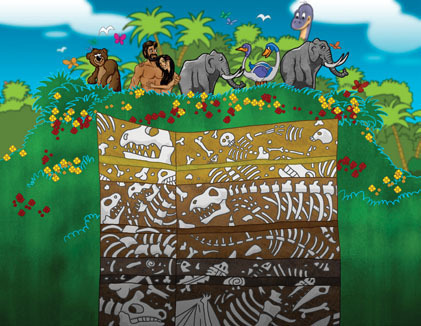
“When did I realise that the earth could be no older than about 6,000 years.? The exact moment that turned my thinking around was when a simple image was put up, of Eden with layers of fossil bones in the earth beneath Adam and Eve. This showed the stark implications for Christianity if e.g. dinosaur fossils were millions of years old. That would mean there was not only death before the Fall; many fossils also show evidence of suffering, bloodshed and violence, and diseases like bone cancer. Yet after Adam and Eve were created, God called everything He had made “very good” (Genesis 1:31). I realised that it made no sense for God to have looked at tumorous dinosaur bones on Day 6, then call this very good, knowing that cancer would cause such enormous future human misery.
The Eden-on-bones scenario also raised a fundamental doctrinal issue. If we put the shedding of blood before sin, then why did God in Jesus shed blood because of sin? (Genesis 3:21, Hebrews 9:22, 10:4–10) I could see that my compromising of God’s Word by believing the secular millions of years completely destroyed the whole basis for the Atonement (1 Corinthians 15:21–22)1.
Evolutionary geneticists have themselves realised that mutations accumulate so quickly (about 60–100 per person per generation), that the human species should have become extinct at least ten times over. Evolutionary geneticist Alexey Kondrashov asks, “Why have we not died 100 times over?*
That presumes we’ve been here for the 100,000+ years of the evolutionary timeline. It’s not a problem in the Bible’s 6,000-year timeline, with only about 200 generations since Adam. We’re still going downhill fast (Romans 8:19–22), but it’s understandable we haven’t gone extinct—there simply hasn’t been enough time.
The importance of the age of the earth in presenting the gospel message is demonstrated by the following testimony of an aboriginal man.
“I’ve been locked up in every jail in Queensland, so I’ve had the Gospel preached to me more times than I can count. But I ain’t never heard the Gospel like this. Just think … we [Aboriginal people] haven’t been here 60,000 years like they tell us; we come from Noah just 4,500 years ago, and Adam 6,000 years ago—along with everyone else alive today— that’s powerful! So Christ died for everyone—whitefella and blackfella!“
*Kondrashov, A., Contamination of the genome by very slightly deleterious mutations: why have we not died 100 times over? J. Theoretical Biology 175:583–594, 1995.
Extract from article in the latest Creation magazine from CMI (www.creation.com) Creation magazine interviews former CMI speaker/scientist Dr David Catchpoole
Part 1 explains that the cause of the universe is supernatural and cannot be explained by natural events. The word of God brought the universe into existence from something that is not visible, something, unlike ordinary visible/tangible matter and energy. This is consistent with the scientific conclusion that the matter and energy that comprise the universe cannot be eternal. Thus, the cause of the universe must be supernatural.
2. There are potential explanations anyway.
Christian astrophysicists have proposed various explanations as to how God might have created things in such a way that even Adam and Eve would have been able to see distant starlight. This section is a bit technical, but we have tried to make it as easy as possible to understand. The ideas are mind-stretching because they seem to conflict with our everyday experience of the world.
Time dilation models
Einstein is famous for discovering that time is not constant but is affected by movement (speed) and gravitational forces. This is known as Special Relativity and General Relativity, respectively. When an object moves very fast, time for that object slows down, or even stops at the speed of light. Also, when an object is in the presence of a massive object, which provides a strong gravitational attraction, time slows down. These effects are measurable and thus have been verified by experiment. They are so real that GPS satellites, which depend on precision clocks for global positioning calculations, must have their on-board clocks adjusted for the lesser gravity (being up in the sky) and for the speed of movement of the satellite.
Now we can try to imagine God creating the universe, “stretching out the heavens” (Psalm 104:2) on Day 4 of Creation Week. This would entail massive gravitational forces and enormous differences in speeds, both of which would change the time ‘out there’ compared to planet Earth. Thus, in one Earth day (Day 4) an enormous amount of time could transpire ‘out there’ allowing ample time for the light to travel to Earth. Various models have been proposed based on these ideas
New Model
Well, this is not so new; it goes back to Einstein’s era. Einstein’s findings of time changing with motion means that the speed of light (c) cannot be measured in one direction. It can only be measured for the round trip (two-way speed). This gives the average speed, but we cannot know if the speed is the same in both directions.
Einstein assumed that the speed of light in all directions was the same (called the synchrony convention) but he realized that it was an assumption without proof.
God calls us to humbly submit to Him and His Word.
Physicists have been wracking their brains ever since Einstein to try to figure out how to measure the speed of light in one direction. For example, we might want to fire a laser beam at the moon and measure how long it takes to get there. However, we need to place a clock on the moon that is telling the same time as a clock on Earth. That is a problem because as we fly the clock to the moon, the time changes on the clock! Putting it another way, the only way the observer on the moon can know when the light beam is sent from Earth is to be sent a message, which then travels at the speed of light. It all becomes totally circular!
There has been quite some discussion about this in recent times, including from secularists—that the speed of light might not be the same in all directions.
So, what if the speed of light towards us was infinite and the speed away from us was c/2? That would give an average speed of c, which we measure. There is no way that we can know that this is not so. And that would mean that light from distant stars would reach Earth the instant that they were created. No problem!
Throughout the account in Genesis 1, the Bible says that God spoke things into existence—eight times, “And God said … ”. And after He spoke, it is often concluded with, “and it was so”. The New Testament tells us,
“By faith we understand that the universe was created by the word of God, so that what is seen was not made out of things that are visible.” (Hebrews 11:3)
The word of God brought the universe into existence from something that is not visible, something, unlike ordinary visible/tangible matter and energy. This is consistent with the scientific conclusion that the matter and energy that comprise the universe cannot be eternal. Thus, the cause of the universe must be supernatural.
And so the Bible describes the Word of God as powerful:
“So shall my word be that goes out from my mouth; it shall not return to me empty, but it shall accomplish that which I purpose, and shall succeed in the thing for which I sent it.” (Isaiah 55:11)
The New Testament tells us that this agency of God, the Word by which He created everything, was none other than the Lord Jesus Christ:
In the beginning was the Word, and the Word was with God, and the Word was God. He was in the beginning with God. All things were made through him, and without him was not anything made that was made. (John 1:1–3)
Genesis 2 tells us that God made the first man and woman. He took dust and made the man, Adam (Genesis 2:7), and took his rib and fashioned the woman, Eve, the mother of all.
I have never had anyone demand that I explain to them how God made a man from dust. And yet there is this demand that we explain how God could have created the stars such that we can see the light from distant stars.
Distant star cluster
The Genesis account makes it clear that the creation of the heavenly bodies was just as miraculous as the creation of the first people:
And God said, “Let there be lights … And God made the two great lights—the greater light to rule the day and the lesser light to rule the night—and the stars.” (Genesis 1:14–16).
Was this any less a miracle than the creation of the man from dust? And yet there is a demand for a naturalistic explanation for how God did this! This seems to me to be quite inconsistent and unreasonable to demand such a thing as a condition of believing the Bible’s account, especially the timeframe.
It’s also interesting that the timeframe of six days with the seventh day of rest—the basis of our 7-day week (Exodus 20:11)—underlines the miraculous nature of God’s actions. And that is part of the problem for those who don’t or won’t believe the timeframe, such as theistic evolutionists and long-age creationists. When they refuse to believe the timeframe, they then tend to think of ‘creation’ in a naturalistic way, over billions of years. And then secular ideas of how things came to be take precedence over the Bible’s clear account. Thus the miraculous nature of Creation Week takes a back seat and so we have this demand for a naturalistic explanation for how we can see distant starlight.
The bottom line: Creation Week involved a series of miracles, one after the other. Thus, these are things for which we can provide no natural explanation. We do not know how God could speak the stars into existence, and thus we cannot know how He created things in such a way that we can see the light from celestial objects millions and billions of light-years distant.
In other words, the question tacitly denies the supernatural nature of the Creation Week events. In doing so it robs God of His omnipotence and limits Him to work only in ways that we can understand. This results in a very diminished view of God. In effect, those who do this are constructing a god compatible with their own limited understanding, which is a form of idolatry.
“The specimen is spectacular, it is one of a kind. It’s absolutely complete and is not missing a single hair on the body, which is remarkable”. These are the words lead author Javier Luque used to describe Cretapsara athanata, the first crab from the ‘Cretaceous dinosaur era’ preserved in amber (fossil tree resin), and the most complete fossil crab ever found. Despite being ‘dated’ at around 100 million years, 3-D scans showed it to be modern-looking.
The amber preserved delicate features such as antennae, compound eyes, and mouthparts covered in minute hairs. It even preserved the well-developed gills which meant the small crab was most likely water-dwelling. Plant material and insect faeces were also found in the same amber lump (c. 20 mm × 7 mm). “How then did a 100 million-year-old aquatic animal become preserved in tree amber, which normally houses land-dwelling specimens?”
For evolutionists, such a question leads to many ‘it might have’ stories. Of course, they would be aware that to preserve the crab in such a complete state the resin would have to engulf it quickly. Today’s generally slow trickle of resin from trees would never suffice.
The conditions found in the Noahic Flood around 4,500 years ago readily account for all aspects of this find. The obvious one is finding an aquatic crab in resin from a tree, alongside terrestrial plant and insect material. As forests were ripped up and carried by the floodwaters, huge rafts of trees crashed into each other. The damaged trees were bleeding abnormally copious amounts of their sticky resin, which quickly enveloped the items it contacted. This also explains the existence of large amber deposits, such as the ones mined in Myanmar from which this specimen came.
Harvard University, International team of researchers discover first dinosaur era crab fully preserved in amber; oeb.harvard.edu, 20 Oct 2021.
Astronomer Danny Faulkner describes his solution to the light travel-time problem, then discusses many of the issues with Big Bang cosmology. Dr Danny Faulkner received his PhD in astronomy from Indiana University. He is distinguished Professor Emeritus at the University of South Carolina-Lancaster, where he taught astronomy and physics for over 26 years. Since January, 2013, he has been the staff astronomer at Answers in Genesis in northern Kentucky. For more information on Dr. Faulkner, please go to https://bit.ly/3kGkcFV
This 20 minute video segment is from “Beyond Is Genesis History? Vol 3 : Bible & Stars,” where they explore the universe, the Tower of Babel, the Hebrew text, and the history of interpretation of Genesis, and much more! Check it out on their website: https://bit.ly/BIGH-3
“Thus says God, the Lord, who created the heavens and stretched them out?” Isaiah 42:5
Once again this article is taken from the latest edition of Creation Magazine – http://www.creation.com. Don Batten CEO of Creation Ministries International interviews high-profile Singapore researcherDr Samuel Gan.You must subscribe, it will bless you and your family immensely.
Dr Samuel Gan is the principal investigator and head of the Antibody & Product Development (APD) Lab in Singapore. His qualifications are impressive.He is an adjunct lecturer at Singapore University of Social Sciences, and at Republic Polytechnic, and is an adjunct associate professor at the Singapore campus of James Cook University (Australia). His qualifications include a B.Sc. (Hons) in molecular cell biology, a B.Sc. (Hons) in psychology, an M.Sc. (merit) in structural biology, and a Ph.D. in allergy. He has a diploma in biotechnology, a graduate certificate in academic practice, a postgraduate certificate in business administration, and certificates in commercial law & technology transfer, religious knowledge, biblical studies, and English/Mandarin translation & interpretation. He is also an Associate of King’s College, London.
His journey to become a Christian who believes the Biblical view of creation is inspiring. Sam said, He has always believed that God created the universe. But he had a ‘crisis of faith’ during his mid-teens because of a childhood interest in other world religions.
Logic and rules of things appealed to me in an uncertain world, and science was presented as having answers and being logical and rule-based. It turned out the only religion that made sense was Christianity, but I ended up with a sort of blend of secular ‘science’ and faith.
No serious scientist could believe that the complexity, order, and time-sensitive interrelationships of living things came about by chance (just physics and chemistry). And the conventional theistic evolution (‘God used evolution over billions of years’) was way too slow. But given my secular training, I came to have a confused hybrid idea involving a form of accelerated evolution during the six days of Creation Week, like millions of years happening within 6 days in some time-dilation-like model that later slowed down, due to my misinterpretation of 2 Peter 3:8. I hadn’t really thought it through!
When CMI’s Dr Carl Wieland in 2014 showed the classic slide of ‘Eden on bones’ (below), in Chin Lien Bible Seminary, Singapore, this challenged Sam’s beliefs involving evolution (albeit in a sped-up form). CMI materials helped him align with God’s Word. That year he took a stand, moved back to a church that taught 6-day creation, and enrolled in Far Eastern Bible College. That provided a strong foundation on the Word of God, and it turned out to be far more important to him than all his secular education.
A good creation could not be built on a foundation of death and suffering
This is what Dr Gan said he would say to a Christian young person thinking of a career in science.
Everyone, regardless of their choice of career, should study—online or part-time—some systematic theology from a good Bible-based seminary or Bible college. The foolishness I had in my younger days would have been avoided had I had more of the wisdom of God. The evolution confusion, the struggles, all came from the lack of knowledge of God’s Word. It is wise to get godly wisdom as early as possible.
Dr Gan’s testimony demonstrates that believing in biblical creation is clearly no hindrance to a high level of achievement in science. Rather, it is a great advantage. Understanding that a brilliant mind created the highly complex beautiful universe we inhabit, Samuel is like the German mathematician, astronomer and astrologer Johannes Kepler. Referring to his work in astronomy, Kepler said: “I was merely thinking God’s thoughts after Him.”
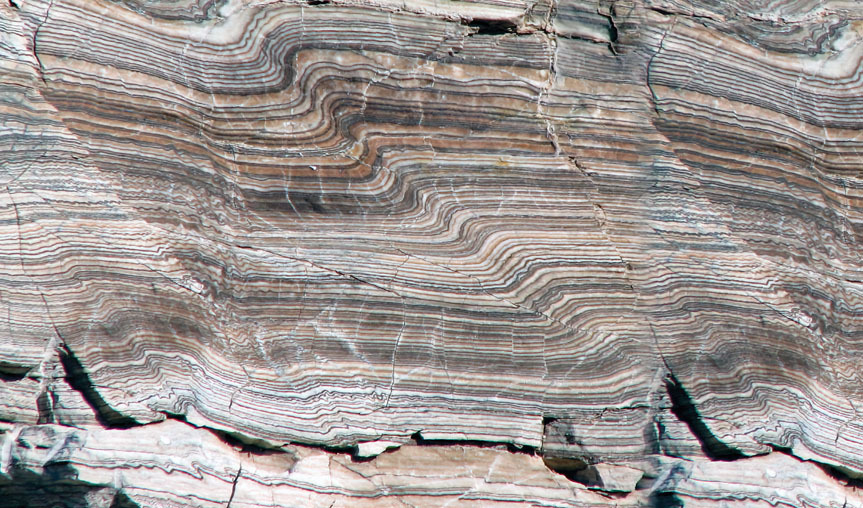
“CURVY ROCK LAYERS UNDERMINE MILLIONS OF YEARS”, article by Gavin Cox in the latest issue of Creation Magazine. Go to http://www.creation.com to sign up for this must have creation resource.
The Bible indicates that the Flood, which lasted just over a year, was a global tectonic event, with much vertical and horizontal earth movement. This provided the forces required to mould sediments and fold rocks. Genesis 7:11 tells us how the Flood started, when “all the fountains of the great deep burst forth.” Genesis 8:1–3 tells us how the Flood ended: “And God made a wind blow over the earth, and the waters subsided. The fountains of the deep … were closed … and the waters receded from the earth continually.” These verses are also describing vast global geological activity. Furthermore, Psalm 104:6–9 clearly describes Noah’s Flood: “The waters stood above the mountains. At your rebuke they fled … The mountains rose, the valleys sank down to the place that you appointed for them … so that they might not again cover the earth.” Evidently, huge earth-moving forces were involved that transported vast amounts of freshly deposited, wet sediments. The Flood provides all the factors necessary to fold strata quickly.
In the Grand Canyon, the rock appears as though it has deformed like wet clay. It becomes thinner where the fold has been in tension (not showing tensional fractures), and thicker where it has been in compression (but not showing signs of being crushed). This is powerful evidence that the sediment was still wet and plastic, like clay, and not solid rock, when it was bent.
Long-agers can accept that an individual rock layer could have been wet and plastic when folded. But not when there are multiple layers clearly bent together, with the top and bottom layers supposedly separated by millions of years. This is because they know it would be unreasonable to think that rock layers would stay soft for millions of years. So, at least the bottom layer of any such folded sequence would have had to be solid when bent.
In the Grand Canyon, where the folded strata are part of a larger formation called the Kaibab Upwarp (figure 3), the deepest layer (the Tapeats Sandstone) is supposed to be 550 million years old. The topmost of the folded layers (the Kaibab Limestone) was allegedly deposited 300 million years later. (The bottom layer is supposedly millions of years older than any of the intervening layers.) So, since they were all folded together in plastic fashion, the straightforward understanding of the evidence is that they were all still wet and pliable when folded.
Long-agers must therefore find some way around this. To preserve long ages, rocks must be seen as able to bend without breaking—in the unobservable past, over huge time periods.
Conclusion
The supposed millions of years to bend rock strata into folds is an illusion. Folded strata do not constitute evidence for vast amounts of time in the rocks. Furthermore, no one has waited for eons to watch if it really takes that long to form folds in strata. ‘Deep time’ is a philosophical idea (derived from uniformitarianism), not a scientific observation.
The idea that there would be just 7,000 years of human history before God ended this time when death and suffering marred His creation is very old. We know from non-biblical sources that the Second Book of Enoch stated that there would be 7000 years of history and that the beginning of the 8,000th year would mark the start of the Eternal State (2 Enoch 33:1).
The idea the world is billions of years old is young. It gained acceptance along with the theory of Evolution which requires billions of years to go from “goo to you” without a creator and by unguided chance. At the same time, Noah’s flood which explains the alleged billions of years in the fossil record was relegated to the world of myths and legends despite the fact most people groups around the world have a flood story in their history and a catastrophic flood which buried animals and vegetation quickly is the best explanation for the fossils location and state of preservation.
Receding water of Noah’s Flood shapes the earth
The oldest existing Jewish reference to the Week of Millenniums is probably the one found in the Talmud which references a statement attributed to the prophetic school established by the prophet Elijah: Six thousand years is the duration of the world. Two thousand of the six thousand years are characterized by chaos ended by Noah’s Flood; two thousand years are characterized by Torah, from the era of the Patriarchs until the end of the mishnaic period; and two thousand years are the period of the coming of the Messiah (Sanhedrin 97a). This concept is echoed in a 10th Century AD midrash called Tanna D’vei Eliyahu. (A midrash is commentary on part of the Hebrew scriptures.) It reads as follows: The world is to exist 6,000 years. In the first 2,000, there was desolation (no Torah, from Adam to Abraham), 2,000 years the Torah flourished, and the next 2,000 years is the Messianic era (He should have come at the beginning of the last 2,000 years; the delay is due to our sins). Of course, we know Jesus did come as the “suffering servant of Isaiah 53.
“He (Jesus) was despised and rejected by men, a man of sorrows, and acquainted with grief; and as one from whom men hide their faces He was despised, and we esteemed Him not. Surely He has borne our griefs and carried our sorrows; yet we esteemed Him stricken, smitten by God, and afflicted. But He was pierced for our transgressions; He was crushed for our iniquities; upon Him was the chastisement that brought us peace, and with His wounds we are healed. All we like sheep have gone astray; we have turned—every one—to his own way; and the Lord has laid on Him the iniquity of us all.”Isaiah 53:3-6
This concept of 6,000 years of human toil and conflict followed by 1,000 years of rest is still alive among Jewish rabbis and is being taught by them. Take, for example, Rabbi Baruch S. Davidson, of Brooklyn, NY who is a writer for Chabad, an Orthodox Jewish Hasidic movement. When asked about the 7,000 year theory, he replied: The Talmud tells us that this world, as we know it, will last for six thousand years, with the seventh millennium ushering in the cosmic Sabbath, the Messianic Era. Six days a week we work, and on the Sabbath we rest and enjoy the fruits of our labor; the same is true with millenniums. The widespread acceptance of the 7,000 year concept among Jewish sages today is illustrated by the fact that the idea is accepted across the Ashkenazi-Sephardi divide, the Hasidim-Misnagdim divide, and across the rational Talmud and mystical Kabbalah perspectives.
The Jewish Millennial Day Theory was picked up by the earliest fathers of the Christian faith and espoused by them. For example, Justin Martyr (100-165 AD), in his Dialogue with Trypho, asserted his belief that the earth will last for 6,000 years followed by a Sabbath of rest lasting 1,000 years. But even earlier than this, the concept was expressed in detail in The Epistle of Barnabas, the complete text of which is preserved in the 4th-century Codex Sinaiticus, where it appears immediately after the New Testament and before the Shepherd of Hermas. Scholars estimate it was written between 70 and 132 AD. The author describes the Millennial Day Theory in these words: “God made in six days the works of His hands, and made an end on the seventh day, and rested on it, and sanctified it” (Gen. 2:2). Attend, my children, to the meaning of this expression, “He finished in six days.” This implies that the Lord will finish all things in 6,000 years, for a day is with Him a thousand years . . . Therefore, my children, in six days, that is, in 6,000 years, all things will be finished. “And He rested on the seventh day.” This means: when His Son shall come, and shall abolish the time of the Lawless One, and shall judge the ungodly, and shall change the sun and the moon, and the stars, then shall He truly rest on the 7th day.” (Epistle of Barnabas, Chapter 15)
Late in the 2nd Century, Irenaeus (130-202 AD), the Bishop of Lyons, France, wrote: “For in as many days as this world was made, in so many thousand years shall it be concluded.” He then added that after the Antichrist has devastated the world, the Lord will return and provide the world rest on “the hallowed seventh day.” One of the most influential theologians of the 3rd Century, Hyppolytus of Rome (c. 170-235AD) asserted that “6,000 years must needs be accomplished in order that the Sabbath may come, the rest, the holy day on which God rested from all His works.” The widespread belief in the Millennial Day Theory among early Christians is attested to by Edward Gibbon in his history of the Roman Empire. He wrote: The ancient and popular doctrine of the Millennium was intimately connected with the second coming of Christ. As the works of the creation had been finished in six days, their duration in their present state, according to a tradition which was attributed to the prophet Elijah, was fixed to six thousand years. By the same analogy it was inferred that this long period of labor and contention, which was now almost elapsed, would be succeeded by a joyful Sabbath of a thousand years; and that Christ, with the triumphant band of the saints and the elect who had escaped death, or who had been miraculously revived, would reign upon earth till the time appointed for the last and general resurrection. But despite this early popularity of the concept, it fell out of acceptance after 400 AD when the Roman Catholic Church, under the influence of the spiritualizing nterpretations of Origen and Augustine, adopted the Amillennial viewpoint which argued that Jesus was never going to return to reign over this earth for a thousand years.
The Millennial Day Theory experienced a renaissance following the Reformation as people began to obtain copies of the Bible in their own languages. The Premillennial viewpoint of end-time events was revived and with it, the idea that 6,000 years of history would be followed by the 1,000 year reign of Jesus.
Distinguished Christian doctrinal expert, Mike Gendron, echoed the 7,000 year theory in an article he published in 2013 when he observed: The first 2,000 years of human history ended when the wrath of God was poured out on sin in the Flood. The second 2,000 years ended when the wrath of God was poured out on sin at the Cross. And the third 2,000 years will end with God pouring out His wrath on an unbelieving world following the tribulation during the 70th week of Daniel with the Trumpet and Bowl Judgements in The Scroll.
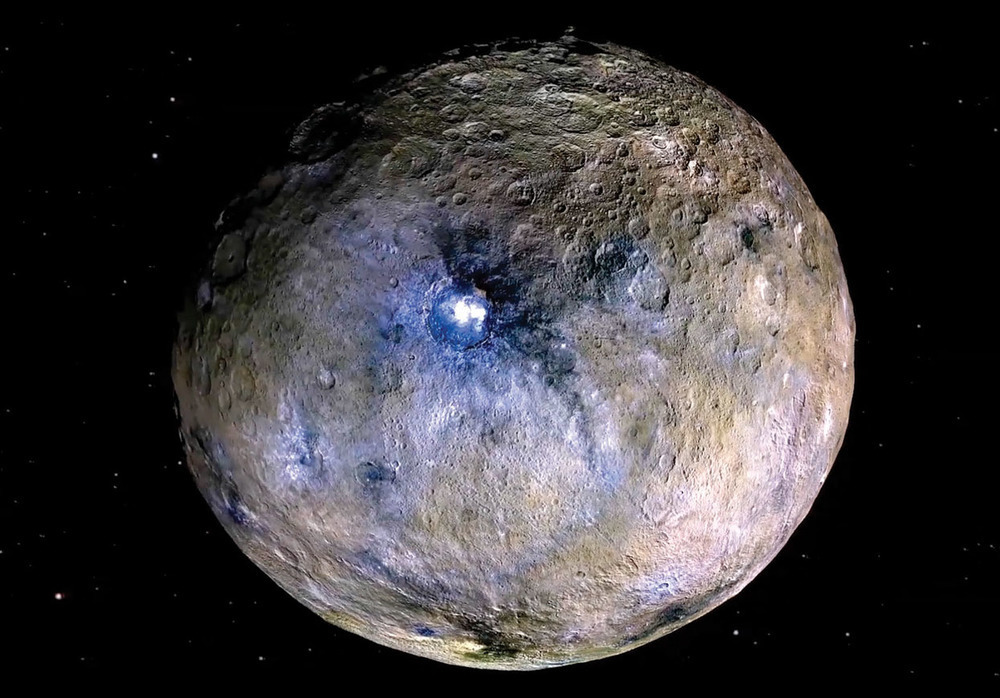
The dwarf planet Ceres is the largest body in the solar system’s asteroid belt, between the orbits of Mars and Jupiter. Recently, NASA’s Dawn spacecraft made detailed fly-over inspections of Ceres and beamed back data that shocked many scientists.
Ceres shows clear signs of being very geologically active.1 For such a small body—only 1.28% the mass of our moon—Ceres has long-age-believing planetary scientists shaking their heads in wonder. One can almost hear them asking, “Are you Cerious!?”
The dwarf planet Ceres
The mystery for evolutionists is how Ceres, which they believe to be very old, can still be so hot inside.
Ceres is too far away from large planets to receive an influx of energy from gravitational effects/tidal heating, and radioactive decay can’t provide the heat over billions of years either.
Secularists believe that planetary bodies were originally molten and gradually cooled. They predicted that Ceres, a miniature world floating alone in the coldness of space, and believed to be the same age as the solar system, would have become frozen and inactive eons ago.
It appears that tiny Ceres, with its lively, hot interior, is no more than a few thousand years old. This is consistent with the Bible’s record that God formed the earth first, around 6,000 years ago.