
Shangdi (上帝, “Highest Deity,” “Lord on High,”) is the ancient Chinese concept of a singular supreme deity, often identified with Tian (天, “Heaven”). Scholars and missionaries (notably Jesuits like Matteo Ricci and later Protestants like James Legge) have highlighted its strong monotheistic characteristics, viewing it as evidence of an early form of monotheism or “original monotheism” in Chinese civilization, predating widespread polytheistic developments.
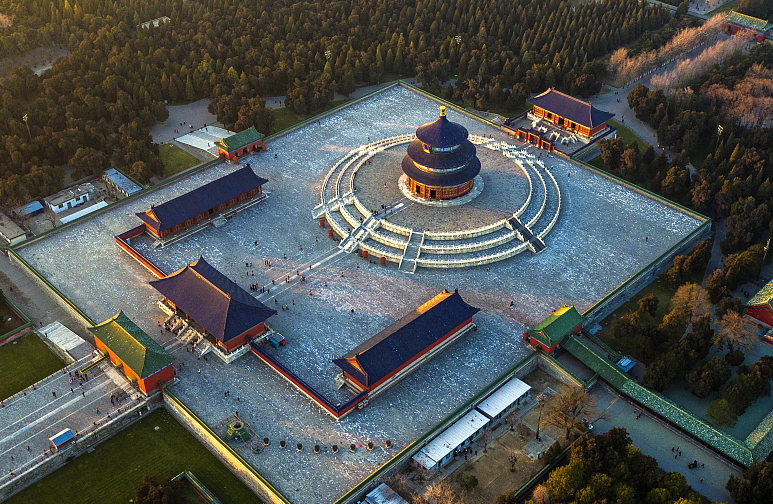
The Temple of Heaven (天坛, Tiāntán) is located in Beijing, China.
The Temple of Heaven was built specifically as an imperial sacrificial altar where the Emperor of China would worship Shangdi (上帝), meaning the Supreme God, Sovereign of Heaven, or God Above. It’s situated in the south-eastern part of central Beijing, just south of the Forbidden City and Tiananmen Square. The entire complex covers about 273 hectares (675 acres) and is now a major public park and UNESCO World Heritage Site. It’s one of Beijing’s most iconic attractions, famous for its beautiful Ming Dynasty architecture (built in the 15th century) where emperors performed annual rituals for good harvests.
Key Monotheistic Aspects
- Supreme and Singular Authority: Shangdi was regarded as the ultimate, transcendent ruler of the universe — the highest power controlling natural phenomena (weather, harvests, floods, thunder), human affairs, battles, and the fate of kingdoms. He was not one god among many but the primordial or highest deity, with lesser gods, nature spirits, and ancestral spirits acting as subordinates or ministers carrying out his will. This hierarchical structure emphasizes his unique supremacy rather than equality with other deities.
- Transcendence and Impersonality (with Personal Traits): Shangdi was seen as distant, inscrutable, and too exalted for direct ordinary worship — more transcendent than immanent. He operated through intermediaries. Yet classical texts describe him with anthropomorphic and personal qualities: he ordains events, responds to moral conduct, and is addressed in prayers. Attributes include being sovereign, eternal, all-knowing, ever-present, infinite, just, merciful, holy, faithful, and compassionate — traits paralleling those in Abrahamic monotheism.
- No Idols or Images: A hallmark of its monotheistic character is the complete absence of physical representations. Shangdi was worshiped aniconically (without images). In the Temple of Heaven rituals, emperors used a simple spirit tablet inscribed with his name (e.g., “Huangtian Shangdi”) rather than statues or icons. This contrasts sharply with the idol-heavy practices in later Chinese folk religion and aligns with strict monotheistic prohibitions against graven images.
- Exclusive Imperial Worship: Only the emperor (as “Son of Heaven”) could perform the grand sacrifices to Shangdi/Tian, typically annual rituals for good harvests or cosmic harmony. This exclusivity underscored his singular status as the ultimate divine sovereign, linking heaven’s mandate to righteous rule on earth. Ordinary people did not worship him directly.
- Creator and Moral Order: Ancient texts portray Shangdi as the creator and sustainer of the universe, humanity, and moral order. He rewards virtue and punishes wrongdoing, granting or withdrawing the “Mandate of Heaven” from rulers based on their ethics. This establishes a unified divine will governing reality.
Historical Context
During the Shang Dynasty (c. 1600–1046 BCE), Shangdi (or simply Di) was the supreme deity. In the Zhou Dynasty (1046–256 BCE), the concept merged or evolved into the more abstract Tian, but retained its core supremacy. While Chinese religion overall became polytheistic and syncretic (incorporating ancestors, nature gods, Taoism, Buddhism, etc.), the classical Confucian and imperial traditions preserved Shangdi/Tian as the singular highest power. Some scholars argue this reflects an original monotheism that was later layered with other beliefs.
Christian missionaries saw strong parallels with the biblical God, leading to debates over using “Shangdi” as a translation for “God” in Chinese Bibles. Today, it is still used in some Chinese Christian contexts and as a general term for the monotheistic God.
In summary, Shangdi embodies monotheistic ideals through his unrivalled supremacy, transcendence, moral governance, and aniconic worship — even as the broader religious landscape included lesser spirits. This made him a focal point for understanding ancient China’s theological heritage.
Currently, the Chinese Communist state seeks unity, stability, and ideological coherence. Christianity disrupts all three — not through rebellion, but through allegiance to a higher authority. And yet the Chinese have in their history a supreme God whom their Emperor worshipped. This would have come down from Noah and his descendants, possibly Ham. Christians obey the law, contribute to society, and love their nation but acknowledge their creator God and His Son, Jesus. The fact that the Chinese once worshipped one God, a supreme being, must be a good starting point in evangelism.
Ancient Chinese characters (especially the oldest pictographic and oracle bone forms) have been analyzed by scholars connected to Answers in Genesis and similar creationist researchers as containing echoes of Genesis 1–11. These interpretations suggest the earliest Chinese retained memories of biblical events from the post-Flood era (after Babel), when their ancestors dispersed.
Here are some of the most commonly cited ones (drawn from AiG articles, Ethel Nelson’s work, and related studies, She co-authored “God’s Promise to the Chinese, The Discovery of Genesis“.
Create (造, zào): Composed of “mouth/speak” (口) + “walking/moving” (辶) + dust/clay (土). Interpreted as God speaking creation into being and forming man from dust, who then walks (paralleling Genesis 1–2 and God’s spoken word in creation).
Garden (園, yuán): Enclosure (口) + two persons (人) + mouth/breath (口) + dust/earth (土). Seen as the Garden of Eden with Adam and Eve (formed from dust and given breath) placed inside.
Boat/Ship (船, chuán): Vessel (舟) + eight (八) + people/mouths (口). Strongly linked to Noah’s Ark with exactly eight survivors (Noah, his wife, three sons, and their wives — Genesis 7:13; 1 Peter 3:20).
Flood: Often includes elements of “universal water” + eight + earth, recalling the global deluge.
Righteousness/Justice (義, yì): Lamb/sheep (羊) + “me/I” (我). Interpreted as righteousness coming through the sacrifice of a lamb on one’s behalf — pointing to the “Lamb of God” (Jesus) in Christian theology.
Good (好, hǎo): Woman (女) + son/child (子). Linked to the promise in Genesis 3:15 (the “seed” of the woman bringing goodness/redemption).
These are based on ancient forms (bronze ware and oracle bone inscriptions, ~4500–3500 years old), not modern simplified characters.
The growth of Christianity in China is not merely a religious statistic. It is a reminder that the human soul resists permanent enclosure. No surveillance system, censorship regime, or ideological campaign has yet succeeded in erasing the desire for transcendent truth.

