
Faith and FIFA’s 2026 World Cup continue to pair up. So much so, the Financial Times (FT) has confidently declared that God is making a comeback. This is evidenced by the undeniable Christo-centric presence in what both the New York Times, The Guardian, and now the FT agree marks an unarguable culture shift. Also tuning in, the FT couldn’t deny that the presence of prayer on the playing field was more prominent, thoroughly unapologetic and mostly Christian.
World Cup and a Christian Cultural Shift
As FT’s veteran columnist and sports journalist, Simon Kuper, wrote, “Religion may have a particular appeal to footballers, but these scenes also reveal broader social shifts.” To make sense of the phenomenon, which is bewildering “God is dead” hard-line secularists, Kuper spoke with Dutch professor of theology, Mariecke van den Berg.
For van den Berg, the social shift is definitely accompanied by the “comeback of religion in the public sphere.” Pointing to the mass importing of Islam into Europe and the counter-cultural rise of evangelicalism in European nations, she determined that “this new religious landscape will look different.” Splitting Christianity down denominational lines, van den Berg explained that soccer was once the domain of Catholicism.
Brought to the game by Latin American players, “that meant the commonest religious gesture over the decades was players crossing themselves.”
Acknowledging the rise of evangelical Christianity since 2002, and Islam’s more pronounced presence since 2022, Kuper, citing van den Berg, said, “The most viable form of Christianity in Europe now is evangelical Christianity.”
Searching for Secular Explanations
Unfortunately, Kuper’s take in the Financial Times took a hostile, far-left turn. Unhinged, the FT journalist implied that Christianity’s influence and impact on the FIFA event were the result of manipulation. Quoting van den Berg, Kuper said the players “manage to connect with youth culture, through short sermons, directed at emotion. And it has a clear story.”
Although Kuper acknowledged that Christianity’s ethical clarity and certainty were a plausible reason for the revival, he put the social shift down to an error within Pentecostalism. “Pentecostal Christianity in Latin American countries,” the FT article asserted, “is often based on the prosperity gospel, which sees wealth as a sign that God blesses you.” Again, appearing to align with the Dutch theologian’s assessment, Kuper reasoned that “many footballers migrate young.” He then insinuated that the public declarations of faith in Christ were an emotional/psychological crutch and nothing more, stating, “Religious faith helps them deal with loneliness, pressure and setbacks like being benched, and it can assuage their guilt about becoming rich while people they grew up with remain poor.”
Expressing a distaste for the Christian cultural shift, Kuper then conflated the gospel groundswell with the so-called “far-right”.
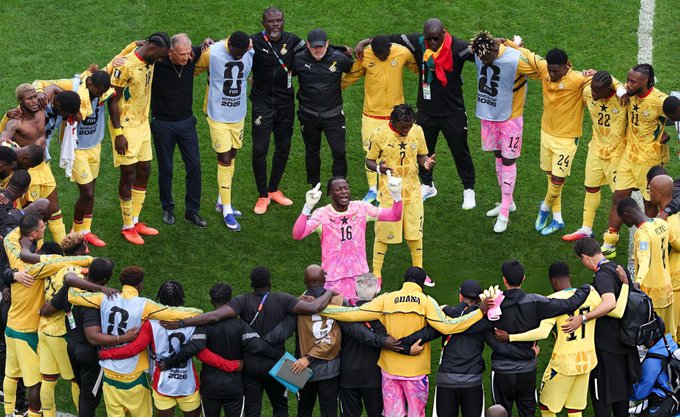
Ghana World Cup Team praying after match with England
While speaking warmly of Islam, Kuper name-dropped Felix Nmecha as an example of why the religious revival was problematic. “Religion in football can spark political conflict.” For example, the FT piece asserted, “Many evangelical Christians hold right-wing views.” Arguing specifics, he noted how the public presence of Christianity might make those who identify as LGBTQ+ feel oppressed.
Calling the late Charlie Kirk a “far-right commentator”, Kuper then recalled how the 25-year-old player with a five-year, 40 million EURO contract was reprimanded for an online tribute to the assassinated TPUSA founder. While Kuper apparently disapproves of Christian soccer players elevating the gospel in between scoring goals, he seems to be more than happy with Muslims quoting the Quran and genuflecting to Mecca.
Kuper especially approves of this when the “‘Islamic expression’ angers Europe’s far right.” By far-right, he means critics of Islam, like Dutch politician Geert Wilders.
Gospel Growth Challenging a Secular Europe
Double standards, whip statements and selective reasoning aside, the FT article’s decidedly clear redemption was van den Berg’s conclusion. “The tournament’s religiosity,” she said, signals “that Europe isn’t as secular as it thought.”
Even though Kuper and the Left’s “God is dead” hegemony might be reluctant to admit there’s a power greater than theirs at work here, FIFA’s faith pair-up is undeniably real. As documented by Ballers in God, and Sports Spectrum, the behaviour, pattern and impact all point to the gospel, not away from it. Despite media misrepresentations,
Ballers reported that they had been flooded with “videos of people doing Felix Nmecha’s ‘crown down’ celebration.” “From stadiums to living rooms,” the ministry said, “people are making one thing clear: The crown belongs to Jesus.”

