WHY DOES GOD ALLOW END TIMES PERSECUTION OF CHRISTIANS?

The Bible says persecution can strengthen the Church

The Bible clearly shows that persecution can advance the Gospel and unify the Church. In Philippians 1:12–13, Paul (writing from a Roman prison) shares how his imprisonment has emboldened others to proclaim Christ without fear. “I want you to know, brothers,” Paul writes, “that what has happened to me has really served to advance the Gospel, so that it has become known throughout the whole imperial guard and to all the rest that my imprisonment is for Christ.

Four Iranian Christians were sentenced to 80 lashes for drinking communion wine.

Throughout history, persecution has purified and strengthened the church, fueling its growth even in the most difficult and dangerous places. Consider the underground church in Iran, the fastest-growing Christian community in the world despite — or perhaps because of — 45 years of oppression by a government doing everything it can to hinder its work.

The church in Eritrea is another remarkable example. Pastors there have found ways to witness to others while in prison. The church thrives when its focus is sharpened, and denominational divisions fall away under the weight of shared suffering and purpose.

The Bible tells Christians how to respond to persecution

The Bible provides clear guidance on how to face persecution. Jesus’ words in Matthew 5:44 are simple and unambiguous: “Love your enemies and pray for those who persecute you.” This radical response reflects God’s love and is a powerful testimony to a watching world.

The Bible also tells us that Christians who aren’t currently facing persecution still have a role to play and shows how to hold our Christian brothers and sisters in our hearts and minds: “Remember those in prison, as if you were there yourself. Remember also those being mistreated, as if you felt their pain in your own bodies” (Hebrews 13:3).

The stories and testimonies of persecuted Christians demonstrate the transformative power of following Christ’s command and example. An imprisoned pastor in Central Asia saw his treatment improve drastically after he began receiving letters of encouragement from believers worldwide. His guards became kinder and his warden more attentive, all because of the unity and love evident among the global body of Christ.

We Christians in free nations must recognize our role in supporting and praying for our persecuted brothers and sisters.

The Bible shows that persecution can be a platform for God’s power

Even amid our trials and weaknesses, God works mightily through his people.

After a house church pastor was arrested in Iran, his wife was terrified that she might be next. She worried that she wouldn’t be able to resist torture and would give up other believers’ names. She prayed that God would hide her from the religious police. But when they arrested and interrogated her, she became empowered by the Holy Spirit, witnessing boldly to her interrogator. “You are an interrogator,” she told him, “but one day you are going to stand before the ultimate interrogator, Jesus Christ, and he is going to examine you. Without him, there is no hope for you.”

After three straight days of her bold, spirit-empowered witness, the interrogator visited her filthy jail cell late one night. She feared that he was there to kill her, but instead he placed his faith in Christ and told her how she could witness for Christ more safely. Then, the interrogator released her and her husband.

This story highlights a profound truth: God often uses human frailty to show us his strength. As Paul reminds us in 2 Corinthians 12:9, God’s power is “made perfect in weakness.

What the Bible does NOT say about persecution

The Bible never tells believers to be afraid.

This is striking, considering the suffering brought by persecution. Yet Scripture repeatedly emphasizes courage and trust in God’s sovereignty. As Richard Wurmbrand, Romanian pastor and founder of The Voice of the Martyrs, observed, the Bible contains 366 admonitions to “fear not” — one for every day of the year, including an extra for leap years. That number was significant to Wurmbrand because he was arrested on Feb. 29, which occurs only in leap years.

Fear is a natural human response, but it does not have to define us. A Filipino pastor once told me, “Until God is finished with you, you are invincible.” His confidence was not rooted in his human strength but in God’s purpose and power.

Persecution may not be part of your reality today, but the call to be involved remains. Whether through prayer, advocacy, or encouragement to believers who are currently facing persecution, every follower of Christ has a role to play.

Let us live boldly, trusting that God’s grace and power are sufficient for every trial we face.

Source: Todd Nettleton is Vice President for Message at The Voice of the Martyrs and host of The Voice of the Martyrs Radio. He is the author of When Faith Is Forbidden: 40 Days on the Frontlines with Persecuted Christians.

PERSECUTION GROWS GOD’S CHURCH

A new study has revealed that Christianity is continuing to spread across the globe despite believers facing extreme persecution for their faith.

The 2023 “Persecutors of the Year” report by the anti-persecution charity International Christian Concern (ICC) details the various groups, organisations, and locations posing a significant threat to Christians worldwide.

The advocacy group claims some 200-300 million believers currently experience persecution for their faith, including torture, imprisonment, and murder. Writing in the document’s forward, ICC President Jeff King says he’s inspired by the courage and strength of Christians who appear to be “thriving” in their faith, amid “unimaginable pain.”

China, Iran, and Nigeria are highlighted as key countries where the Church appears to be expanding despite fierce opposition.

NIGERIA: The ICC argues Nigeria is one of the most dangerous places to be Christian today. Believers are kidnapped, tortured, and killed every week by Boko Haram, Fulani militants and other Muslim extremist groups while churches and Christian institutions are destroyed and burned to the ground. “Boko Haram and Islamic State West African Province (ISWAP) have killed tens of thousands of Christians and displaced millions to discard Western influence and impose strict Islamic Sharia law,” it reads. Yet, the approximately 100 million Christian population is steadily growing in the region.

IRAN: The report claims that the Islamic Republic of Iran has “one of the fastest-growing churches in the world.” While 99% of the population is Muslim and Christians there are harshly penalised for practicing their faith, ICC reports show a Christian population that has rapidly grown to around 500,000 – 800,000. Iranian Christians face persecution in the form of raids, arrests, fines, detention, torture, and death penalties for practicing their faith.

CHINA: China reportedly has between 70-100 million “underground Christians”. This is despite the communist country “aggressively suppressing free religious expression” which is seen as a threat to national security. House churches face persecution and harassment by the authorities, as they are often unregistered and not sanctioned by the government. Some are denied registration while others choose not to be state-run due to the heavy surveillance and restrictions that are applied.

In highlighting the extent of suffering Christians encounter across the world, ICC says the “resilience of the body of Christ” is also revealed.

We cannot say that Jesus did not warn us of the persecution/tribulation that Christians will face in the last days before His second coming. It will be a church refined by fire that will be raptured to heaven prior to God pouring out His wrath upon an unrepentant world with the Trumpet and Bowl judgments.

Then they will deliver you up to tribulation and put you to death, and you will be hated by all nations for my name’s sake. And then many will fall away and betray one another and hate one another. And many false prophets will arise and lead many astray. And because lawlessness will be increased, the love of many will grow cold. But the one who endures to the end will be saved.Matthew 24:9-13

LAST DAYS PERSECUTED CHURCH

Listen to what this pastor in Iran said: “In the east, hearing God’s voice is absolutely crucial. Being led by the Spirit is the difference between life and death. We can not afford to get away with the sins that so easily entangle. The disciple-making lifestyle accelerates your maturity in God. You must have an active relationship with God. You must pray and remain in prayer. You must be in the Word. This is the only way forward in the days ahead – total absolute reliance on God.

 Loving your enemies is unnatural, but you can only do that if you are seeing with spiritual eyes. Natural eyes tell us to stand and fight against oppression…but what if oppression brings harvest and grows the church? That’s our tension.”

Moves of God happen in the most desperate places, and right now, Iran is one of those places. The political upheaval, economic distress, resource scarcity, social unrest, and religious persecution are creating a perfect storm for the Gospel to spread like wildfire inside Iran.     

Just as these Iranian Christians have discovered, being sold out to God is what will be required to live the Christian life in the prophesied “last days” before Jesus returns. In the west, since Gay Marriage and LGBTQ issues are now law Christians are coming under increasing persecution and this will only intensify.

Therefore, since we are surrounded by so great a cloud of witnesses, let us also lay aside every weight, and sin which clings so closely, and let us run with endurance the race that is set before us, looking to Jesus, the founder and perfecter of our faith, who for the joy that was set before him endured the cross, despising the shame, and is seated at the right hand of the throne of God.Hebrews 12:1-2

CHURCH IN THE LAST DAYS

The effects of the pandemic, the growing cultural disdain for “organized religion,” and the socio-politico turn to secularism have reduced church rolls. A Gallup report going all the way back to 1937 shows formal church membership has dropped from a high of 70% to 39% in 2020.

“Continued decline in future decades seems inevitable,” predicted Gallup Senior Editor Jeffrey M. Jones.

Is it over for American churches? Are we living in the era of end-times apostasy signaling an inevitable, irreversible slow fade of church life as we know it?

Movements come and go, say some historical observers, and it just may be that the church’s journey in finite time from the launch at Pentecost has sputtered out. Institutional atrophy seems inevitable.

Sadly, the institutional quest causes a church to become introverted, focusing more on its institutional survival than on incarnational mission. The focus on survival and reconstruction on the ruins of a collapsed institution means a church’s own survival becomes more important than the Lord who created it, the truth He gave it, the call to which He summoned it, and the people to whom He sent it.

The biblical view is the kairological outlook: God so often uses catastrophes for His purposes and no doubt this will be a new day for the Church of Jesus Christ. The church Jesus intended as described in the Book of Acts.

The focus must not be on trying to breathe life into dying institutions. In the biblical scheme, death leads to resurrection. Rather than seeing this period with the desperation of hopeless people watching the creep of finite time bringing death to antiquated hulks, the better focus should be that of the infusion of new life. Rather than pre-occupation with sustaining structure, the energy should be spent on building ministry, making disciples of Jesus. Instead of mourning the death that is inevitable in chronos-time, it is better to rejoice at the new kairological day that is rising before us.

adapted from an article in Christian Post: A New Day for the Church Part 1 by Wallace B Henley

CHURCHES GROW UNDER PERSECUTION

A new peer-reviewed study published last month in the academic journal Sociology of Religion demonstrates that churches grow under persecution.

The study’s findings, outlined in Christianity Today by authors Nilay Saiya and Stuti Manchanda, buck conventional wisdom. In places where Christians enjoy official support from national governments, religious faith tends to decline. Conversely, Christianity spreads most successfully in countries with legal commitments to religious pluralism and in places that actively discriminate against and persecute believers.

These are the countries with the fastest growing Christian populations (the states with low/no official support for the faith are in bold): Tanzania, Malawi, Zambia, UgandaRwandaMadagascarLiberia, Kenya, DR Congo, and Angola.

And here are the countries with the fastest declining Christian populations (the states with moderate/high official support for the faith are in bold): Czech RepublicBulgariaLatviaEstonia, Albania, MoldovaSerbiaGermanyLithuania, and Hungary.

Hungary, for example, is an officially Christian nation. Even still, faith is waning: Although a majority of Hungarians identify as Catholic, only 12% regularly attend church services and just 14% describe religion as “very important” in their lives.

It is worth noting, as author Rod Dreher has, Prime Minister Victor Orban’s governance in Budapest is very much aligned with politically conservative Christian views. As such, the country has passed legislation to that end.

Nevertheless, Saiya and Manchanda argue that, in pluralistic societies, where religious ideologies coexist and must compete, for lack of a better word, Christianity — untethered from politics — often flourishes. Paradoxically, they found, “state favoritism of religion inadvertently suppresses it.”

That is due to the fact that, countries that are “officially Christian,” and even in the U.S., to an extent, Christianity may become less about a convictional relationship with Jesus and instead morph into just one aspect of a citizen’s larger national identity, resulting in faith being less about personal beliefs and more about cultural tradition.

On the other hand, the Christian faith has expanded most in Asian countries, where there’s no “official” faith and pluralism has been embraced: In contrast to Europe, Christianity in Asian countries has not been in a position to receive preferential treatment from the state, and this reality has resulted in stunning Christian growth rates. The Christian faith has actually benefited by not being institutionally attached to the state, feeding its growth and vitality.

Consider the case of South Korea, which in the course of a century has gone from being a country devoid of Christianity to one of its biggest exporters. It currently ranks as the second-largest sender of missionaries, trailing only the United States.

This example illustrates well the paradox of pluralism. Because South Korea is not a Christian country, Christianity enjoys no special relationship to the state. In fact, Christianity in Korea endured the brutal persecution of Japanese colonial rule, during which churches were forcibly closed down and their properties confiscated. Indeed, the church persisted through poverty, war, dictatorship, and national crises throughout Korean history.

Since World War II, Korean Christianity has grown exponentially, with tens of thousands of churches being built and seminaries producing thousands of graduates every year. Today, about a third of the country is Christian.

Christianity also seems to flourish — as it did for the early church leaders in Acts — in places where believers face discrimination and persecution.

The faith of those facing persecution for their convictions is often deeper and more profound, because the stakes are inherently higher when it’s not in one’s cultural best interest to embrace such beliefs.

Open Doors USA, an advocacy organization tracking Christian persecution around the globe, ranks Iran as the eighth-worst place in the world for believers. Despite facing “extreme” persecution — where the government has outlawed conversion from Islam, imprisons those who evangelize, and arrests people for attending secret house churches or sharing Christian literature — it’s believed there could be at least one million Christians in the Islamic country.

A similar phenomenon is believed to be unfolding in Afghanistan, which Open Doors lists as the second-worst place to be a Christian. There is only a small number of believers in the country, where it is illegal to convert from Islam, and those who do face certain imprisonment, violence, and potentially even death. Rula Ghani, the first lady of Afghanistan, is a Maronite Christian from Lebanon.

Outside the Middle East, the world’s largest persecuted body of believers is found in China, where the communist government continually discriminates against and harms Christians.

Chinese police destroyed several church buildings earlier this year, including one where 50,000 Christians worshipped.

Much to President Xi Jinping’s chagrin, Protestant Christianity has continued to grow exponentially in China, where the government estimates some 200 million of its 1.5 billion citizens are believers.

Fenggang Yang, a sociologist of religion at Purdue University, said in 2019 he believes more Protestant Christians will live in China by 2030 than any other country in the world.

“When Communists took power in 1949, there were one million Protestants living in China, compared with 58 million in 2010 and probably around 100 million in 2019,” he said. “Despite the government’s efforts to suppress, I don’t think it will stop the growth of Christianity in China. All the evidence I have collected shows it’s undeniable; it’s already happening.”

If these numbers reveal anything to Christians, it is that believers should place their trust not in conventional wisdom, but in the often paradoxical work of the Holy Spirit.

Russian philosopher Fyodor Dostoevsky once lamented the deeply misguided belief held my many Christians “that Christ cannot reign without an earthly kingdom.”

It would be folly for the Christian to spend his or her life building an impenetrable kingdom on earth. We know from Scripture such an effort would be in vain. Psalm 46 says, “The nations rage, the kingdoms totter; he utters his voice and the earth melts. The Lord of hosts is with us; the God of Jacob is our fortress.” And, in Matthew 24, Jesus told His disciples it is His authority alone that will stand the test of time: “Heaven and earth will pass away, but my words will not pass away.”

In Matthew 6, Jesus warned His followers against storing up treasures on earth, “where moth and rust destroy and where thieves break in and steal.” Instead, He told them to invest in the eternal Kingdom of God.

Our ultimate hope, redemption, and restoration comes not in the protection of the state, which is never certain, but through salvation in Jesus, with whom we are heirs to a Kingdom operating outside the space and time of this temporal world.

Article by Tré Goins-Phillips Editor of Faithwire

BIBLE BELIEVING COUNTER-CULTURAL CHURCHES THRIVING

The most common religious identity among young adults in the U.S. is “none,” and the majority of Americans don’t believe it’s necessary for a person to believe in God to be moral and have good values, a new survey has found. The survey on American Life investigating contemporary religion in the U.S. found that among young adults (age 18 to 29), the most common religious identity today is none. More than one in three (34%) young adults are religiously unaffiliated.  Nearly nine in 10 (87%) Americans report they believe in God, but just over half (53%) report they believe in God without any doubts at all. Overall, 42% of Americans have a close social connection with someone who is religiously unaffiliated — up from 18% in 2004.
Additionally, most Americans say it’s not necessary for a person to believe in God to be moral and have good values. Close to six in 10 (59%) Americans say a belief in God is not a precondition to being moral and having good values, while 41% of the public say a belief in God is essential. These statistics, the authors say, mark a “remarkable shift in recent years. The study also found that Americans are almost equally divided over whether it is better to discuss religious beliefs and ideas with those who do not share the same perspective, and most Americans have never been invited to church. A majority (54%) of Americans say they have not been asked to participate in a religious service in the past 12 months or have never been asked.

The survey corroborates a 2019 Pew Study survey that documented the decline of Christians and rise of religiously unaffiliated. Pew noted that the religiously unaffiliated group rose to 22.8% share of the population in 2014, eclipsing the number of Catholics in America, who fell to 20.8%. Christians as a whole fell from 78.4 to 70% of the population between 2007 to 2014, with every major group experiencing a decline. Similarly, the 2018 General Social Survey found that the number of religious “nones” in the U.S. are now statistically equal to the number of evangelicals. Ryan Burge, a political science researcher at Eastern Illinois University who analyzed data from the survey, told The Christian Post that the religious “‘none’s’ are not slowing down.”

THE GOOD NEWS

Russell Moore, president of the Ethics & Religious Liberty Commission of the Southern Baptist Convention, previously said the “increasing strangeness” of Christianity is actually “good news” for the church. “Christianity isn’t normal anymore. It never should have been. The increasing strangeness of Christianity might be bad news for America, but it’s good news for the church. The major newspapers are telling us today that Christianity is dying, according to this new study, but what is clear from this study is exactly the opposite: while mainline traditions plummet, evangelical churches are remaining remarkably steady,” Moore said.

He added that statistics indicate there are honest atheists in America today, and that they are rejecting what’s called “almost-Christianity,” or traditions that “jettison the historic teachings of the Church as soon as they become unfashionable.” “The churches that are thriving are the vibrant, counter-cultural congregations that aren’t afraid to not be seen as normal to the surrounding culture. This report actually leaves me hopeful. The Bible Belt may fall. So be it,” he continued. “Christianity emerged from a Roman Empire hostile to the core to the idea of a crucified and resurrected Messiah. We’ve been on the wrong side of history since Rome, and it was enough to turn the world upside down.”

GOD’S WORD IS INERRANT

MIRACLES EVIDENT IN FASTEST GROWING CHURCHES

Church growth in Nepal

In 1951, Nepal reported no Christians in its government census. And by 1961, that number increased to just 458. Today, the World Christian Database ranks the country as the 12th fastest-growing Christian population in the world with 1,285,200 believers, said database co-director Gina Zurlo. The real number might be higher.

Until 2008, Nepal was a Hindu kingdom. For Hindu radicals, being Nepali means being culturally Hindu, Pastor Tanka Subedi told CP. Subedi leads Nepal’s Family of God Church and serves as director of the International Nepal Fellowship. Although most Hindus live in peace with Christians, he said some fiercely oppose the Gospel. “The prime minister himself says he doesn’t believe in God but is Hindu,” said Subedi. “State media and government officials [say] Christianity is coming to Nepal to destroy our culture. It’s challenging to evangelize people who have that mindset.”

The pressure and violence Christians experience from Hindus places the country at No. 34 on Open Doors USA’s global persecution watch list.

Despite rising persecution, Christians continue to share their faith, Subedi said, because the government can’t arrest them all. We come from a persecuted background. We were never free. We are used to it, he said.

People feel eager to become Christians because of the reality of the Christian faith and the healings, Subedi added. 

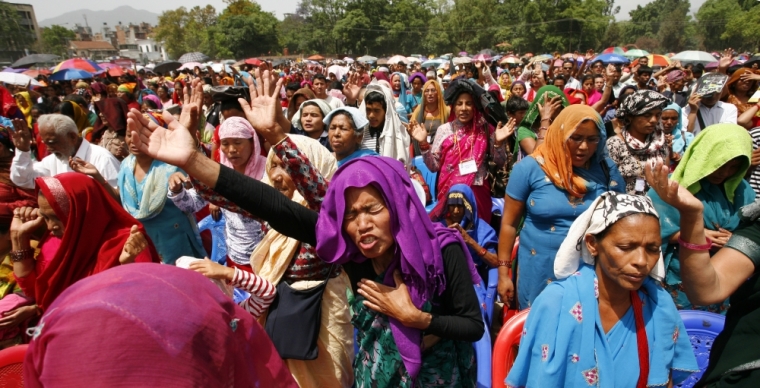
Nepalese Christians Reuters/Shruti Shrestha

Suroj Shakya, a 41 year old church elder in Nepal told CP that he became a Christian at 8 years old after God healed him from food poisoning. When Suroj was 19, his mother Gita Shakya was diagnosed with a painful, paralyzing spinal growth. Doctors told Gita and Suroj, that her best option for healing was a risky, potentially lethal surgery, Suroj shared with The Christian Post. Surgery was expensive, and Gita’s husband, Babukaji, a Buddhist priest, refused to pay his Christian wife’s expenses. Doctors in Singapore gave 19-year-old Suroj two days to decide whether to let his mother live in terrible pain or risk her death.

Suroj prayed, then decided it was best to do the surgery. But he didn’t know what he would tell his family if Gita died, he said. At that time, I felt so alone in Singapore because it was my first visit, and I had nobody to share my problems with besides talking with the Lord in prayer, he added.

Suroj heard a knock at the door. It was a group of local church members who wanted to pray for Gita. After 20 minutes of prayer, a miracle happened, he said. Gita stood up. She kicked out with her left foot, which hadn’t moved for years. She punched out with her left arm. Suddenly, she could move. Gita started to weep and praise God, Suroj recalled. “There was no pain and sadness, which she had before. Her face was changed into joy and happiness,” he said.

Afterward, Suroj said doctors didn’t believe Gita was the same woman. Babukaji didn’t believe his wife had been healed without surgery until he saw she had no scars. Then along with his son, Suman, he became a Christian.

Such stories happen often in Nepal, said Suroj. Despite persecution and poverty, the Nepalese church has grown incredibly quickly. The South Asian country has one of the fastest-growing Christian populations in the world. To secular Westerners, it might seem impossible. But the mountains of Nepal have witnessed incredibly fast church growth in part because of miraculous healings.

The church growth is because of miracles, Suroj asserted. “[If] people don’t [get healed] from the hospital, they go to the church and ask for prayer from the church leaders. When the church family and church leaders pray for the sick people, they are getting healed.”

I believe as persecution of Christians intensifies in the West the Christian remnant will be more like the church described in the Book of Acts. Healings and miracles will be normal and an important part of church growth just as it is in Nepal.