
Throughout human history most people understood that human beings are physical beings, but also spiritual. People have physical bodies, but they are also non-material beings, with things like a soul, consciousness, and a mind. But militant Darwinists and atheists have rejected that understanding of what it means to be human.
I want to recommend a new book that seeks to rebut philosophical naturalism and make the case for the reality of non-material realities such as the mind. In this case, the writers are Christians, but they make their case based on what the science is actually discovering and saying.
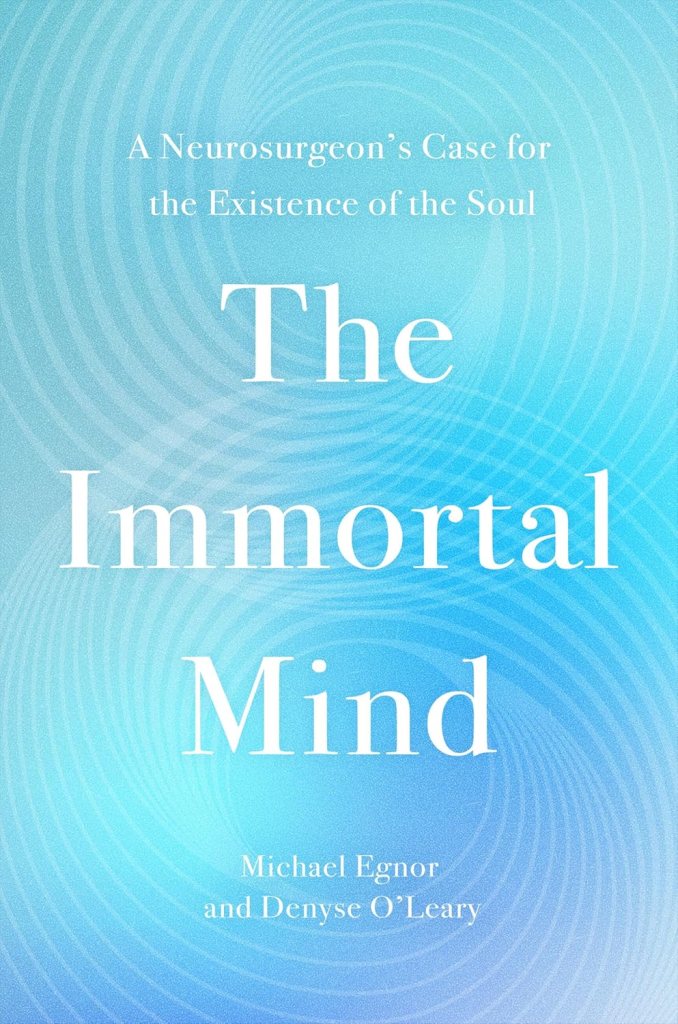
The book is: The Immortal Mind: A Neurosurgeon’s Case for the Existence of the Soul by Michael Egnor and Denyse O’Leary (Worthy Books, 2025). Denyse O’Leary has written on matters of science and faith, while Michael Egnor is a neurosurgeon, neuroscientist, and professor of neurosurgery in New York.
From the Operating Room to the Chapel
In this post, I simply want to look at the testimony of Michael Egnor. He was an atheist, but his profession – involving 40 years in neurosurgery and 7,000 brain surgeries – has led him to faith.
Just two quotes from his Introduction – a short one and a long one – inform us of how his journey from atheism to Christian faith came about. The first one is this:
“When I was a medical student, I believed that science could explain everything. I was sure that answers to the big questions—How does consciousness emerge from the brain? Do we have a soul? Do we continue to exist after death?—would be found in the laboratory and the operating room. And so I was surprised when, late one night, I found the answers on the floor of a hospital chapel.“
This book is the story of what I learned after I got up off that chapel floor. It is about my search for the evidence that the mind is immortal and that, by extension, the human soul exists. That actual story goes as follows:
When my son was a few months old, my wife and I noticed that he wasn’t smiling or making eye contact with us. He would look at objects with interest, but not at people. We started to face the possibility that he might be autistic. This terrified me—I had always dreaded autism. I knew it would be the worst agony to have a child you love who doesn’t know you or love you back. I had nightmares about my son as an older child sitting in a room, alone and rocking back and forth, while his schoolmates played baseball and enjoyed normal childhoods.
We took the child to an autism specialist, but he said it was too soon to be sure. We would have to wait before we could know more. But at nearly six months of age, he was still not responding to us. I found it harder each day to go about my daily tasks because I thought about him all the time.
One night, it all came to a head. I was called to see a patient at a Catholic hospital in another town. As I was leaving the hospital, I passed the chapel. I thought, “I don’t believe in God, but I’ll do anything now. I just want my son to know me.” I went into the chapel and knelt before the altar. “God,” I said, “I don’t know if you exist, but I need help. I am terrified that my son is autistic. It’s agony to have a child who will never know or love me.”
Then I heard a voice—it was the only time in my life I’d ever heard a voice in my head that was not mine—and the voice said, But that’s what you’re doing to Me. I collapsed in front of the altar.
The voice I heard had only spoken seven words, but I felt like He knew me intimately and had been watching me with love and wisdom all my life and that He knew me better than I knew myself. It was like a curtain was lifted, and the Source of my life was speaking to me directly. My heart burned in me. When I recovered, I prayed, “Lord, I will stop doing it to You. I’m sorry. I won’t be autistic to You any longer. Please heal my son, and please heal me.” I walked out of the chapel a shaken man, and a different man.
The next morning, I called my local Catholic church (my epiphany had happened in a Catholic chapel, and I sensed that this is where He wanted to meet me) and asked to be baptized. A few days after my prayer in the chapel, I went home in the evening to my son’s six-month birthday celebration. That night, he was behaving like a completely normal child, looking us in the eye, smiling and laughing. I knew I had experienced a miracle. It seemed as if, just as I had stopped ignoring the Lord, He had also allowed my son to see me.
The next Easter, I was baptized, along with my son and other members of my family.
People of faith will find this to be a very powerful and moving testimony. Even some non-Christians might be greatly impacted by this amazing story. But of course, critics and sceptics will likely scoff at all this, saying it is all so much baloney, and this guy is just some hillbilly whacko.
It is hard to see how someone with his background, neurosurgeon, neuroscientist, and professor of neurosurgery can be dismissed as just some religious nut. But before these misotheists go to war here, they should get the book which looks at the careful scientific and philosophical case that the authors make.
If you want more information by PhD scientists on the case for intelligent design and a Creator go to http://www.creation.com and http://www.answersingenesis.org

